

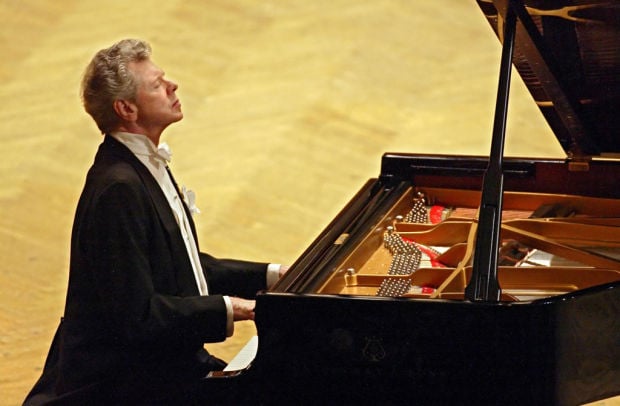
Van Cliburn, the tall, gangly, curly-haired Texan who became the most famous classical pianist in American history over the course of a single extraordinary week in 1958, died Feb. 27 at his home in Fort Worth, Texas. He was 78.
His death, from bone cancer, was announced by his publicist and longtime friend, Mary Lou Falcone.
In April 1958, Cliburn went to Moscow at the height of the Cold War and brought home the gold medal in the new Tchaikovsky International Piano Competition for his rendition of the composer's Concerto No. 1. The contest had been established to showcase the Russian superiority in culture, a mere six months after the scientific triumph of launching Sputnik, the first space satellite.
Cliburn's performance - the crystalline touch, the welling songfulness - prompted an eight-minute standing ovation. But such were the political tensions of the time, the judges of the competition checked with Soviet Premier Nikita Khrushchev before announcing their decision to give the prize to a non-Soviet musician.
People are also reading…
"Is he the best?" Khrushchev is said to have replied. "Then give him the prize!"
Cliburn was mobbed in Moscow by joyful admirers. Women reportedly wept and fainted at his concerts.
"Van looked and played like some kind of angel," the Russian pianist Andrei Gavrilov later recalled. "He didn't fit the evil image of capitalists that had been painted for us by the Soviet government."
Cliburn was equally positive about the people he met during his visit.
"I was just so involved with the sweet and friendly people who were so passionate about music," he later recalled. "They reminded me of Texans."
Cliburn's achievement was reported on the front pages of newspapers throughout the world. He returned home to a New York ticker-tape parade and the sort of shrieking, unfettered adulation that a few years later would be transmuted into Beatlemania. In May 1958, Time magazine put him on its cover with a banner that read "The Texan Who Conquered Russia."
Fans ripped off the door of his limousine during a visit to Philadelphia. RCA Victor signed him to an exclusive contract, and his first recording - the Tchaikovsky Piano Concerto No. 1, of course - quickly became the best-selling classical record in history, a position it would retain for most of a decade.
By the time he was 24, he was the subject of a biography by critic and composer Abram Chasins titled "The Van Cliburn Legend." Few young musicians have ever faced so many expectations.
Such sudden celebrity was heady stuff for a shy, soft-spoken young man who not long before had spent most of his time playing scales in the obscurity of a practice room at New York's Juilliard School. Not surprisingly, Cliburn seems to have found the expectations impossible to live up to.
Within five years, his playing had begun a marked deterioration.
"From the mid-1960s, it seemed he could not cope with the loss of freshness," Michael Steinberg wrote in the New Grove Dictionary of Music and Musicians. "His repertory was restricted; his playing, always guided primarily by intuition, took on affectations and the sound itself became harsher."
By 1978, Cliburn had withdrawn from the concert stage. He moved to Fort Worth, where he bought a mansion and became increasingly prominent in the city's social life. In 1989, he came out of retirement to play his signature piece at the Mann Center in Philadelphia, to respectful reviews.
After that, he made sporadic public appearances, almost always playing the Tchaikovsky.
"Van looked and played like some kind of angel. He didn't fit the evil image of capitalists that had been painted for us by the Soviet government."
Andrei Gavrilov, Russian pianist
The local angle
Van Cliburn owned an almost 5,000-square-foot house for 32 years in Tucson, selling it in 1993. The home, on a dirt road called North Indian House Road, was on a large lot north of what is now Park Place.
Early news clips indicate Cliburn, like so many others, came to Tucson at least partly for his health. In 1958, it was to recover from a bronchial infection; in 1959, it was for two months of "rest and relaxation." That same year, the young pianist also had some dental work done in the Old Pueblo.
During the late '50s and all through the '60s, Cliburn performed in Tucson, everywhere from the Tucson Symphony Orchestra to the living room of the Rev. Newton H. White. The two men also dined at the Cliff House on North Oracle Road near Rudasill, where the pianist reportedly downed three bowls of turtle soup.
Former Star reporter J.C. Martin recalled a meeting with the pianist.
"Sometime in the early 1960s, Van Cliburn had a concert stop in Tucson, and I interviewed him for the Star," Martin wrote on Wednesday. "He was very sweet and unassuming in spite all the hoopla surrounding his win, the win of an American, in the dangerous Soviet Union.
"But what I remember most about him is that in the course of the interview, I dropped my pencil. Without a moment's hesitation he swooped down and picked it up and handed it back to me."
- Arizona Daily Star


