

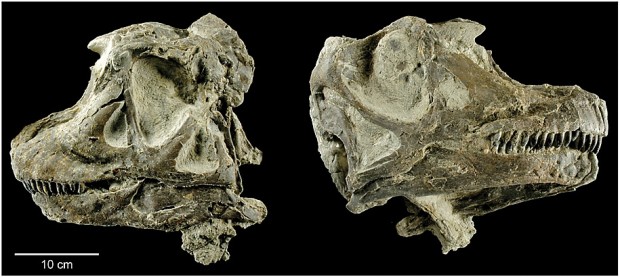
LOS ANGELES - Scientists have made a rare find: four skulls of a new species of giant plant-eating dinosaur, one of them completely intact.
Skulls of plant-eating dinosaurs were so light and fragile that they have rarely been preserved. Reaction to the find, made in Dinosaur National Monument in eastern Utah, was "probably not printable in a newspaper," said lead report author Dan Chure, a paleontologist at the monument.
"Everyone was really dumbfounded," Chure said. "You can go your entire career without seeing one of these. … To find multiple heads was just phenomenal."
Abydosaurus, which lived about 100 million years ago, is a type of sauropod, the largest kind of dinosaur to walk on land. Like its relative Brachiosaurus, the long-necked Abydosaurus had a massive body with tree-trunk legs but a relatively tiny head. The smallest sauropods could weigh as little as 10 tons; the largest as much as 50 or 60 tons.
People are also reading…
The skulls that were discovered were those of juvenile dinosaurs, probably about 25 feet long, Chure said.
The dearth of skulls among dinosaur fossils has posed a hurdle in learning about the creatures' biology and evolution, experts said.
"When you meet somebody you look at their face," said co-author Jeff Wilson, assistant curator at the University of Michigan Museum of Paleontology. "There's a lot of information which has to do with their face - organs, eyes, nose, ears, intricate parts of the brain."
Thus the discovery of the heads has provided a potential treasure trove of information. Scientists can perform CT scans of the head to map the brain's shape.
The heads also contained rows of key data - teeth. Sauropods roamed the earth from 200 million years to 65 million years ago, and their teeth seemed to change over time. Older species tended to feature more wide, flat teeth, whereas more recent species such as Abydosaurus had narrower, sharper, more densely packed teeth.
Studying its teeth might provide valuable information on the animals' diet and digestive systems, the authors wrote.
Wilson said sauropods like Abydosaurus did not digest food at all in their mouths, instead vacuuming plants straight to their stomachs. This system, he said, might help explain why sauropods could grow from a football-sized egg to 50 feet in length.


