
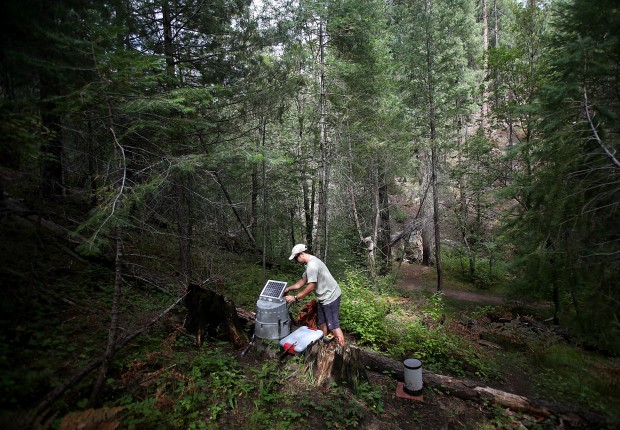
Scientists were pioneers of Mount Lemmon, the peak often used as shorthand reference for the entire Santa Catalina Mountain Range.
Here, new species of plants were found in 1881 by a pair of botanists on honeymoon.
Here, the newborn science of dendrochronology - tree-ring study - was employed in its infancy.
Here, on the second highest peak, Mount Bigelow, the field of infrared astronomy was born in the 1960s, as astronomers mapped the moon for NASA's human exploration of it.
Today, scientists still study the stars and keep vigil for killer asteroids atop these peaks.
Biologists still track plant and animal species, and geologists still seek to explain how snow, rain and rock produce the magnificent forest atop the Catalinas, feed the creeks and fill the aquifers of the Tucson Basin.
People are also reading…
In a three-part series beginning today, we'll cast a scientific eye on our beautiful, diverse and accessible mountain retreat. Today, you'll meet the scientists who study its critical zone - the space from treetop to aquifer where the magic of landscape evolution takes place.
THE LINEUP
• Today: How the mountains formed - and how they create what lies beneath them. Story begins on Page A4
• Nov. 4: Tucson's Sky Island: birds that migrate vertically; native vs. non-native species; fire on the mountain.
• Nov. 11: Looking at stars and guarding against meteorites - new uses for aging telescopes and top-secret facilities.