

Even when snow makes the unpaved Mount Lemmon Control Road impassable, Nate Abramson still has to work.
He straps snowshoes onto a backpack full of sample bottles and collecting equipment, and steps onto his snowboard. Then he takes a three-mile glide down the hill to the mid-level sampling stations of the Critical Zone Observatory, which is on a steep slope with no road and no trail leading to it.
That happened five times last winter.
"It's not perfect conditions. There are icy patches and shallow snowpack with big trees sticking out. It's certainly an adventure."
Then there is that trek out, three miles uphill on snowshoes, his samples weighing him down along with the added weight of the snowboard he is now carrying.
"I love it," he said. "I grew up on a snowboard."
People are also reading…
On a recent fall morning, conditions are more benign.
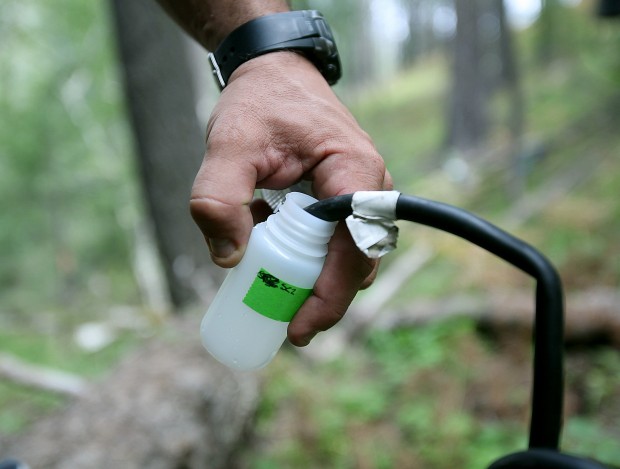
Abramson drives to the site along the control road and bounds down a steep hill, stopping to attach a pump to one of his subsurface collecting bowls. The floor pump has two tubes. One creates a vacuum to draw water into the vessel. The other forces it into his collecting bottles. An ephemeral stream is flowing today, so he collects water into a sanitized bottle.
Afterwards, a stop at a lower point along the stream to fill more collecting bottles, then on to a hike along a popular trail at higher elevation.
Here, there are two sites, each with three stations, where water is collected for analysis of the changes it undergoes as it courses downhill through the soil.
In addition to the water-sampling devices, the forest here is rigged with precipitation, soil-moisture and stream-flow monitors. Some of the trees sport a padded metallic wrap, beneath which are two probes that record sap movement.
Abramson is methodical when collecting his samples and a lot quicker walking site to site. He knows the trail, warns in advance of a wet spot where bees congregate. He's allergic and carries a syringe with epinephrine, but he'd rather not employ it.
That became a problem when bees decided to nest in one of his instruments. He's also had some problems with bears, who occasionally attack and scatter his equipment.
Mostly, it's all good. Abramson, who has a degree in environmental sciences from the University of California-Santa Cruz, spent three years after college working ski resorts in winter and leading kayaking expeditions in summer.
This job has tempted him to apply for graduate school, but he's not certain he'd enjoy the additional hours in the lab and at the computer.
It would be tough to walk away from days like today, when he gathers a sample of water from a stream rolling over gentle boulders on the the north slope of the Catalinas.
"I like this stuff much better," he says.


