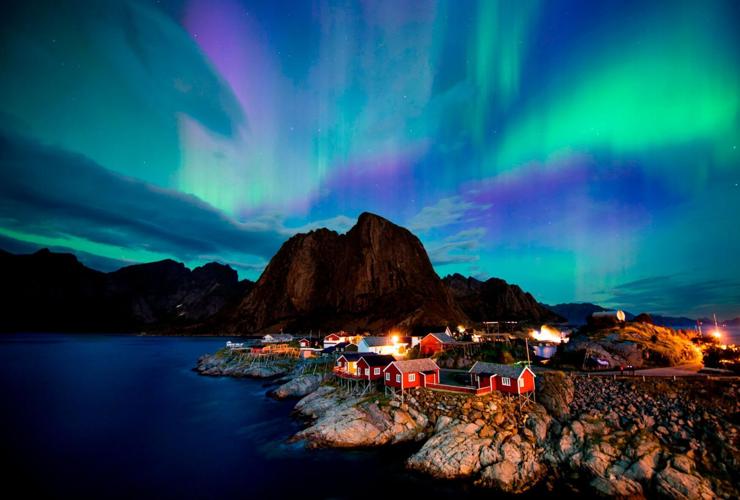
The Aurora Borealis lit up the skies of Alaska as the end of the auroras season draws near.
The aurora borealis, or northern lights, could easily be described as Earth's greatest light show. A phenomenon that's exclusive to the higher latitudes has had scientists in awe and wonder for centuries.
The mystery surrounding what causes the northern lights has been speculated but never proven, until now.

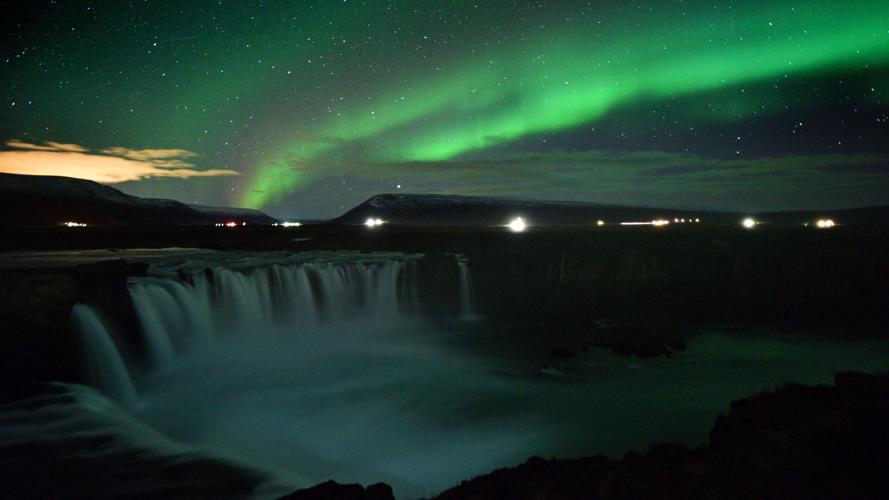
The northern lights over a waterfall in Iceland.
The great aurora mystery finally solved
A group of physicists from Iowa State University have finally proven that the "most brilliant auroras are produced by powerful electromagnetic waves during geomagnetic storms," according to a newly released study.
The study shows that these phenomena, also known as Alfven waves, accelerate electrons toward Earth, causing the particles to produce the light show we know as the northern lights.
People are also reading…
"Measurements revealed this small population of electrons undergoes 'resonant acceleration' by the Alfven wave's electric field, similar to a surfer catching a wave and being continually accelerated as the surfer moves along with the wave," said Greg Howes, associate professor in the Department of Physics and Astronomy at the University of Iowa and co-author of the study.
This idea of electrons "surfing" on the electric field is a theory first introduced in 1946 by a Russian physicist, Lev Landau, that was named Landau damping. His theory has now been proven.

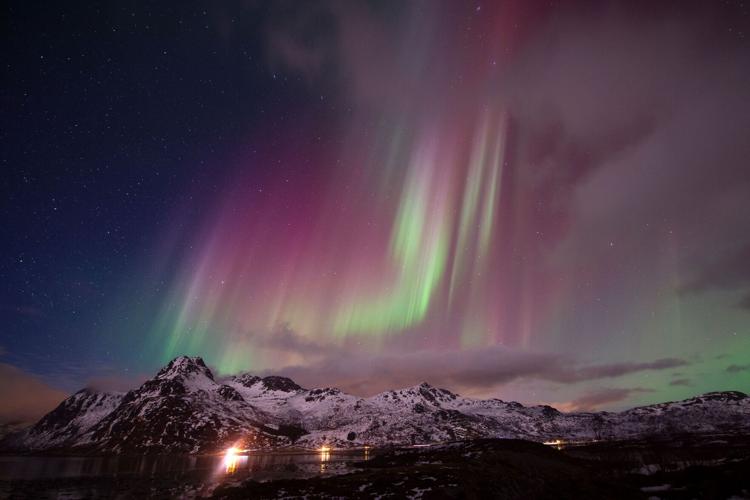
The northern lights dancing across the night sky, high in the Arctic Circle.
Recreating the northern lights
Scientists have understood for decades how the aurora most likely is created, but they have now been able to simulate it, for the first time, in a lab at the Large Plasma Device (LPD) in UCLA's Basic Plasma Science Facility.
Scientists used a 20-meter long chamber to recreate Earth's magnetic field using the powerful magnetic field coils on UCLA's LPD. Inside the chamber, scientists generated a plasma similar to what exists in space near the Earth.
"Using a specially designed antenna, we launched Alfven waves down the machine, much like shaking a garden hose up and down quickly, and watching the wave travel along the hose," said Howes. As they began to experience the electrons "surfing" along the wave, they used another specialized instrument to measure how those electrons were gaining energy from the wave.
Although the experiment didn't recreate the colorful shimmer we see in the sky, "our measurements in the laboratory clearly agreed with predictions from computer simulations and mathematical calculations, proving that electrons surfing on Alfven waves can accelerate the electrons (up to speeds of 45 million mph) that cause the aurora," said Howes.

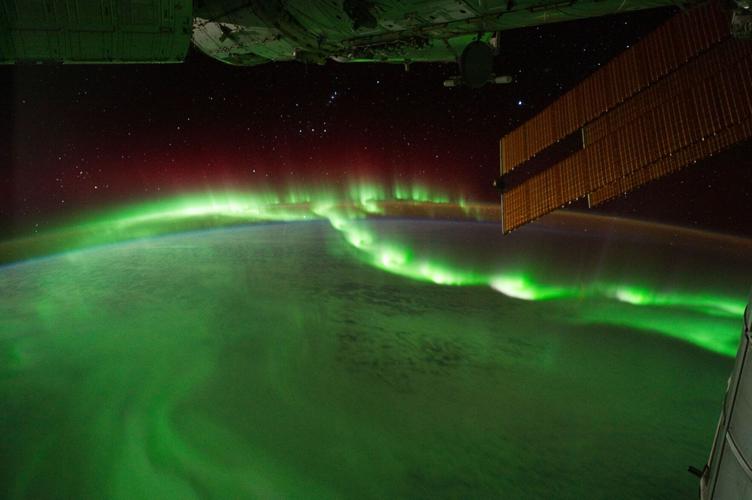
Auroral beads seen from the International Space Station.
"These experiments let us make the key measurements that show that the space measurements and theory do, indeed, explain a major way in which the aurora are created," said Craig Kletzing, the study co-author.
Space scientists around the country were ecstatic to hear the news. "I was tremendously excited! It is a very rare thing to see a laboratory experiment that validates a theory or model concerning the space environment," said Patrick Koehn, a scientist in the Heliophysics Division of NASA. "Space is simply too big to easily simulate in the lab."
Koehn believes being able to understand the acceleration mechanism for the aurora-causing electrons will be helpful in many studies in the future.
"It does help us understand space weather better! The electron acceleration mechanism verified by this project is at work elsewhere in the solar system, so it will find many applications in space physics. It will be of use in space weather forecasting as well, something that NASA is very interested in," Koehn said.

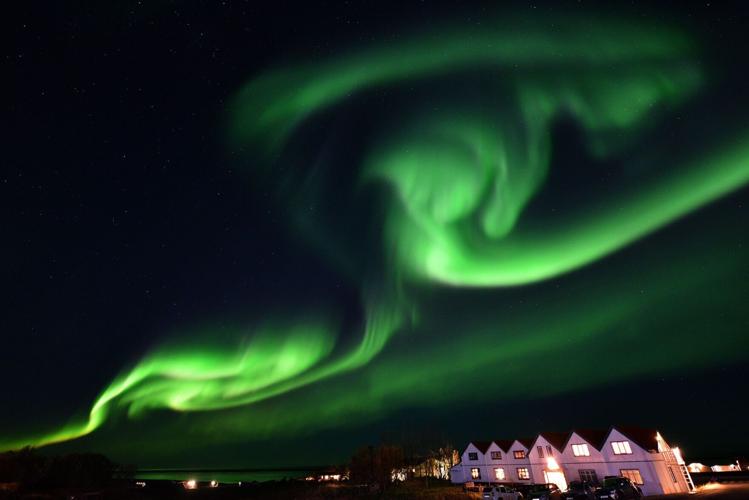
The aurora borealis lighting up the night sky in Iceland.
A long way to go
Now that the theory of how the illuminating aurora is created has been proven, there's still a long way to go in forecasting how strong each storm will be.
"Predicting how strong a particular geomagnetic storm will be, based on observations of the Sun and measurements from spacecraft between the Earth and the Sun, remains an unsolved challenge," said Howes in an email.
"We have established the link of electrons surfing on Alfven waves about 10,000 miles above the Earth's surface, and now we must learn how to predict the strength of those Alfven waves using spacecraft observations," he added.

The "most brilliant auroras are produced by powerful electromagnetic waves during geomagnetic storms," according to a newly released study.
PETA petitions Minnesota mayor to change Ham Lake to Yam Lake, and more of this week's weirdest news
Truck carrying tomato puree crashes, turning road red

A truck carrying tomato puree crashed in England on June 1, spilling its contents and turning the road red.
A truck laden with tomato puree crashed in England this week, turning a highway red and prompting a number of food-related puns from people on social media.
The vehicle was involved in a crash with another truck in Cambridgeshire, eastern England, on Tuesday, Highways England told CNN.
The government highways authority said the vehicle "lost its load and damaged the carriageway," leading to a road closure on the A14.
One driver sustained a "minor" injury, Highways England said.
A spokesman confirmed it was carrying tomato puree, which spilled across the road and prompted emergency road resurfacing overnight until Wednesday afternoon.
The crash prompted some jokes -- of varying quality -- on social media.

The road had to be resurfaced overnight after the tomato puree damaged the surface.
"What happens when you go too fast trying to ketchup to the Volkswagen Passata in front of you," said one person on Twitter.
"I went pasta that. Took a while for the traffic to ketchup," said another.
One person tweeted of the road closure: "And I imagine when it does reopen cars will have to passata slow speed?"
"So this was the sauce of all the traffic problems in Cambridge today," another commented.
While relatively uncommon, food spillages on highways do happen.
In 2019, a river of chocolate was seen flowing on an Arizona highway after a tanker hauling 40,000 pounds (18,144 liters) of liquid chocolate rolled over on the interstate near Flagstaff.
A crash near Knoxville, Tennessee, spilled more than 17 tons of M&M's onto an interstate ramp in the same year. The candy remained in the packaging but had to be destroyed.
Hundreds of thousands of red Skittles were found spilled on a road in Dodge County, Wisconsin, in 2017. The local Sheriff at the time said they were surplus and were on their way to a cow farm, where they were to be mixed with livestock feed.
PETA petitions Ham Lake mayor to change city’s name to Yam Lake

Animal rights group PETA is petitioning the mayor of Ham Lake to give the city a more "pig-positive" name.
MINNEAPOLIS (WCCO) -- Animal rights group PETA is petitioning the mayor of Ham Lake to give the city a more “pig-positive” name.
Ham Lake, which sits north of the Twin Cities off Highway 65, earned its name in 1871. The city was named for the identically monikered nearby body of water, which was called Ham Lake because its shape resembled a ham, according to the city’s website.
PETA’s letter to Mayor Mike Van Kirk notes that “pigs killed for food spend their lives confined on filthy factory farms and are denied everything that’s natural and important to them.” It also argues the lake actually looks more like a yam, and so states the city should be renamed Yam Lake.
“[Yams are] extremely versatile, easy to prepare, and great to eat alone or include in both sweet and savory dishes,” the letter reads.
PETA even offered to pay for new city signage and send “delicious candied yams for the whole town.”
You can read PETA’s full letter here.
___
The-CNN-Wire™ & © 2021 Cable News Network, Inc., a WarnerMedia Company. All rights reserved.