

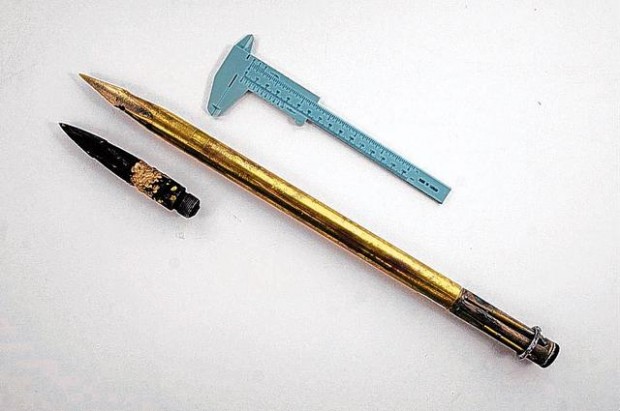
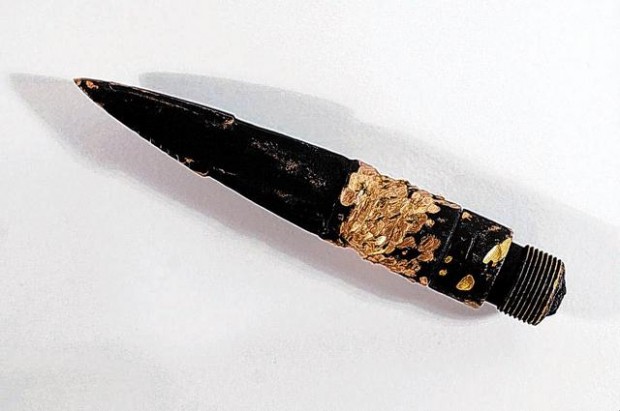
BOSTON — A 50-ton bowhead whale caught off the Alaskan coast last month had a weapon fragment embedded in its neck that showed it survived a similar hunt — more than a century ago.
Embedded deep under its blubber was a 3 1/2-inch arrow-shaped projectile that has given researchers insight into the whale's age, estimated between 115 and 130 years old.
"No other finding has been this precise," said John Bockstoce, an adjunct curator of the New Bedford Whaling Museum.
Calculating a whale's age can be difficult and is usually gauged by amino acids in the eye lenses. It's rare to find one that has lived more than a century, but experts say the oldest were close to 200 years old.
The bomb lance fragment, lodged in a bone between the whale's neck and shoulder blade, was likely manufactured in New Bedford, Mass., then a major whaling center, Bockstoce said.
People are also reading…
It was probably shot at the whale from a heavy shoulder gun around 1890. The small metal cylinder was filled with explosives fitted with a time-delay fuse so it would explode seconds after it was shot into the whale. The bomb lance was meant to kill the whale immediately and prevent its escape.
The device exploded and probably injured the whale, Bockstoce said.
"It probably hurt the whale, or annoyed him, but it hit him in a nonlethal place," he said. "He couldn't have been that bothered if he lived for another 100 years."
If the whale was 130 years old, it would have been born in 1877, the year Rutherford B. Hayes was sworn in as president, when federal Reconstruction troops withdrew from the South and when Thomas Edison unveiled his newest invention, the phonograph.
The 49-foot male whale died when it was shot with a similar projectile last month. The older device was found buried beneath its blubber as hunters carved it.
"It's unusual to find old things like that in whales, and I knew immediately that it was quite old by its shape," said Craig George, a wildlife biologist for the North Slope Borough Department of Wildlife Management, who was called to the site soon after it was found.
Bockstoce said he was impressed by notches carved into the head of the arrow, a traditional way for the Alaskan hunters to indicate ownership of the whale.


