

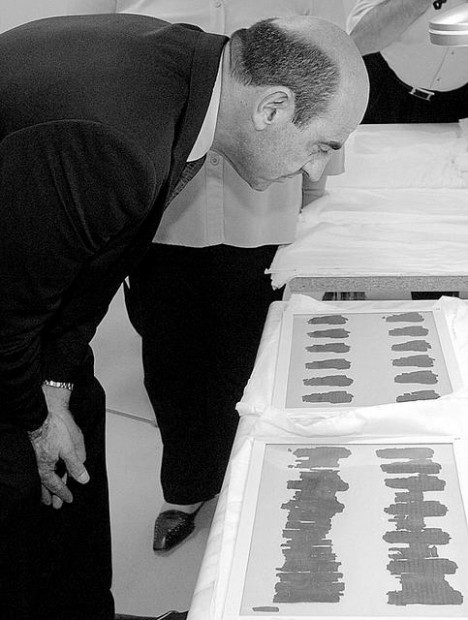
ATHENS, Greece — The burned remains of a 2,400-year-old scroll buried with an ancient Greek nobleman may help unlock the secrets of early monotheistic religion — using new digital technology.
A team of U.S., British and Greek experts is working on a new reading of the enigmatic Derveni papyrus, a philosophical treatise on ancient faith that is Europe's oldest surviving manuscript.
More than four decades after the papyrus was found in a grave in northern Greece, researchers said Thursday they are close to uncovering new text from the blackened fragments left after the scroll was burned on its owner's funeral pyre.
Large sections of the mid-fourth-century B.C. document — a philosophical treatise on religion written in ancient Greek — were read by scholars years ago.
But now, archaeologist Polyxeni Veleni believes U.S. imaging and scanning techniques used to decipher the Judas Gospel — which portrays Judas not as a sinister betrayer but as Jesus' confidant — will considerably expand and clarify that text.
People are also reading…
"I believe some 10-20 percent of new text will be added, which however will be of crucial importance," said Veleni, director of the Thessaloniki Archaeological Museum, where the manuscript is kept.
"This will fill in many gaps. We will get a better understanding of the sequence, and the existing text will become more complete," Veleni said.
The scroll, originally several yards of papyrus rolled around two wooden runners, was found in 1962. It dates to around 340 B.C., during the reign of Philip II of Macedon, father of Alexander the Great.
"It is the oldest surviving book, if you can use that word for a scroll, in Western tradition," Veleni said. "This was a unique find, of exceptional importance."
Greek philosophy expert Apostolos Pierris said the text may be a century older.
"It was probably written by somebody from the circle of the philosopher Anaxagoras, in the second half of the fifth century B.C.," he said.
Anaxagoras, who lived in ancient Athens, is thought to have been the teacher of Socrates and was accused by his contemporaries of atheism.
Last month, experts from Brigham Young University in Utah used multispectral digital analysis to create enhanced pictures of the text, which will be studied by Oxford University papyrologist Dirk Obbink and Pierris, and published by the end of 2007.
A separate, Greek team is also working to produce a new edition by the end of 2006.


