

In a world filled with hazards, some workers obviously face perilous conditions: miners burrowing hundreds of feet deep in the earth, farmers spraying pesticides, meatpackers wielding long knives to carve up huge carcasses moving quickly down a line.
By that yardstick, mixing an additive that's used to flavor popcorn, candy, baked goods and other foods — it's also found naturally in small amounts in staples such as milk and butter — almost seems innocuous.
But to many, it's not.
For several years, diacetyl, a chemical that gives foods a buttery taste, has been linked to a rare, irreversible lung disease. The result has been a health debate that has stretched from Congress to courtrooms across the nation, leading to tens of millions of dollars in judgments.
Scientists, doctors, politicians, food companies, labor unions, lawyers and others have weighed in — some pointing angry fingers at the government — as hundreds of workers have claimed they have severe lung disease or other respiratory illnesses from inhaling diacetyl vapors.
People are also reading…
May go beyond workers
And it may go beyond workers. It was recently disclosed that a man who ate at least two bags of buttery microwave popcorn daily for several years may have the same disease found in workers. His lung problems were linked to breathing the vapors.
Now some major microwave popcorn companies have eliminated or plan to drop the ingredient, while Congress — with the support of the flavoring industry — is looking to reduce the danger in the workplace. But the Bush administration, some business groups and others say there isn't enough scientific evidence to warrant immediate government limits.
Edwin Foulke Jr., a top federal official, testified this spring at a congressional hearing that diacetyl is a "substance of suspicion," but there's no clear evidence it's the one chemical that causes this disease.
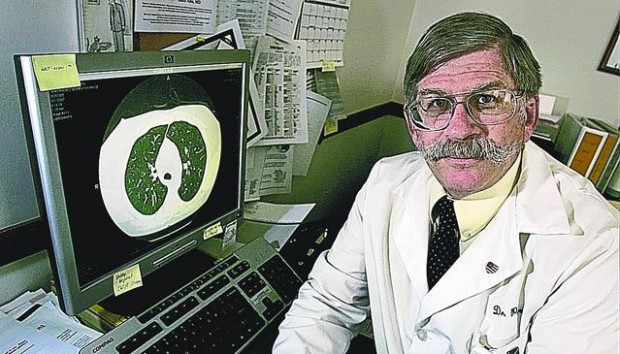
But the doctor who was one of the first to detect the illness in workers says the science is solid and popcorn makers are right to drop diacetyl.
"I just wish this had been done earlier," says Dr. Allen Parmet, a Kansas City public-health physician. "There are hundreds of people who are sick and who are hurt and it never should have happened."
A devastating disease
Seven years ago, an attorney asked Parmet to review the medical records of several workers with some unusual lung problems.
Within 20 minutes, Parmet says, he knew what it was: bronchiolitis obliterans, a devastating disease that destroys the small airways of the lungs, leaving victims coughing and gasping for air.
Parmet had seen it only three times in 25 years. Now he was poring over documents indicating several people had the disease — all workers at the Gilster-Mary Lee microwave popcorn plant in Jasper, Mo.
"It was 'holy smokes!' " he says. "I've got eight or nine cases here in a group of 200 people in a town of 1,000. Mentally, I've made this leap — that's an epidemic."
The National Institute for Occupational Safety and Health (NIOSH) dispatched investigators to the plant. By 2001, it had reported a link between butter flavorings and the disease, which became known as popcorn lung.
Bronchiolitis obliterans can be mistaken for asthma or bronchitis. Sometimes, the disease progresses very quickly.
"In months you can go from being a healthy person to hardly being able to breathe, coughing all the time, not being able to do your job," says Dr. Richard Kanwal, a NIOSH medical officer who has investigated the illness since 2001. "It's terrifying."
Over the years, NIOSH investigators have identified or reviewed medical records of dozens of cases in microwave-popcorn plants in Illinois, Iowa, Missouri, Nebraska and Ohio and flavor-making plants in California, Indiana, New Jersey, Maryland and Ohio.
There have been three reports of deaths among workers. How many people are ill is unclear.
There are, however, hundreds of claims filling the court dockets.
Missouri attorney Ken McClain has more than 500 lawsuits pending against the companies that produce or use the butter flavoring.
About $50 million has been awarded in verdicts that were later settled for confidential amounts. Another 100 cases have been settled that reportedly involve tens of millions of dollars.
As civil lawsuits have increased, so, too, has pressure on federal agencies by scientists, unions and some in Congress to do more to protect workers.
The Occupational Safety and Health Administration has been criticized by some researchers, unions and doctors who claim the agency has been lax, not ordering safety standards or increasing inspections at plants using diacetyl.
This spring, Foulke, assistant secretary of labor for OSHA, defended his agency, saying that after the 2001 Missouri cases, it alerted its regional offices and ordered them to look into the issue.
Is microwave popcorn safe?
Meanwhile, consumers are wondering whether eating microwave popcorn is safe, especially after a Colorado man who ate at least two bags every night for several years was diagnosed with "significant lung disease" similar to that seen in some microwave popcorn workers.
The illness — the first suspected case in a consumer — was linked to the man's habit of inhaling fumes from extra-buttery microwave popcorn.
Dr. Cecile Rose, a lung specialist at the National Jewish Medical and Research Center in Denver, says eating microwave popcorn isn't dangerous, but what's not yet known is what hazards may be associated with the fumes.
Dr. Phil Harber, a UCLA lung specialist, also says there isn't enough information to determine whether there's a "medically significant risk" but added that people who eat lots of this kind of microwave popcorn should try to limit exposure when cooking it.
Find stories and webcasts on health issues at go.azstarnet.com/health
On the Net
thepumphandle.wordpress. com/


