

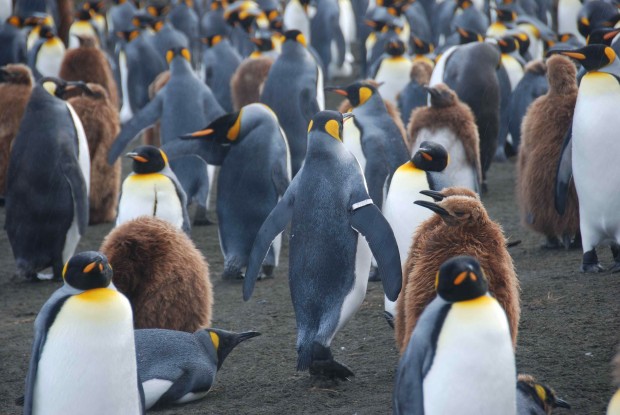
WASHINGTON - Some scientists studying penguins may be inadvertently harming them with the metal bands they use to keep track of the tuxedo-clad seabirds, a new study says.
The survival rate of king penguins with metal bands on their flippers was 44 percent lower than those without bands, and banded birds produced far fewer chicks, according to new research published Wednesday in the journal Nature.
The theory is that the metal bands - either aluminum or stainless steel - increase drag on the penguins when they swim, making them work harder, the study's authors said.
Author Yvon Le Maho of the University of Strasbourg in France said the banded penguins looked haggard, appearing older than their actual age.
Consequently, studies that use banded penguins - including ones about the effects of global warming - may be inaccurate, confusing other changes in penguins with the effects of banding, said Le Maho and colleague Claire Saraux.
People are also reading…
Le Maho said this is the first study showing a long-term harm from banding.
"There is an ethical question: Should we continue?" Le Maho asked.
The researchers followed 50 banded adult penguins and 50 without bands for 10 years, tracking them with under-the-skin transponders. Thirty-six percent of the non-banded seabirds survived for 10 years, compared to only 20 percent of the band-wearing birds.
The penguins were studied on a French island in the Indian Ocean between Africa and Antarctica.
Online
Nature: www.nature.com/nature


