

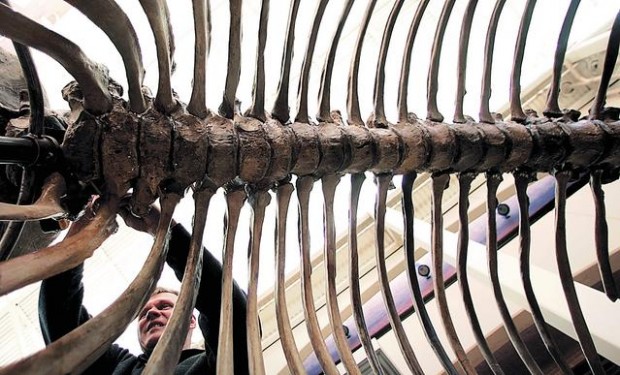
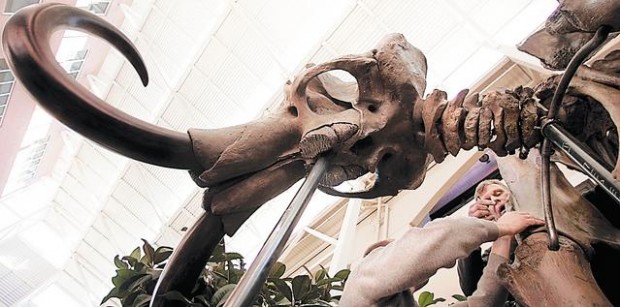
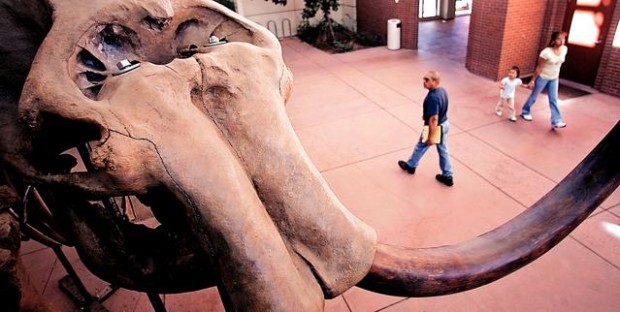
Complete fossil skeletons of two ice age mammals — a woolly mammoth and woolly rhino — are being erected in the atrium of the state office complex Downtown at 400 W. Congress St.
You can visit them for free.
Heck, you can buy them if you've got the cash.
The exhibit is sponsored by the Tucson office of the Arizona Geological Survey and supplied by a natural history museum in Siberia that sells its fossils to raise money. It's not illegal, but it's certainly not condoned, say U.S. museum officials.
"Science is not a business, nor should it be," said K. Christopher Beard of the Carnegie Museum of Natural History in Pittsburgh. "I know the gem and mineral show brings a lot of activity, but boy, I wish the level of paleontological commercialism could be reduced down there."
People are also reading…
Beard hasn't been to the gem show but said he received a report on fossil sales from his aunt, who is spending the winter here.
Oleg Medvedev, deputy director of the Museum of Natural History in Novosibirsk, Russia, doesn't disagree with what Beard said.
"We would like to say this, but in the other way, we have no money to pay for expeditions," Medvedev said, shortly after attaching the curved ivory tusks of a mammoth to its skeletal frame in the open-air atrium.
"Our main goal is to gather exhibits for us, but we need money to carry out our expeditions," Medvedev said.
Medvedev, a molecular geneticist, and museum director Igor Grebnev, a paleontologist, are in Tucson for the third straight year at the Gem, Mineral & Fossil Showcase. They sell pieces of tusks and prehistoric bones from a tent in the parking lot of the Ramada Inn Downtown.
They also sell tusks, bones and carved items online through a company called Siberian Fossils.
Medvedev said they would like to sell the mammoth skeleton to a museum and are in negotiations with a new natural history museum in Seoul, South Korea.
But if a private buyer offered $150,000, they'd call it a deal, he said.
The mammoth is one of 16 his museum has unearthed in southern Siberia, near Novosibirsk, Medvedev said. Some parts were missing. One foot and a few of the ribs are from other fossil specimens, he said, and one small foot bone and two ribs are resin replicas.
This particular mammoth is probably 15,000 to 20,000 years old, he said
The museum, established in 1994, has no state funding, Medvedev said, and is financed solely through sales of fossils.
Carnegie's Beard said he realizes that American museums such as his have an easier time hewing to ethics.
"It's hard to critique other countries and what they do with their paleontological heritage," said Beard, who is head of the vertebrate paleontology section at Carnegie, one of the largest natural history museums in the country.
It just doesn't seem right, he said.
"It's kind of like buying and selling George Washington's wooden teeth."
For Lee Allison, director of the Arizona Geological Survey, a connection with the Russian museum was an opportunity to tie in to the annual Gem, Mineral & Fossil Showcase, which he said brings not only collectors, but scientists from around the world to Tucson.
Next year, he hopes to put together a public lecture series during the shows, Allison said.
In addition to the ethical considerations of selling vertebrate fossils, there are practical reasons for not exhibiting them outside of museums, said Amy Henrici, collection manager at Carnegie.
"You have to watch the climate they're stored in," said Henrici. If they're exposed to very dry air, it's bad. Moving any fossil numerous times is hazardous," she said.
"This transfer and traffic of ancient material is problematic," said Nancy Odegaard, conservator for the Arizona State Museum.
"It's not illegal for somebody who owns something to sell it, but it's certainly not approved of," she said.
The problem with the sale of fossils and other archaeological artifacts is that it "creates a value other than scientific value," said Barnet Pavao-Zuckerman, associate curator of zooarchaeology at the Arizona State Museum.
That creates black markets for things that should either be displayed in museums or studied and left where they are found, she said.
On StarNet: Find more science and technology stories at azstarnet.com/science


