

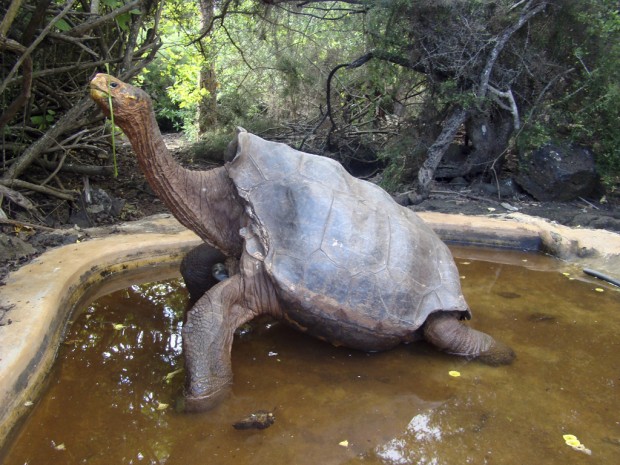
QUITO, Ecuador - Lonesome George's inability to reproduce made him a global symbol of efforts to halt the disappearance of species. And now the late, famed giant tortoise has an heir apparent.
The Galapagos Islands have another centenarian who fills a shell pretty well. He's Diego, a prolific, bossy, macho reptile.
But unlike Lonesome George, who died June 24, Diego symbolizes not a dying breed but one resurrected.
Having sired hundreds of offspring, Diego has been central to bringing the Espanola Island type of tortoise back from near extinction, rangers at Galapagos National Park say.
Diego was plucked from Espanola by expeditioners sometime between 1900 and 1930 and wound up in the San Diego Zoo, said the head of the park's conservation program, Washington Tapia.
When the U.S. zoo returned him to the Galapagos in 1975, the only other known living members of his species were two males and 12 females.
People are also reading…
Chelonoidis hoodensis - some consider it species, some a subspecies - had been all but destroyed, mostly by domestic animals introduced by humans that ate their eggs.
So Diego and the others were placed in a corral at the park's breeding center on Santa Cruz, the main island in the isolated archipelago whose unique flora and fauna helped inspire Charles Darwin's work on evolution.
Diego was so dominant and aggressive, bullying other males with bites and shoves, that he had to be moved eight years later to his own pen, with five of the females. The reptiles are not monogamous.
A U.S.-based herpetologist for the Galapagos Conservancy, Linda Cayot, says Diego is the most sexually active of the bunch because he's the biggest and the oldest of the males. "In tortoises, the biggest dominates."
Tapia said it is impossible to know Diego's age, but he is well over 100. He estimates Diego is the father of 40 percent to 45 percent of the 1,781 tortoises born in the breeding program and placed on Espanola island.
At least 14 species of giant tortoise originally inhabited the islands 620 miles off Ecuador and 10 survive, their features developing in sync with their environment, as Darwin observed.
Diego is nearly 3 feet long, weighs 176 pounds, and has a black saddleback shell.
Fausto Llerena, Diego's keeper, says tourists take to him automatically, if from a safe distance.
"I think he's going to be the successor to Lonesome George, the new favorite."
A visit to Lonesome George became de rigueur for celebrities and common folk alike among the 180,000 people who annually visit the Galapagos.
Before humans arrived in the Galapagos, the six islands were home to tens of thousands of giant tortoises. Numbers were down to about 3,000 in 1974, but the recovery program run by the national park and the Charles Darwin Foundation has succeeded in increasing the overall population to 20,000.


