Climate change is making major league sluggers into even hotter hitters, sending an extra 50 or so home runs a year over the fences, a new study found.
Hotter, thinner air that allows balls to fly farther contributed a tiny bit to a surge in home runs since 2010, according to a statistical analysis by Dartmouth College scientists published in Friday's Bulletin of the American Meteorological Society. They analyzed 100,000 major league games and more than 200,000 balls put into play in the last few years along with weather conditions, stadiums and other factors.
"Global warming is juicing home runs in Major League Baseball," said study co-author Justin Mankin, a Dartmouth climate scientist.
It's basic physics.

FILE - Milwaukee Brewers center fielder Lorenzo Cain (6) can't catch a ball hit for a home run by Chicago Cubs' Jason Heyward (22) during the first inning of a baseball game, Aug. 2, 2019, in Chicago. A new study released Friday, April 7, 2023, finds that climate change is making major league sluggers into even hotter hitters, sending an extra 50 or so home runs a year over the fences. (AP Photo/David Banks, File)
When air heats up, molecules move faster and away from each other, making the air less dense. Baseballs launched off a bat go farther through thinner air because there's less resistance to slow the ball. Just a little bit farther can mean the difference between a homer and a flyout, said Alan Nathan, a University of Illinois physicist who wasn't part of the Dartmouth study.
People are also reading…
Nathan, one of a group of scientists who has consulted with Major League Baseball on the increase in homers, did his own simple calculation, based purely on known physics of ballistics and air density as it changes with temperature, and said he got the same result as the Dartmouth researchers.
Both Nathan and the Dartmouth team found a 1% increase in home run likelihood with every degree the air warms (1.8% with each degree Celsius). Total yearly average of warming-aided homers is only 1% of all home runs hit, the Dartmouth researchers calculated.

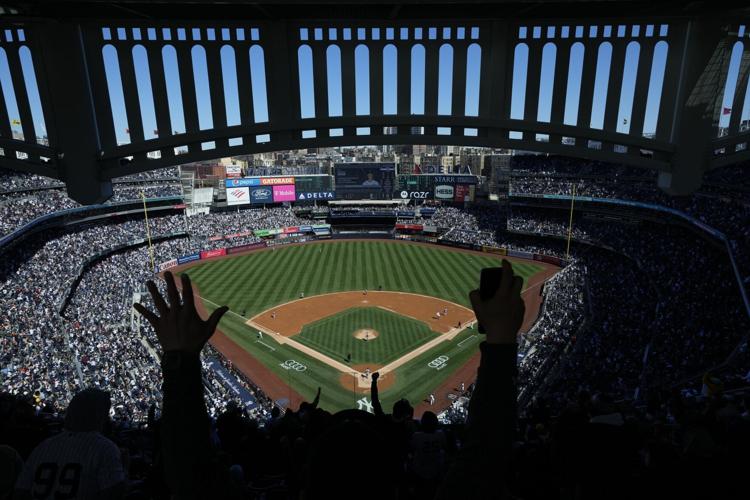
FILE - Fans react after New York Yankees' Aaron Judge hits a home run during the third inning of a baseball game against the San Francisco Giants at Yankee Stadium, April 2, 2023, in New York. A new study released Friday, April 7, 2023, finds that climate change is making major league sluggers into even hotter hitters, sending an extra 50 or so home runs a year over the fences. (AP Photo/Seth Wenig, File)
Non-climate factors contribute even more to the barrage of balls flying out of the park, scientists and baseball veterans said. The biggest is the ball and the size of the stitches, Nathan said, and MLB made slight adjustments to deaden the ball prior to the 2021 season. Others include batters' recent attention to launch angle; stronger hitters; and faster pitches. The study started after the end of baseball's infamous steroids era saw a spike in home runs.
Veteran baseball players and executives said the research fits with what they've seen on the field.
"We always felt that way for years," Phillies president of baseball operations Dave Dombrowski said. "When it's warmer, the ball travels more and they have scientific evidence to back that up."
Homers have always varied by ballpark due to simple factors like dimensions that are friendlier to pitchers than hitters, or vice versa, as well as wind conditions.

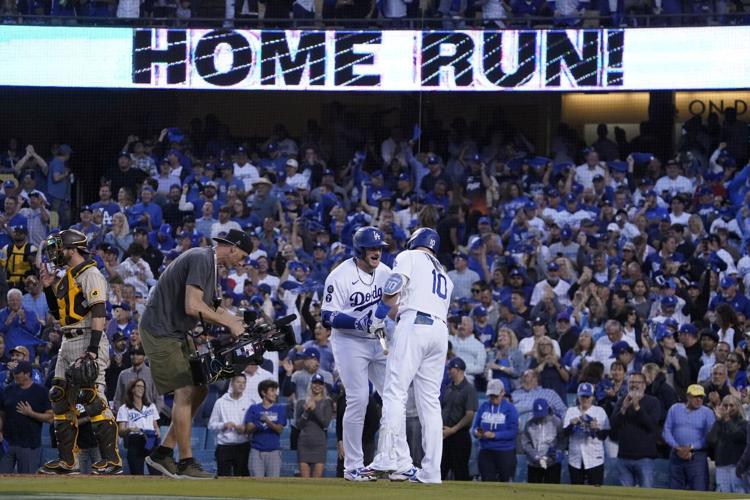
FILE - Los Angeles Dodgers' Max Muncy (13) celebrates his solo home run with Justin Turner (10) during the second inning in Game 2 of a baseball NL Division Series against the San Diego Padres, Oct. 12, 2022, in Los Angeles. A new study released Friday, April 7, 2023, finds that climate change is making major league sluggers into even hotter hitters, sending an extra 50 or so home runs a year over the fences. (AP Photo/Mark J. Terrill, File)
The Dartmouth team found the climate homer effect varied by field, too. Chicago's Wrigley Field, which still hosts a lot of day games, has the most warming-homer friendly confines. The statistical analysis found no significant heat-aided homers at Tampa's Tropicana Field, the only full-time domed stadium in Major League Baseball.
"It's interesting to think about," said five-time All-Star pitcher David Cone, who once threw a perfect game and is now a television baseball analyst. "I'd probably more likely look at the makeup of the baseball itself, the variances and the specs. Of course, weather matters, definitely I wouldn't shoo it away."
After a 1-0 victory in Coors Field, Colorado Rockies reliever Brent Suter said the study, which mentions more than 500 home runs since 2010, rings true to him.
"Obviously I'm not a fan in any way as a pitcher," Suter said with a laugh. "500 seems a lot, but I could believe it."

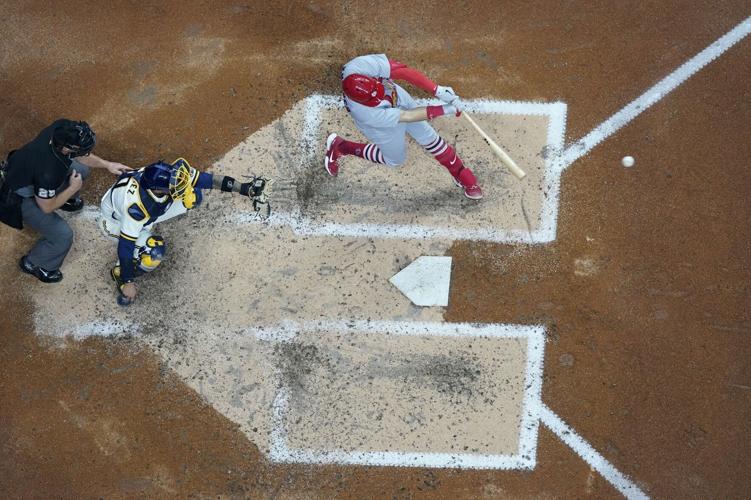
FILE - St. Louis Cardinals' Andrew Knizner hits a two-run home run during the fourth inning of a baseball game against the Milwaukee Brewers, Sept. 27, 2022, in Milwaukee. A new study released Friday, April 7, 2023, finds that climate change is making major league sluggers into even hotter hitters, sending an extra 50 or so home runs a year over the fences. (AP Photo/Morry Gash, File)
The heat is also hard on players and fans, Suter said: "I remember pitching some games I was just, like 'This does not feel like normal heat. It's crazy hot.'"
The average U.S. temperature in June, July and August has increased by more than 2 degrees (1.1 degrees Celsius) in the last 40 years, according to the National Oceanic and Atmospheric Administration.
Mankin called what's happening "a fingerprint of climate change on our recreation." Callahan said what's been seen so far is nothing compared to projections of hundreds of extra homers in the future.
How many extra homers depends on how hot it gets, which depends on how much greenhouse gas the world spews from the burning of coal, oil and gas. Callahan ran different scenarios of carbon pollution through computer simulations.

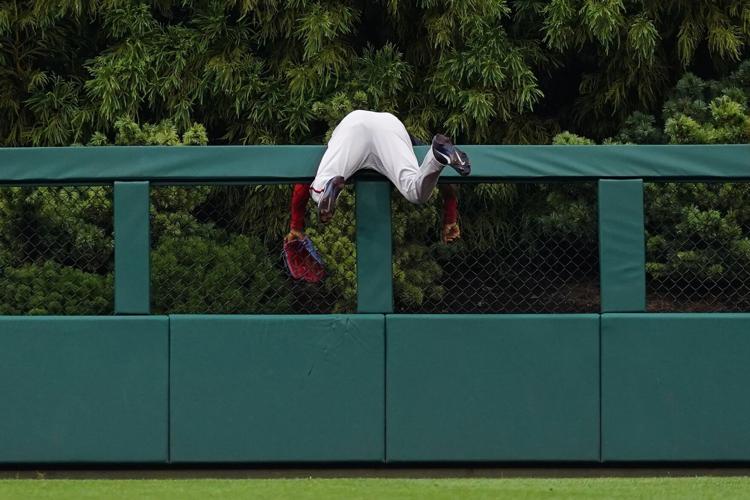
FILE - Washington Nationals center fielder Victor Robles cannot reach a home run hit by Philadelphia Phillies' Kyle Schwarber during the first inning of a baseball game, July 5, 2022, in Philadelphia. A new study released Friday, April 7, 2023, finds that climate change is making major league sluggers into even hotter hitters, sending an extra 50 or so home runs a year over the fences. (AP Photo/Matt Slocum, File)
In the worst-case warming trajectory – which some scientists say the world is no longer on based on recent emissions – there would be about 192 warming-aided homers a year by 2050 and around 467 hot home runs by the year 2100. In more moderate carbon pollution scenarios, closer to where Earth is now tracking, there would be about 155 warming-aided homers a year by 2050 and around 255 extra dingers at the end of the century, Callahan said.
Because baseball has so many statistics and analytics, such as the tracking system Statcast, trends can be seen more easily than other effects of climate change, Mankin said. Still, the scientists can't point to a single homer and say that's a warming-aided home run. It's a detail that can be only seen in the more than 63,000 homers hit since 2010.
Several climate scientists told The Associated Press that the study makes perfect sense and the statistics are analyzed properly, though they also point out factors other than climate change are in play and likely have bigger effects.
Both Texas A&M's Andrew Dessler and University of Illinois' Don Wuebbles said while the rise in home runs is interesting, it pales next to the issues of extreme weather and rising seas.
But Callahan said it actually brings home the threat of climate change in a unique way. Besides resulting in more home runs, a warming climate will likely require more domed stadiums because it will simply be too hot outside for humans in some places.
"Global warming is going to reshape so many of the things that we care about in so many pernicious and subtle ways," Callahan said. "And the fact that we'll get to go to fewer baseball games played in open air is not a civilization-ending crisis, but it is another sign of the way that we have reshaped our lives due to our greenhouse gas emissions."
___
Today in sports history: April 7
1946: Herman Keiser edges Ben Hogan by one stroke to win Masters

1946 — Herman Keiser edges Ben Hogan by one stroke to win the Masters.
1951: Ben Hogan wins the Masters by two strokes over Robert Riegel.

1951 — Ben Hogan wins the Masters by two strokes over Robert Riegel.
1963: Jack Nicklaus, 23, becomes youngest golfer to win Masters

1963 — Jack Nicklaus, at 23, becomes the youngest golfer to win the Masters, beating Tony Lema by a stroke.
1985: New Jersey’s Herschel Walker rushes for USFL-record 233 yards

1985 — New Jersey’s Herschel Walker rushes for a USFL-record 233 yards in leading the Generals to a 31-25 victory over the Houston Gamblers.
2003: Carmelo Anthony leads Syracuse to NCAA championship

2003 — Syracuse wins the NCAA tournament with an 81-78 victory over Kansas. Freshman Carmelo Anthony, fighting off a bad back, finishes with 20 points, 10 rebounds and seven assists. Gerry McNamara hits six 3-pointers in the first half and finishes with 18 points.
2007: Vince Carter, Jason Kidd first teammates with triple-doubles in same game

2007 — Vince Carter and Jason Kidd are the first teammates with triple-doubles in the same game since Michael Jordan and Scottie Pippen in 1989. Carter matches his season high with 46 points, adds a career-best 16 rebounds and 10 assists. Kidd ties a career high with 16 rebounds, equals his season high with 18 assists and adds a late free throw for 10 points to lead New Jersey to a 120-114 overtime win over Washington.
2008: Kansas grinds out overtime win in NCAA title game

2008 — Mario Chalmers hits a 3-pointer with 2.1 seconds left in regulation to push the game into overtime, and Kansas grinds it out from there for a 75-68 victory over Memphis in the men’s NCAA basketball title game.
2009: UConn routs Louisville to capture sixth women's basketball title

2009 — Tina Charles scores 25 points and grabs 19 rebounds as Connecticut routs Louisville 76-54 to capture sixth women’s basketball title. UConn (39-0) wins every one of its 39 games by double digits, a first in college basketball.
2010: Don Nelson sets NBA career record for victories by coach

2010 — Don Nelson sets the NBA career record for victories by a coach in the Golden State Warriors’ 116-107 win over the Minnesota Timberwolves. Nelson with 1,333 wins, surpasses Lenny Wilkens to move atop the list.
2014: UConn wins second NCAA title in four years, beating Kentucky's freshmen

2014 — Shabazz Napier scores 22 points and Connecticut wins its second NCAA men’s title in four years, beating the Kentucky freshmen 60-54 in the championship game. Kentucky, with five freshmen starters, never led in the championship game. The Wildcats missed 11 of 24 free throws, while the Huskies were perfect on 10 tries.
2015: Geno Auriemma ties UCLA’s John Wooden for the most titles in college basketball

2015 — UConn’s women’s basketball team beats Notre Dame 63-53 for their 10th NCAA championship. Coach Geno Auriemma ties UCLA’s John Wooden for the most titles in college basketball.
2016: Golden State becomes second team to win 70 games in season

2016 — Golden State becomes the second team to win 70 games in a season by beating the San Antonio Spurs 112-101. The Warriors (70-9) bounce back from their second loss in three home games two nights earlier against Minnesota and join the 1995-96 Chicago Bulls as the only teams to win 70 games. This is the first regular-season meeting in NBA history between two teams that enter with at least 65 victories apiece.
2016: Ernie Els records sextuple bogey, worst score on first hole of Masters

2016 — Ernie Els, winner of four major titles, makes Masters history. He opens with a 10 on the Par 4 first hole. After his first two shots, Els seven-putts from 2 feet. His sextuple bogey is the worst score on the first hole at the Masters, beating the old mark by two strokes.
Associated Press reporters Pat Graham contributed from Denver and Ron Blum contributed from New York.
Associated Press climate and environmental coverage receives support from several private foundations. See more about AP's climate initiative here. The AP is solely responsible for all content.