

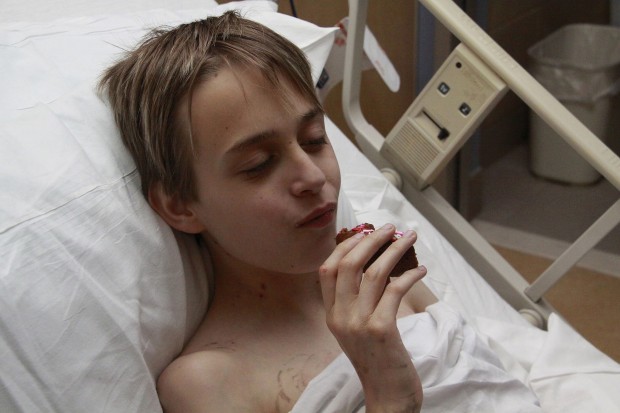
It's fitting that Kyle Chamberlain is one of the first patients to stay at the newly opened Diamond Children's Medical Center at UMC.
Over the years, he's spent countless days at University Medical Center, where he said his first words and took his first steps as a tot.
But after his most recent surgery, Chamberlain, now 14, will no longer be a familiar face around the hospital - unless, of course, he comes by for a visit.
Chamberlain was born with a rare condition in which the left ventricle of his heart failed to develop completely, formally known as hypoplastic left heart syndrome. The defect occurs in less than 1 percent of all babies and must be followed by three stages of open-heart surgery so the existing ventricle can maintain blood circulation for both the lungs and body.
Chamberlain's first surgery was performed when he was 8 days old, the second at 8 months, and the third, known as a Fontan, was performed at 22 months. The surgeries saved his life, but with only one ventricle doing the work of two and little possibility of a heart transplant, Chamberlain has always dealt with certain physical limitations.
People are also reading…
These limits were intensified when, in March 2006, he was diagnosed with plastic bronchitis, a rare but potentially fatal complication of a Fontan operation.
Rather than circulating through his body by way of the lymphatic system, any fat that Chamberlain eats makes its way into his lungs, forming rubberlike obstructions called casts inside his small bronchial tubes. As they thicken, even taking a breath becomes difficult - a major drawback for a growing boy who loves to skateboard, Roller Blade and swim.
"Really what he is doing is suffocating, and he needs complicated medical and breathing treatments to try to keep his airways open," said Dr. Michael Teodori, a specialist in congenital heart surgery at UMC.
Along with regular breathing treatments, a long list of medications and a series of medical procedures necessary to clean out his lungs, Chamberlain has spent years on a diet of only 3 grams of fat a day. Though most people would never settle for just one potato chip, that's been his reality.
"He really savors something like that when he gets it," said Ginny Gann, a pediatric specialist with Dependable Nurses Inc. who has been Chamberlain's nurse for more than three years.
Due to his deteriorating condition, in March doctors gave Chamberlain three to five years until his heart would give out entirely. But Teodori wouldn't give up.
After investigating similar cases of plastic bronchitis, he offered a solution. By performing a thoracic duct ligation, in which he would divert the fat entering Chamberlain's lungs elsewhere, Teodori hoped to give the teen a new lease on life.
According to scholarly literature, there are only a few cases in which the surgery has proved successful in children with a Fontan operation.
"Mostly, it falls into a gray zone in medicine," Teodori said.
Though it's not an uncommon procedure, the ligation also posed inherent dangers for Chamberlain, whose underlying medical condition put him at greater risk during surgery. Nonetheless, on April 15 Chamberlain was wheeled into the operating room.
"Mostly we just watched Kyle and watched what he did and talked to him, and decided this was his best chance," Teodori said.
Though the teen is still recovering, today the Chamberlain family and Teodori are happy to report that the boy's breathing has improved and the casts have ceased forming.
"Now, for the first time in the last four years, he is allowed to eat whatever he wants to eat and breathe comfortably," Teodori said.
Upon approval from his doctor, Chamberlain promptly ordered curly fries and has since enjoyed a chocolate doughnut, candy bars, chips and even a side of bacon.
Trading in his oxygen tanks for hamburgers and heading off to high school aren't his only goals.
Though his hopes for a transplant are slim, Chamberlain wants to encourage other kids to consider organ donation.
"Once you have been in the hospital like I have, you see that there are a lot of sick kids," he said. "I think that's what people don't understand - there are people who are really sick and need hearts or lungs."
Though Teodori said there is no telling how long Chamberlain's heart will last, what's important is that his quality of life has been improved.
"All I did was fight and never gave up, and I think that's what other kids should do," Chamberlain said.
Bethany Conway is a UA journalism student who is apprenticing at the Star. Contact her at 573-4142 or at starapprentice@azstarnet.com


