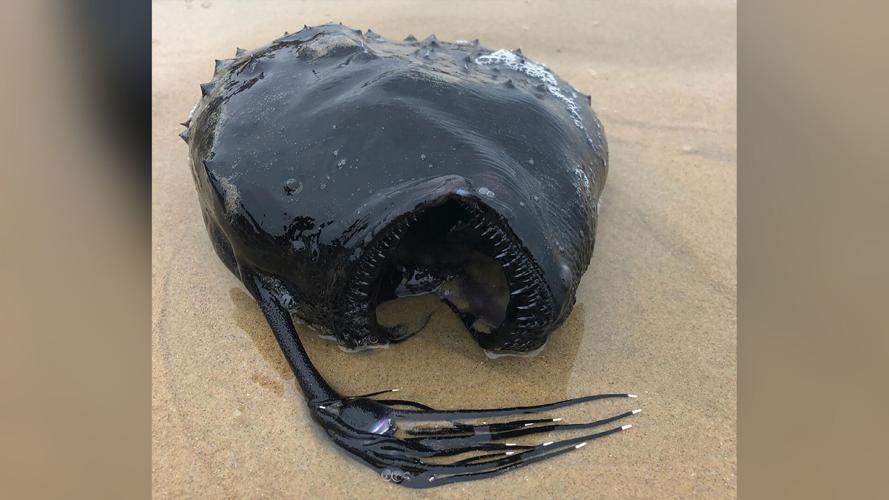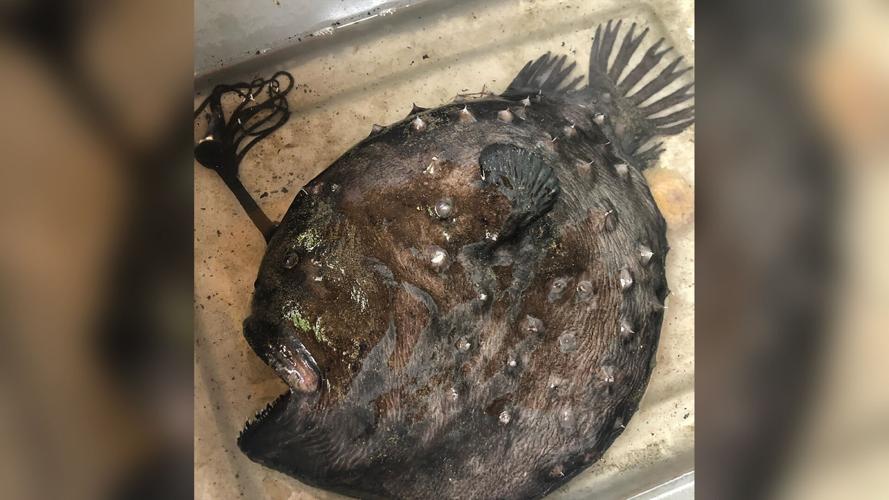
A deep-sea anglerfish typically found at ocean depths of more than 3,000 feet was found washed up on Crystal Cove State Park.
An unusual fish with teeth as sharp as glass and a body shaped like a football washed ashore on a California beach last week.
The creature was found with its mouth agape on the shore of Crystal Cove State Park's Marine Protected Area in Laguna Beach last Friday. The park shared images of the fish on social media and identified it as being most likely the Pacific Football Fish.

This unusual football-shaped fish, normally found in the depths of the ocean, washed ashore on a beach at Crystal Cove State Park in California.
"To see an actual anglerfish intact is very rare and it is unknown how or why the fish ended up on the shore," reads the Facebook post.
The Pacific Football Fish is one of more than 200 species of anglerfish worldwide, according to California State Parks, and is normally found in the depths of the ocean. The creature's teeth are sharp and pointy like shards of glass, and the "large mouth is capable of sucking up and swallowing prey the size of their own body."
People are also reading…
Due to the creature's size and the protruding stalk on the top of the head, California State Parks said this is a female.
"Only females possess a long stalk on the head with bioluminescent tips used as a lure to entice prey in the darkness of waters as deep as 3,000 feet!" according to the Crystal Cove State Park post.

The stalk on the head of the anglerfish that washed ashore on a California beach was used to lure prey.
Females can grow to lengths of 24 inches while males only grow to be about an inch long, the post reads, while the sole purpose of the male fish is to help a female reproduce.
"Males latch onto the female with their teeth and become 'sexual parasites,' eventually coalescing with the female until nothing is left of their form but their testes for reproduction," reads the post.
The body of the fish is being held by the California Department of Fish & Wildlife, according to CNN affiliate KFSN. It is expected to be studied for research and educational purposes.
"Seeing this strange and fascinating fish is a testament to the diversity of marine life lurking below the water's surface," reads the Crystal Cove State Park post, "... and as scientists continue to learn more about these deep sea creatures it's important to reflect on how much is still to be learned from our wonderful ocean."
Photos: Fishing, harvest of eggs blamed for drop in sea turtles

This July 5, 2017, photo shows a leatherback turtle swimming in the Pacific Ocean near Moss Landing, Calif. All seven distinct populations of leatherbacks in the world are troubled, but a new study shows an 80% population drop in just 30 years for one extraordinary sub-group that migrates 7,000 miles across the Pacific Ocean to feed on jellyfish in cold waters off California. Scientists say international fishing and the harvest of eggs from nesting beaches in the western Pacific are to blame. (Kate Cummings via AP)

In this photo taken Sept. 25, 2007, in the waters off central California, scientists including Scott Benson, at far left, can be seen posing with a giant western Pacific leatherback sea turtle as they take measurements and attach a GOP satellite tracking device to its shell. (Heather Harris/NOAA-ESA Permit #15634 via AP)

In this aerial photo provided by Joel Schumacher, scientists in a research boat pursue a Pacific leatherback turtle in the Pacific Ocean off California in September 2016. (Joel Schumacher via AP)

A leatherback turtle is seen in Monterey, Calif., during a scientific expedition to research the turtles' migration patterns. (Scott Benson via AP)

Scott Benson, an ecologist and leatherback turtle expert with the National Oceanic and Atmospheric Administration Fisheries Service, looks out over the water from his research boat in Monterey, Calif., on March 25, 2021. Benson has studied western Pacific leatherback turtles for decades and recently co-authored a study that shows an 80% population drop in just 30 years for one extraordinary sub-group that migrates 7,000 miles across the Pacific Ocean to feed on jellyfish in cold waters off California. (AP Photo/Haven Daley)
The-CNN-Wire
™ & © 2021 Cable News Network, Inc., a WarnerMedia Company. All rights reserved.