

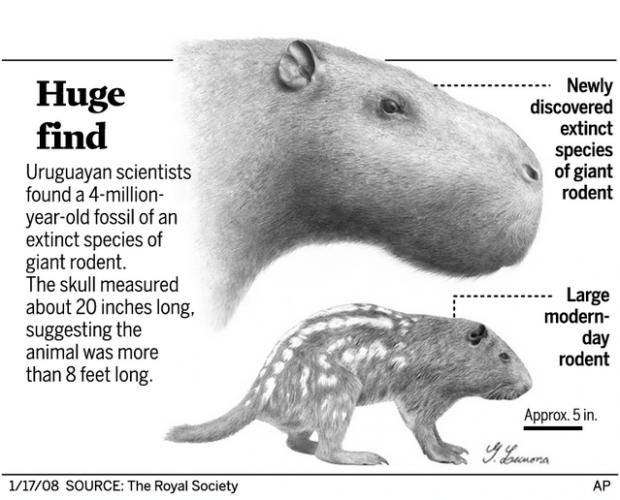
LONDON — Eeek! Imagine a rodent that weighed more than a ton and was as big as a bull.
Uruguayan scientists say they have uncovered fossil evidence of the biggest species of rodent ever found, one that scurried across wooded areas of South America about 4 million years ago, when the continent was not connected to North America.
A herbivore, the beast may have been a contemporary, and possibly prey, of saber-toothed cats — a prehistoric version of Tom and Jerry.
For those afraid of rodents, forget hopping on a chair. Its huge skull, more than 20 inches long, suggested a beast more than 8 feet long and weighing between 1,700 and 3,000 pounds.
Although British newspapers variously described it as a mouse or a rat, researchers say the animal, named Josephoartigasia monesi, actually was more closely related to a guinea pig or porcupine.
People are also reading…
"These are totally different from the rats and mice we're accustomed to," said Bruce Patterson, the curator of mammals at the Field Museum in Chicago, adding that it was the biggest rodent he had ever heard of.
An artist's rendering showed a creature that looked like a cross between a hippopotamus and guinea pig.
The fossil was found in 1987 about 65 miles west of the capital of Montevideo, near the vast River Plate estuary — a muddy waterway separating Uruguay from Argentina that empties into the South Atlantic. That area is a site of ancient riverbanks and other deposits where fossils have been found, he said.
An Argentine fossil collector identified as Sergio Viera donated the skull to Uruguay's National History and Anthropology Museum nearly two decades ago, said museum director Arturo Toscano.
It spent years hidden away in a box at the museum and was rediscovered by curator Andres Rinderknecht, who enlisted the help of fellow researcher Ernesto Blanco to study it.
Blanco told The Associated Press that he was shocked when he first saw the fossil, saying it looked even bigger than a cow skull.
"It's a beautiful piece of nature," he said in an interview. "You feel the power of a very big animal behind this."
Blanco said the skull's shape and the huge incisors left no doubt they were dealing with a rodent, but he cautioned that the estimate of the animal's bulk was imprecise.
The extinct rodent clearly outclassed its nearest rival, the Phoberomys, found in Venezuela and estimated to weigh 880 to 1,500 pounds.
Blanco said the rodent was far more enormous than any South American rodent alive today, surpassing even the present-day capibara that can weigh up to 110 pounds.
He said the animal's teeth pointed to a diet of aquatic plants.
"From what we can tell, we know it was a herbivore that lived on the shores of rivers or alongside streams in woodland areas," Rinderknecht said.


