

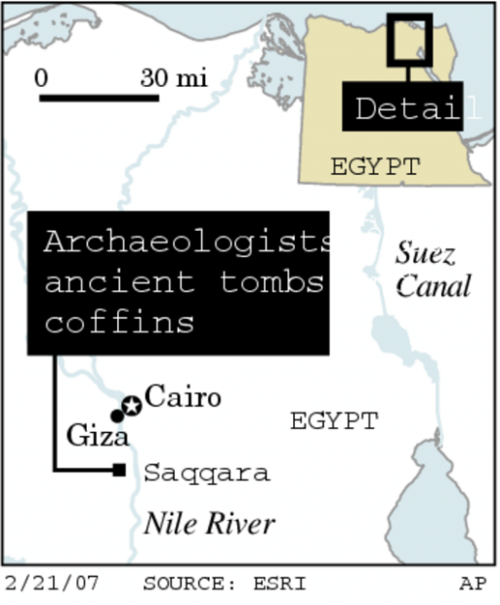
SAQQARA, Egypt — Archaeologists unveiled the tombs Tuesday of a pharaonic butler and a scribe that have been buried for more than 3,000 years — proof, they say, that Egypt's sands still have secrets to reveal.
Although archaeologists have been exploring Egypt intensively for 150 years, some estimate only one-third of what lies underground in Saqqara, site of the country's most ancient pyramid and burial site of kings, has been uncovered.
"The sands of Saqqara reveal lots of secrets," said Egypt's antiquities chief, Zahi Hawass, as he showed reporters a 4,000-year-old mud-brick tomb that belonged to a scribe of divine records, Ka-Hay, and his wife.
The tomb, with the butler's 3,350-year-old limestone grave and two painted coffins, was found earlier this year near the famous Step Pyramid of King Djoser — the oldest of Egypt's more than 90 pyramids.
People are also reading…
Hawass said the discoveries are just the tip of what remains undiscovered at Saqqara, burial grounds for Memphis, capital of Egypt's Old Kingdom.
In December, archaeologists in Saqqara discovered the mummified remains of a doctor buried with surgical tools more than 4,000 years ago. Two months earlier, the graves of three royal dentists were discovered in Saqqara after the arrest of tomb raiders led archaeologists to the site.
Hawass said the mud-brick tomb unveiled Tuesday, which also featured wooden statues and a door with intricate hieroglyphic carvings, "could enrich our knowledge about the people who actually surrounded the kings of Saqqara."
"It doesn't look great because it was built from mud brick and not built of limestone, but I really believe that this tomb is very important," said Hawass.
Three wooden statues also were found in the tomb. Two were about 3 feet tall and depicted the scribe, and one of them was missing the left arm. The third was not shown because it was in poor condition.
On the other side of the Step Pyramid, archaeologists then unveiled the second tomb, which belonged to a butler who died 3,350 years ago.
Carved out of limestone, it contained murals that showed scenes of people performing rituals and monkeys eating fruit. The blue-and-orange colors of the paint were surprisingly well-preserved.
"This is a very, very lively scene," said Maarten Raven, the excavation's director and a curator at the National Museum of Antiquities in Leiden, Netherlands.
Hawass also unveiled two wooden coffins, 4,000 years old, that were found south of the Step Pyramid. The rectangular coffins, painted light orange with blue hieroglyphics, held human-shaped coffins known as anthropoids, containing the mummies of a priest and a woman, who Hawass said was identified in the hieroglyphics as the priest's "girlfriend."


