

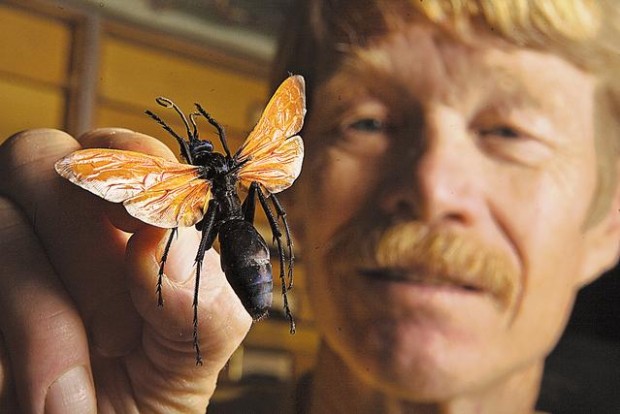
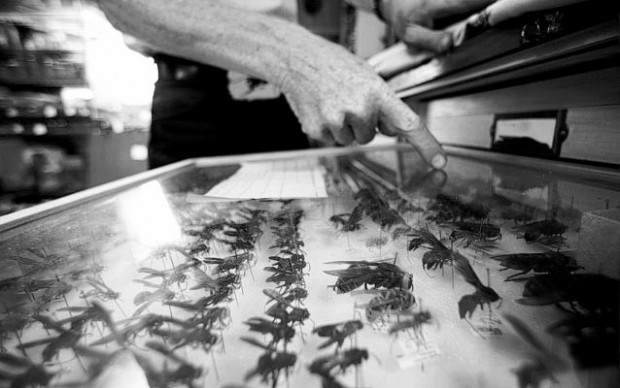
Justin O. Schmidt swears he's not a masochist. It's just that sometimes there's no substitute for getting stung by a really nasty insect.
He's the originator of the Schmidt Sting Pain Index, a system for ranking insect bites and stings — from 1 to 4, or from annoyance to "just shoot me" agony.
Although he's been stung by 150 different species on six continents, he said our tarantula hawk is one of only three insects that rate a 4 on his index.
Most of the time, there are people who have been stung or bitten who can tell him how their experience compared with that standard of insect pain, your basic honeybee sting, which rates a 2 on the Schmidt scale.
Is it better or worse than a honeybee sting, or about the same? Schmidt asks.
"I've been called coldhearted," Schmidt said. "Somebody gets stung, and I rush up and ask them how it feels to get another data point."
People are also reading…
Schmidt, retired from the U.S. Department of Agriculture's Tucson Carl Hayden Bee Research Center, knows his honeybees. Schmidt not only studied bee pheromones and nutrition, but he survived the media hysteria over "killer bees," the northward march of Africanized bees that finally crossed into Arizona in 1993.
In fact, Schmidt said, it was part of his job to put the killer-bee invasion in perspective in the early 1990s. He walked the sensible middle turf between ignoring the ill-tempered invading gang of "pollen pigs" and the B-movie plot that was selling a lot of newspapers and causing makeup cracks on the faces of wide-eyed, gasping TV reporters.
Although bees interested him, he said the job allowed him to pursue what really intrigued him.
"I'm a predator-prey defensive-system guy," he said, referring to the purpose of insect stinging.
The message of a sting, he said, is invariably, "Leave me alone." But Schmidt said a study of the system requires a way of comparing the threat to the outcome.
Sometimes there's a lot more bite than bark. Take the residents of Uncle Milton's Fascinating Ant Farm, the ubiquitous, clear-sided biology-in-action kit that millions of kids have watched.
Inside, Schmidt said, are harvester ants. It's hard to get them to bite, he said, but when they do, they rate an excruciating 3 on his scale.
And then there's our tarantula hawk, with that winged-evil look — and the punch to go with it.
You might want to update what you know about tarantula hawks, those lumbering airborne mothers that look for our indigenous hairy spiders, paralyze them with their stingers, and lay their eggs in them. You know — the ones about which many of us have heard, "Oh, they're scary-looking, but they don't sting people."
Occasionally, Schmidt has to induce a sting, sometimes because there aren't enough people to interview about their experiences of getting stung by specific species. And sometimes it's for the benefit of an "annoying camera crew" that needs a close-up shot of a stinger in a human arm.
"I carry Benadryl whenever I go near him," said Dawn Gouge, an urban entomologist with the University of Arizona's Maricopa Agriculture Center.
"He's loads of fun, but it hurts, generally," she said. "The first thing he ever said to me was, 'Put this bee on your arm and pull its head off.' "
But Schmidt said getting bitten and stung comes with the job, and he's been stung in some exotic parts of the world, including Costa Rica, home of the bullet ant and its 4-rated sting.
"But I'd have a real hard time forcing myself to get stung by a bullet ant," he said, even though it's happened four or five times, including once when an ant fell from an overhead vine and bit him as it bounced off his cheek — an indication of how aggressive they are.
As for how they all stack up against Arizona's poisonous snakes, lizards and spiders, Schmidt said he doesn't know and isn't going to find out. Some insect bites and stings may be painful, but none is deadly — except in the rare person who truly is allergic to a sting.
"Which is why I don't get stung by scorpions, spiders, jellyfish and snakes," Schmidt said.
Justin O. Schmidt's Sting Pain Index:
1 A fire ant. Big reputation, Schmidt said, but really not much of a bite. "A (rating of) 1 is something that definitely gets your attention but shouldn't cause tears or anything more than surprise."
2Honeybee. "A 2 shuts down what you're doing, and often you'll get some vocalization and scream "ouch!" and expletives — that sort of thing."
3 Harvester ants (the bigger red or black ants seen on local sidewalks). Really "Yow! What was that?" Makes you sit down and cry. Often a 3 will be longer-lasting (than a 2). Really intense."
4The tarantula hawk is our only local example. (The bullet ant and the warrior wasp of Costa Rica are the other two examples.) "Basically shuts down any function that you can do other than awareness of the pain. Excruciating, unrelenting pain. For a warrior wasp, 12 hours (before pain subsides), and a bullet ant, 12 to 24 hours. It's two or three minutes for a tarantula hawk. More like a sheer bolt (of electricity) that hits you — immediate."


