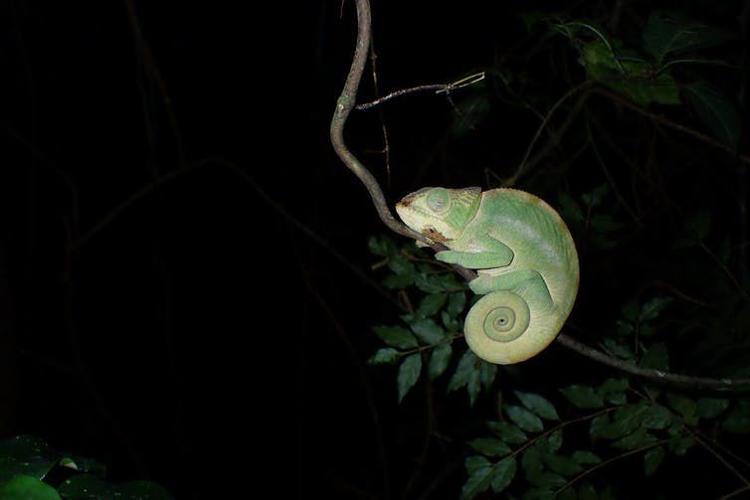

A Furcifer pardalis (panther chameleon) sleeps in a tree in Madagascar.
Curious Kids is a series for children in which we ask experts to answer questions from kids.
Can chameleons change color when they sleep? (Ikechukwu, 6, Lagos, Nigeria)
What a great question, Ikechukwu! It doesn’t have a simple answer, though: yes, chameleons do change color when they sleep, but we think it happens in a different way to when they’re awake. People like me who study chameleons know quite a lot about chameleons and their colors when they are awake and moving around, but there’s still more to learn about what is going on when they sleep.
Chameleons are really special reptiles, with a whole bunch of special features that make them look very different from all other lizards: they have eyes that can look in two directions at once, a tongue that they shoot out to catch prey, weird grasping hands, and a prehensile tail that they use to hold on while they climb around in trees and bushes.
People are also reading…
Around half of all chameleons (there are over 200 species) are found on the island of Madagascar, which is where I do my research and is quite close to the coast of Tanzania in East Africa. The other half are found in mainland Africa, Asia, and in parts of southern Europe.
All chameleons are able to change color at least a little bit, but some species can do it much more than others. Usually, their colors are quite neutral – plain colors that don’t attract a lot of attention, which is important when they are looking for prey. They don’t want the creatures they eat to see them coming, so they stick to the kinds of colors that are all around them: the browns and greens of sticks and leaves and the sand.
It’s different when the chameleons see predators that want to eat them, or other chameleons of their own species or other species. Then, many chameleon species, especially the big ones, can change to all sorts of colors.
That all happens when they are awake. What about when they sleep?
Controlling color
Chameleons change color by contracting and relaxing certain cells in their skin that contain either crystals or pigments. The crystals are colorless or slightly yellow, but by lining them up in a certain way, they can be made to reflect certain colors of light, like blue. Pigments, on the other hand, have their own colors, like red or black.
When chameleons are awake (they sleep about as much as we do) they control this process, probably without even thinking about it, like the way the hair on your arms stands on end when you are cold or frightened. That means that when the chameleon sleeps, the color control is relaxed. Sleeping chameleons become light in color, probably because certain pigment cells that absorb light relax.
This is actually the best way to find chameleons: if you shine a torch on a sleeping chameleon, its light skin reflects the torchlight, making it easy to see. But while you have the torch on the chameleon, wait a few seconds and you will notice that it gets darker. In fact, if you then move to look at the chameleon close-up, you’ll see that the side you had the torch shining on is darker than the other side. Even better, if you had a leaf covering part of the area that you had the torch shining on, the area of skin behind the leaf would stay light green, while the area exposed to light would darken.

A sleeping Calumma ambreense, which is a species of chameleon.
Chameleons don’t seem to be able to do this – make some parts of their skin lighter than others – when they’re awake. That means the active color change is different from the one that is used at night. Scientists like myself think that what happens at night might be made possible by light on the skin itself, like the torch you shine on that sleeping chameleon in your garden or at the park.
More to learn
Since chameleons are such interesting lizards, you would think that we had already studied them in so much detail that we knew everything there is to know about them. But actually, scientists like me still have lots and lots to learn. One of those things will be to understand more about sleeping chameleons and the ways they change color. Finding out this new information is one of the things that makes being a scientist so exciting – you never stop learning!
Hello, curious kids! Have you got a question you’d like an expert to answer? Ask an adult to send your question to CuriousKidsUS@theconversation.com. Please tell us your name, age and the city where you live. We won’t be able to answer every question but we will do our best.
This article is republished from The Conversation under a Creative Commons license. Read the original article.