Normally, it would be remarkable that the new police chief in a sizable city like Tucson was born here, grew up here, went to college here and spent their career in the local police department.
All that is true of Tucson's new police chief, Monica Prieto.
But it was also true of Tucson's last police chief, Chad Kasmar.
Those similarities reflect what may be most notable in the transition that took effect in March from Kasmar to Prieto — continuity.
Prieto is leading a department that is finding its feet after several difficult years around the pandemic in 2020. The number of officers dropped, homicides surged, and drug addiction became a pervasive feature of life on Tucson streets, but under Kasmar, some stability returned.
Now in the top office, Prieto is extending evidence-based policing practices that began under Kasmar's predecessor, Chris Magnus, and grew under Kasmar. The hope is to get a better grip on Tucson's persistent safety problems, such as street racing, traffic deaths, gun crimes and the nuisances like drug use and trespassing.
People are also reading…

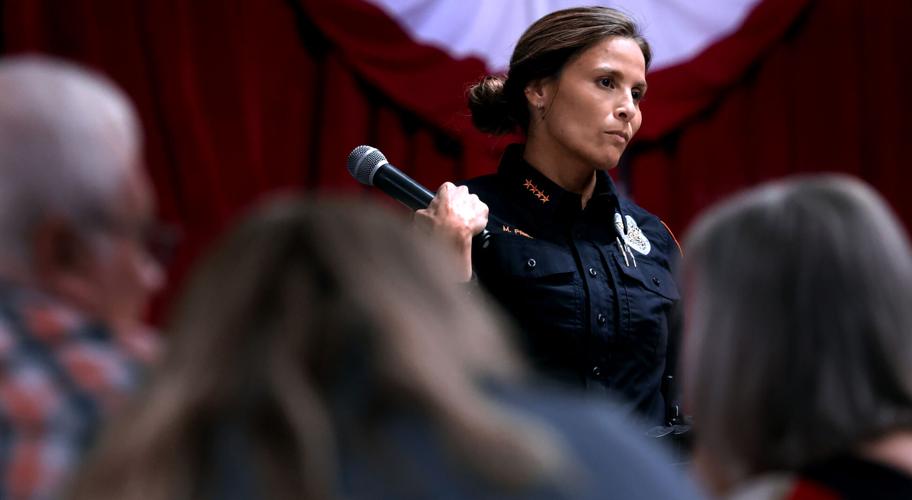
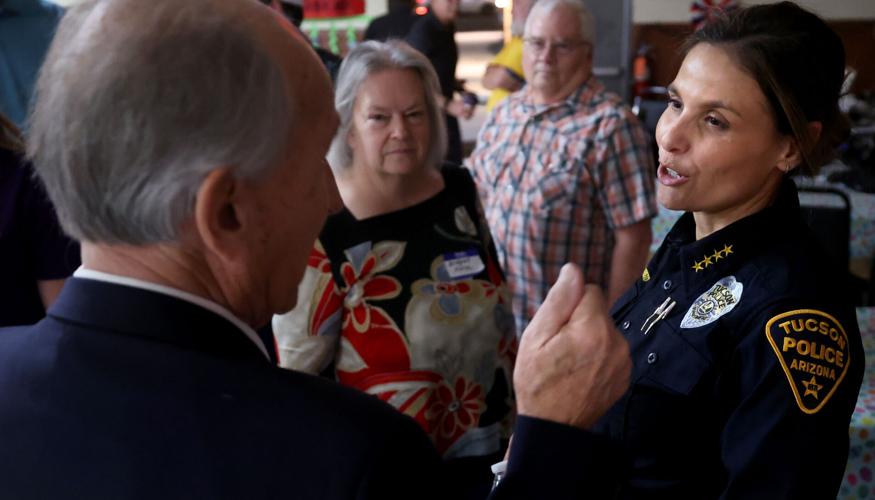
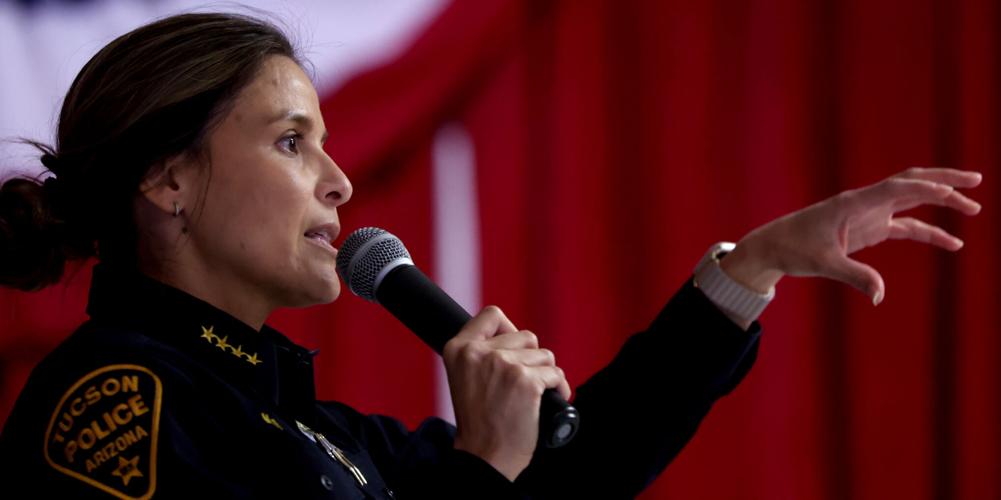
Tucson Police Chief Monica Prieto listens to a question from the audience at a meeting last week of Our America Foundation.
Her three-pillar plan for the department is to emphasize:
• Workforce development for employees
• Safe and strategic policing using data and technology
• Enhancing trust within the department and connection to the community
At a Thursday morning crime-reduction meeting Prieto oversaw in the department's Miracle Mile station, attended by about 30 high-ranking department members, attendees went around and around the table describing recent incidents, patterns and new approaches to persistent problems and ongoing offenders.
The idea of the monthly gatherings, Prieto said in an interview, is to find out, "Do we have any patterns and trends? What have those division commanders done in the past month to improve those stats? And what are they going to do in the next month, so that we can talk about a follow up with them the following month to see if that's working?"
"What's happening is that divisions are sharing information, and divisions are coming up with creative, innovative ways to really get their staff involved more."

Tucson Police Chief Monica Prieto talks with Nick Pierson, president of the Tucson chapter of Our America Foundation.
It's all backed up by a research and analysis operation within the police department that Prieto termed "super robust."
"Using data and analytics and predictive tools, we're being a lot smarter and more efficient with our resources," she said.
Prieto, a graduate of Desert View High School and the University of Arizona's Eller College of Management, answered questions about Tucson's public-safety problems and the department's efforts to solve them during a 45-minute interview. This is an edited transcript:
Q: What is your perception as a person who grew up in Tucson of how we're doing in terms of public safety?
A: Well, Tucson has its challenges, no doubt about it, right? We've all seen some of the incidents that occur. But if you look at us, we are a major city. And if you look across the nation, every major city is going to have their issues and their problems. We do have a decrease of Part 1 violent crime (murder, manslaughter, rape, robbery and aggravated assault) in the last five years by about 18%.
We are definitely a learning organization. So we reach out to other chiefs, other cities, other major cities, that have the same types of problems, and try to get their perspectives. Because no one has (all) the answers, right? No, no one knows exactly what to do. The great thing about us is we're totally open to feedback.
Q: Where is the department in terms of the number of sworn officers, and where would you like us to be?
A: We're at about 814 officers, sworn officers, but that includes the ones that are in training. That's probably 30ish.
Q: So you have in the upper 700s on duty?
A. Yeah, yeah. So in patrol, you have 325 patrol officers, yeah, and then you have 103 community service officers (not sworn officers).

Chief Monica Prieto shares details of her career at the Tucson Police Department.
Q: What numbers would you like to be at realistically?
A: I can tell you that in 2008, we had over 1,100 officers, and that is the highest number we've had. And I'd love to get to a place where we have that amount. Realistically, though, I just want to be above 900 next year, and I'm working towards that. Luckily, I have the support from city leadership, from the mayor, to hire 50 more officers, and that's because of the cops grant as well that we received. So yes, my goal is to be above 900.
Q: How about retention? I assume you're doing something to try to keep people here.
I mean, it's all about valuing our employees, giving them the right training. One of the pillars that, you know, I sent out to the department my first week or two weeks was my priority is workforce development and making sure that they get the right training, making sure that we can develop their careers.
And you know, it's essentially, if they feel valued, if they feel like they're getting the right training, then they want to stay, they want to be part of this team. That is the main goal is to retain people that way — really investing in them.
Q: What is your analysis of Tucson's traffic safety problem, and do you have any solution?
A: I think you saw a dip in enforcement, quite frankly, after COVID. And I think you can see that trend nationwide. I think we need to get back into more enforcement, and we're doing that. We have a dedicated traffic lieutenant now who's come up with a three-prong approach, and that includes making sure we are using our "problem-oriented precision policing" tactics.
So, when there are POPPs, they're basically just putting officers in those hot spots. It worked with violent crime. We want to do that for traffic areas now that we've identified using data, those problem corridors, those problem intersections. Then we auto-dispatch our officers now for 30-minute increments in those areas so that they can do nothing but traffic. That started March 1.
We're already seeing a 61% increase in written warnings and about an 18% increase in citations.
Q: The city and University of Arizona are conducting a study of unreported crime in Tucson. Do you suspect that there's such a degree of underreporting that the crime trends aren't even correct, that we don't know the real trends?
A: Yeah, it's possible. We definitely want to get the true story and information right, because I think, you know, with the fentanyl crisis, you do see the various impacts that there are on the community, and do you have stores that are just not recording thefts? Because they're just so used to it, and maybe they feel that we're not going to respond in a timely manner.
Q: There have been some serious crimes on buses or at stops. Do you know whether crime has increased in relation to free fares on the buses?
A: That is definitely an interesting question. We don't have data to correlate free bus fares to to crime, and, I don't know how we would go about doing that, but at this point, we can't correlate it to that. We don't have the actual data.
Q: What is your vision for the department, and what changes do you foresee as you implement your vision?.
A: So when I talked about the workforce development, my second pillar is the safe and strategic policing. And that's, like I mentioned, just continuing our strategies and data-driven, informed methods, and using those predictive tools, those analytics to really help us.
Technology has been a game-changer for policing as well. So my focus is, is wanting to to use responsible technology. It's got to be responsible, but that's in the space of, like, drones have been so game-changing for us. We have line-of-sight drones. We've had them since 2019, they've been valuable to us and locating, you know, using, using drones to be put in situations where I don't have to put an officer in harm's way.
We've just presented a pilot for drones as a first responder. We presented to our city leadership, and they are supportive of this, of an aerial emergency response drone, essentially. What does that do? They would launch from different areas in the city. So we'd spread them out in the city so when you get a 911, call and it's an emergency, we're able to deploy a drone from a rooftop, and it's controlled from our CSARC (Community Safety and Response Center) area.
We can launch those, into those areas, get eyes on and with a two-minute response. So that way, our officers can get information. We have someone monitoring the screen, sharing that information immediately to officers that are responding.
Contact columnist Tim Steller at tsteller@tucson.com or 520-807-7789. On Bluesky: @timsteller.bsky.social

Tim Steller
Columnist


 Political Notebook: Sen. Mark Kelly votes to block arms sale to Israel