


Astrophysicists make pretty good gamblers.
Steward Observatory Director Peter Strittmatter has never placed a bet at a casino, but he routinely makes high-stakes wagers on the outcome of huge astronomical projects.
Right now, for instance, he is betting that a $23 million, 8.4-meter mirror being polished at his observatory's mirror lab will one day join six other giants on a mountain peak in Chile to become the Giant Magellan Telescope.
The GMT is not the first multi-million-dollar risk Strittmatter has taken on behalf of the University of Arizona, but it could be the last.
Strittmatter, 72, is resigning his twin posts of observatory director and head of the UA astronomy department this month after 37 years. Under his leadership the research budgets of those institutions grew from less than $400,000 to a high of $80 million in 2009.
People are also reading…
Strittmatter's gambles on giant mirrors became "skin in the game" for astronomy at UA, said Chris Impey, deputy head of the department. It allowed the university to compete with the likes of Harvard and Caltech for students, faculty and projects.
"When he took over, it was a small department and an undistinguished observatory," said astronomer Laird Close. "Today, it is a powerhouse."
"The last remnant"
Former UA President John P. Schaefer said Strittmatter is "the last remnant" of his administration. He hired Strittmatter as Steward's acting director in 1975, during his push to transform the UA into a full-fledged research university.
The UA's entire research budget in 1971, when Schaefer took over, was $14 million. Today, it approaches $600 million. Steward Observatory led the way, with its 200-fold increase in research dollars.
Schaefer said he and Strittmatter shared a philosophy of leadership. "You just hire the best people you can and let them go. Peter is a very entrepreneurial scientist, and he recognized and upgraded opportunities as he found them."
Strittmatter inherited his first big project - the Multiple Mirror Telescope (MMT) being built atop Mount Hopkins in the Santa Rita Mountains south of Tucson. In addition to combining the light from six mirrors to a single focus, it pioneered design elements and technical improvements now used in most modern telescopes.
It handcuffed him to his job. When offered the directorship of Kitt Peak National Observatory in 1977, heturned it down, saying, "The MMT is at a critical stage, and it is important to the future of American astronomy. I feel it is my responsibility to see it through."
Segmented mirror technology was one way to overcome a perceived limit in the size of telescopes. Mirrors with diameters bigger than the 200-inch (5-meter) at Palomar Observatory were presumed too costly and impossible to fabricate. They would also require enormous structures to house them.
UA astronomers Roger Angel and Nick Woolf had another idea and, with Strittmatter's acquiescence and a little startup money, Angel began a series of increasingly costly experiments that led to the $10 million construction of the rotating furnace and stress-lap polishers of the Steward Observatory Mirror Lab beneath the bleachers of UA Stadium.
Its mirrors, up to 8.4 meters (27.6 feet) in diameter, are now used at observatories throughout the world. They are honeycombed to make them lighter and deeply ground and polished to reduce focal length, allowing smaller enclosures.
These revolutionary mirrors allowed the UA to play with the big boys in an optics "arms race."
"The bottom line is, we would not be able to participate in these big consortiums if it weren't for the mirrors, said UA Dean of Science Joaquin Ruiz. "We'd never be able to afford it. We would be a second-rate astronomy department for sure if it wasn't for the productivity created by Peter."
The Mt. Graham controversy
The mirrors also led Strittmatter and the university into its biggest controversy - a fight to build an observatory atop Mount Graham that would pit him and UA administrators against a coalition of Native American groups, environmentalists, students and some UA faculty members.
Early plans were to lure a National Science Foundation project for a 15-meter telescope. By 1985, the UA and the Smithsonian Astrophysical Observatory had teamed up with Ohio State University to propose six major telescopes and 12 smaller ones in the fir/spruce forest atop Southern Arizona's highest peak.
Environmentalists picketed the first meeting outlining the plan.
The controversy, which came to center on the endangered Mount Graham red squirrel, held up construction for a decade. Ohio State pulled out. Potential partners were scared off and the UA's remaining partner, Italy's Arcetri Observatory, was having second thoughts.
Strittmatter doesn't talk about the controversy these days, but he says his general philosophy is to keep on pushing. "In science, you think what you want to do, you try and identify the resources to do it and you steam ahead," he said in a recent interview. "Newton's laws imply that if you keep pushing in a certain direction, motion will occur in that direction."
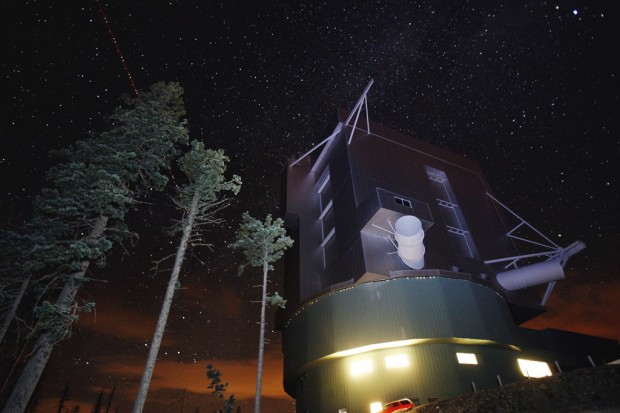
In 1992, former UA President Schaefer, then president of Research Corp., stepped in with a $7.5 million guarantee to save what was then called the Columbus Project. It would eventually combine two of Angel's big mirrors into the Large Binocular Telescope or LBT, which joined the smaller Vatican Advanced Technology Telescope and the Heinrich Hertz Submillimeter Telescope on Mount Graham.
lbt's adaptive optics
The LBT has yet to make a significant scientific discovery, though it has demonstrated the technical prowess of its adaptive optics system, which removes most of the blurring effects of the atmosphere. Scientific papers published in March included the clearest images yet taken of known exoplanets.
Last month, its team combined distortion-free light from both mirrors to create an interference pattern that makes those images even crisper. The LBT is about to live up to its billing as the world's largest and clearest telescope.
"It's amazing work," said Buell Jannuzi, former director of Kitt Peak and the man selected to take Strittmatter's place at UA. "If you had told me in graduate school that you could get a picture of four planets around a star from the ground, I would have laughed at you."
"The LBT has turned the corner, and it's fitting that it happens while Peter is still there," said Leslie Tolbert, UA vice president for research.
Strittmatter's reputation among his colleagues is at odds with the bulldog he became in the Mount Graham fight. They describe him as nurturing, inspirational and funny - a man who calls faculty gatherings by yodeling down the hallways.
A native of England
Strittmatter was born in England to Swiss parents. He said he practiced his yodeling skills in the bathroom of his family home in a London suburb until his sister told him the neighbors could hear him a block away.
His most important attribute, according to Close: "He has never, ever told a faculty member, 'Don't do that; that's too risky.'"
The telescopes and the mirror lab are just part of the Strittmatter legacy. Strittmatter led Steward into submillimeter (radio) and infrared astronomy. He hired an entire group of infrared scientists from the UA Lunar and Planetary Lab. They went on to build multimillion-dollar cameras for all of NASA's major space telescopes - Spitzer, Hubble and now the James Webb Space Telescope.
In addition to the Mirror Lab, Strittmatter created the Imaging Technology Lab, which builds the world's largest CCD cameras, the innovation that transformed astronomy, not to mention commercial and consumer photography.
During his tenure, public programs and education outreach expanded at the SkyCenter on Mount Lemmon, and the Catalina Sky Survey became the world's leader in detection of potentially dangerous near-Earth objects.
All of those things happened, said Strittmatter, because he surrounded himself with talented people.
"In a place like this, it is the creativity of individual faculty members that counts, and the director's task is to help facilitate whatever they happen to be involved with - with some direction."
Astronomy Department faculty bring in an average $1 million a year in grants and contracts, and the department says it receives five times its state income from outside sources.
Impey, deputy department head for the past 12 years, said the Strittmatter model works for the department's theorists as well as those on the nuts-bolts-and-lenses side. "We've also built up theory. Theory is really strong here."
Impey runs the academic side of things for Strittmatter. He calls the observatory side "the Leviathan." "We're like a $60 million-to $70 million-a-year, 400-person corporation, operating within a university environment."
"Hot, new stuff" in 1969
Strittmatter, who earned his doctorate at Cambridge University's St. John's College, didn't come to Arizona to run an observatory. He simply wanted to look through telescopes and the UA, in 1969, had built a 90-inch telescope on Kitt Peak that was the seventh-largest in the world.
"I was interested in the spectroscopy of quasars at that time." he said. "It was hot, new stuff."
Strittmatter's name began showing up in scientific papers and news headlines. In 1973, he observed a quasar whose light had traveled 10 billion years. "At the time, it was the most distant quasar known. That record lasted three or four weeks," he recalled recently.
Strittmatter is not leaving the UA. He is moving to the fifth floor of Steward, where he will continue to work with colleagues and the UA's growing list of international partners on projects he put into motion.
Asked if had advice for the new director, the gambler suggested a gamble: "Never stop a promising project because it's risky."
Contact reporter Tom Beal at tbeal@azstarnet.com or 573-4158


