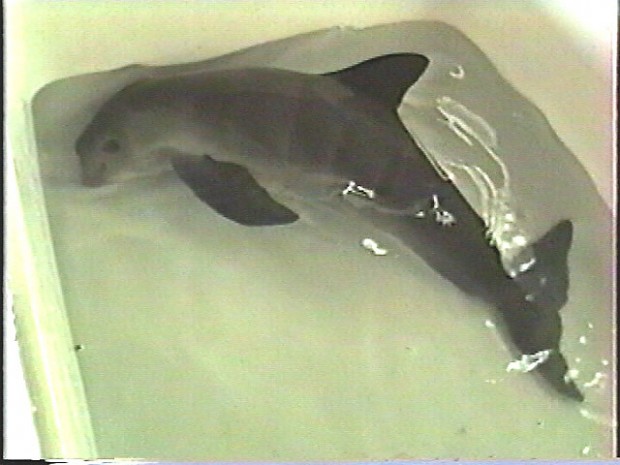
Just a few hours south of Tucson, in the shallow waters of the Gulf of California, swims the world's smallest - and most endangered -marine mammal species. A coalition of biologists and the Mexican government is taking unprecedented measures to save it.
The shy vaquita porpoise is endemic to the upper portion of the gulf, and only about 200 remain - down two-thirds from the count about a decade ago. Much of the area is a protected biosphere reserve, but biologists say the protections are insufficient.
The U.S. ban on wild Mexican shrimp also won't help them - vaquitas avoid the large shrimp trawlers that scour the sea floor because they don't like the engine noise.
But fishermen in skiffs, called pangas, can pose a serious threat to the vaquita, said Lorenzo Rojas, coordinator for marine mammal research and conservation at Mexico's National Institute of Ecology. These fishermen typically shrimp with gill nets, which are veritable death traps for the porpoise.
People are also reading…
"It's very easy to fish for shrimp with gill nets," Rojas said. Fishermen kill the outboard motor, toss the net overboard and wait.
"You can have a sandwich or burrito and a beer," he said. Vaquitas swim into the net, become entangled and drown.
Rojas estimates that since 2007, the Mexican government has spent $20 million to $25 million to save the vaquita in a three-pronged effort.
That year, the government implemented voluntary buyout and rent-out programs. The government pays fishermen to turn in their gear for a year or a larger sum to turn it in permanently, he said. Other programs offer to trade out gill nets for vaquita-safe prototypes. More than 1,500 pangas operated in the upper gulf in 2007, but the various programs have now cut that number by a third.
Second, fishermen are required to submit an environmental-impact plan when they apply for a permit to fish in the reserve, said Peggy Turk Boyer, executive director of Intercultural Center for the Study of Deserts and Oceans, known as CEDO. The plan outlines how the fishermen will mitigate their impact on the environment, she said.
The group also is working to help fishermen understand and comply with the reserve's evolving regulations. But not all fishermen take the time to get a proper license, and rules can be difficult to enforce. "There's legal fishermen, and there's illegal fishermen," she said.
Third, the fisheries and environment departments are working together to develop new kinds of nets - similar in design to the large trawling nets but small enough for a panga. Unlike gill nets, they are pulled through the water. And they are vaquita-safe.
This is the most promising avenue, but further tests are needed.
"We haven't had the results we'd like to have," Rojas said. "This is a continuous experiment. The best thing is to use those as an interim design and continue working on better designs."
Last fall, when fishermen tried the new net designs, the results weren't impressive. The shrimp didn't migrate north as early as they often do, and there was a bit of a learning curve with the new nets; using them is more labor-intensive than with gill nets, Turk Boyer said. For this reason, some fishermen resist using the new nets.
In 1993, Mexico established the Upper Gulf of California and Colorado River Delta Biosphere Reserve to protect the vaquita and other species. But vaquita populations continued to decline.
Mexico designated a no-fishing vaquita refuge in 2005 that encompasses about 80 percent of vaquita sighting locations. The other 20 percent falls within the biosphere reserve's borders, which offer fewer protections.
To reduce vaquita by-catch - those caught in nets unintentionally - the government has tried using different mesh sizes, "pingers" that emit an underwater sound to repel the vaquitas, and shrimp pots to avoid nets altogether. None proved viable, said Tim Ragen, executive director of the Maryland-based Marine Mammal Commission. The commission studies marine mammals and makes policy recommendations to other U.S. government agencies.
Ragen praised Mexico's "remarkable conviction" in its efforts to save the vaquita and criticized U.S. efforts as inadequate.
"The U.S. has provided support in many ways but has not stepped forward as much as it should," he said. "We are the primary shrimp market, which means we should bear some of the responsibility for how it is caught."
The shrimp industry is the most important industry in the upper gulf - even more so than tourism - and saving the vaquita means a wholesale conversion to vaquita-safe nets. But the clock is ticking.
Rojas emphasized that any successful effort would have to be entirely mandatory rather than voluntary, as many elements are now.
"To save the vaquita, we have to reach zero incidental mortality," he said. "I think we have two good years to be able to do it."
On StarNet: Go to azstarnet.com/news/ science/environment to read more articles about the environment and wildlife.
DID YOU KNOW
• The vaquita was discovered in 1958, when three skulls washed ashore.
• In 2006, biologists searching China's Yangtze River couldn't find a single baiji dolphin - then the most endangered marine mammal species - and the vaquita took the title.
• Commercial shrimp trawlers net 9 pounds of by-catch for every pound of shrimp.
Devlin Houser is a University of Arizona journalism student who is apprenticing at the Star. Contact him at 573-4142 or at starapprentice@azstarnet.com