

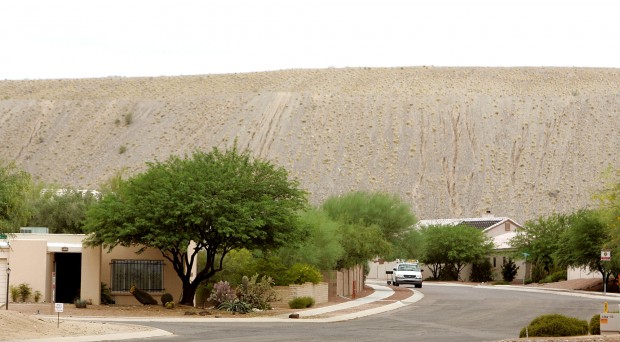
The tailings at Asarco's Mission Mine near Sahuarita and Green Valley contain no more heavy metals than the surrounding desert.
But the tailings contain many more small particles than found in natural dust - particles that can lodge in lungs, aggravate existing respiratory problems and could even force asthmatics to the emergency room, University of Arizona researchers say.
These findings are spelled out in early results of a $14 million, five-year study of the health effects of mine tailings being conducted by UA. The federally financed study, run by UA's Superfund Research Program, got started this year.
With 350,000 acres of mine tailings statewide, "mining has brought many benefits to Arizona and the Southwest in decades past, but we are learning more every year about the legacy of our mining history," said Jay Gandolfi, the UA Superfund program director.
People are also reading…
Mine tailings - the large piles of crushed rock left over in the old mines after copper, silver, gold or zinc were extracted - contain many other metals that may harm people in ways we don't fully understand yet, he said.
At the still-active Mission Mine, three dust storms last winter and spring caused tailings to blow into the air in concentrations exceeding standards set by the county's Department of Environmental Quality. The first two storms, in November and December 2009, sent huge clouds of dust into a homes and patios in a neighboring subdivision in Sahuarita.
Farther north, in a small town called Dewey-Humboldt outside Prescott, the UA researchers have found high concentrations of arsenic in tailings at a long-closed mine for copper, zinc, gold, lead and silver. The researchers are about to embark on a study of residents to determine if the tailings have harmed their health.
Tailings at the Iron King Mine, which operated from the late 1800s until the early 1960s, contain about 4 percent arsenic, Gandolfi said. That mine is part of a larger federal Superfund toxic waste-cleanup site. At the Mission Mine, the tailings contain only 0.1 percent to 0.5 percent arsenic, he said.
But an analysis of the fine particles found in dust at the Mission mine and from a neighboring patio just after the winter storms raises potential health concerns, UA officials say.
The analysis of the Mission Mine dust found:
• Twice as many of what's known as PM 10-sized particles in the tailings dust and patio dust as in natural desert soils. PM 10 particles are 0.0004 inches wide, or one-seventh the width of a human hair, the Environmental Protection Agency says.
• One and one-half times as many of the still-smaller, PM 2.5-sized particles in the tailings and patio dust as in the natural desert. The largest particles in this category are one-thirtieth of a human hair's width, says the New York State Department of Health.
Smaller particles, which can penetrate more deeply into the lungs, can cause more health problems than larger particles, said Clark Lantz, a professor of cell biology and anatomy and deputy director of UA's Southwest Environmental Health Science Center.
Depending on the dust levels that people living near the tailings breathed during the storms, the dust can provoke or aggravate symptoms of asthma and bronchitis, including coughing and wheezing, he said.
It also can cause irregular heartbeats, changes in heart rate and shortness of breath, he said. While all people can potentially be affected by high dust levels, children, the elderly and people with existing health problems will be most affected, he said.
At high enough levels, symptoms could be bad enough that people would want to visit a doctor or even go to an emergency room, he said. Whether these dust storms were bad enough to send residents to doctors or hospitals would depend on how much tailings dust gets into the air, he said.
Rosemary Simo of Sahuarita said she firmly believes that the winter dust storms hurt her health, since she suffered coughing, wheezing, breathing problems and burning chest pains in the storms' immediate wake. The problems have subsided since then, said Simo, who lives in Rancho Sahuarita, east of Interstate 19, and across the freeway from the tailings.
"I've had these health problems for at least three years, I believe. I've lived here seven years and in Arizona 30 years, but I never had any problems until I moved here," Simo said.
The mining company shares the concerns about fine particles, particularly the smallest ones, said Tom Aldrich, Asarco's vice president of environmental affairs.
"At all of our facilities, we are striving to control the dust. I think we are doing a very good job of it, quite frankly," Aldrich said.
"When you look over time at the Mission Mine, our figures show we have been 99 percent effective in controlling the dust and that we've had problems only during high winds."
But as a result of last year's dust storms, Pima County has accused Asarco of air quality violations, which the mining company has denied committing. The two sides are negotiating over a settlement that the company would pay as an alternative to going to court over the issue.
Contact reporter Tony Davis at tdavis@azstarnet.com or 846-7746.


