

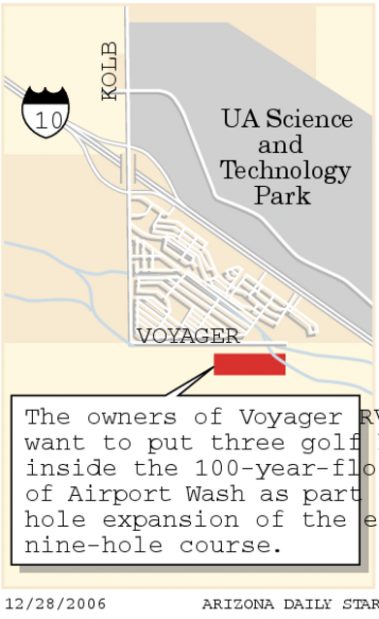
Developer Ike Isaacson's quest to expand his Voyager RV Park Golf Course has run smack into a neighboring wash.
Isaacson sees his expansion from nine to 18 holes as a way to increase his RV park's amenities. It has a silversmithing room; a library; tennis, volleyball, shuffleboard and boccie ball courts; two dog runs; a pool room; a swimming pool; an exercise room; and a wellness screening room.
Right now, the small course operates at capacity during the winter, when as many as 4,000 people live or recreate on the 254-acre park that includes detached and manufactured homes and recreational vehicles, Isaacson said.
But the project has run into some resistance at City Hall because it would put three greens, a cart path and six tee boxes in the flood plain of the north fork of the Airport Wash. That's a broad, virtually level wash that falls under the city's Environmental Resource Zone law, which tries to preserve sensitive wash habitat.
People are also reading…
On Dec. 12, the city's Stormwater Advisory Committee voted 8-3 to recommend denial of the plans, warning that it would set a precedent. Currently, washes cut through many Tucson-area golf courses but far fewer have built fairways or greens inside a wash, numerous course owners said.
City and county officials said they know of few, if any, courses approved in washes since the governments started protecting riverfront riparian areas in the early 1990s.
The city's Development Services Department is now reviewing this proposal and will make a decision in January.
Decisions can be appealed by either side to the City Council.
The golf-course expansion is part of a broader, 64-acre project that includes 185 homes on the Voyager property at 8701 S. Kolb Road, south of Interstate 10.
The City Council had approved the zoning for this project in 2003 — before the laws tightened to require another layer of environmental review.
"If people look at the overall picture, the use of resources, they'd all agree that expanding the golf course is the best use," Isaacson said this week as he drove and walked past homes, recreational vehicles and athletic facilities on his property.
He said he's not concerned that the golf holes could be damaged by flooding because the existing course already is a detention basin that has flooded in the past. Since the course opened in the mid-1980s, it has never been closed for more than two days by flooding, he said.
If the city won't let him put the greens in the wash, he will build homes along the wash and scrap the golf-course expansion, Isaacson said. People wanting to play 18 holes will have to burn gasoline to get to another course, he said.
"Think of all the resources and all the traffic on the highway that takes," he said.
The advisory committee concluded that putting golf holes into the wash wasn't in keeping with the city's goal of trying to preserve riverfront habitat, said Linda Morales, the committee chair. She said the stretch of wash affected is small, but that the committee was concerned about a precedent.
"We allow one new golf course in a wash, what happens when the next one comes along?" Morales said.
That is a legitimate issue, said Bill Zimmerman, an advisory committee member, but he voted against the recommendation for denial because he thought the developer deserved more opportunity to address the committee's concerns.
The wash cuts southeast to northwest, stops at the existing course and continues north of the course. The area in question is dotted with mesquite, acacia and hackberry trees. Prickly pear, cholla and barrel cacti alternate with creosote bushes.
Tall yellow grasses crowd the trees and cacti. University of Arizona Natural Resources professor William Shaw's 1986 map of Pima County's sensitive riverfront areas classifies the area as Class II habitat, providing living space for native birds and mammals although it isn't linked with protected areas.
Fifty-three, mostly acacia, out of 288 native plants on 2.6 acres of wash would be cleared. The developer said he will plant two young specimens for every one cleared.
In an e-mail to co-workers last August, Development Services Administrator Glenn Moyer wrote that while the developer says the wash's vegetation isn't of high quality, the proposed development may not be allowed as planned because of the Environmental Resource Zone rules.
But what Isaacson would do to the wash is nothing compared with what area subdividers and home builders do to the surrounding desert, Voyager resident Dick Wood said as he stood in his living room next to the ninth fairway. Wood, whose wife works for Voyager's activities department, recalls spending $5,000 to $10,000 extra to buy near the course.
"They just brought in bulldozers and took everything away," said Wood, an avid golfer who moved to Voyager in 1994 from environmentally strict Vermont.
John Sears, an Albuquerque resident who is staying at Voyager for a month, said he has played the layout a few times and finds it "an enjoyable little course." But he saw no reason golfers wanting an 18-hole round couldn't just play the nine holes twice.
"I"m reluctant to see the expansion taking over more and more of our natural habitat," Sears said. "You have to have places to live, but some of the other stuff, if you don't have to do it, I'd just as soon not."
But nine-year Voyager resident John Ross said he believes this golf course expansion would be good for the park, although he isn't a golfer. "I'm for any improvement that can be made to the park," he said.
The Sonoran Institute, while supporting preservation in general of significant washes, declined to take a stand on this proposal. But the Coalition for Sonoran Desert Protection's Carolyn Campbell said she doesn't think it should be approved.
"A lot of people in this community, including large developers themselves, have come to the conclusion that we already have enough golf courses in the desert," she said.


