

Tucson Water "cop" Tony Almodova pointed to strips of cactus, yucca and rock in front of the Williams Centre office complex on East Broadway, where lawns and flowers dominated the landscape three years ago.
"This is my poster child," Almodova said recently, as he wheeled his pickup between the complex's twin tower buildings.
After he took the Williams Centre complex to court for repeatedly letting its water run illegally onto the street, he recalled, the owners spent about $150,000 to stop it from happening again.
Now, Almodova and other Tucson Water officials say they've prodded not just the Williams Centre but many other businesses into doing a much better job of obeying the city's long-established but often-ignored law against water waste.
The utility has used the stick of fines or the threat of fines, combined with the bully pulpit of educational brochures and classes, the officials say.
People are also reading…
Complaints poured in
Five years ago, complaints of violations poured in at 10 to 20 per week. Back then, Tucson Water officials had ordered water cops to play the role of educators and to not cite or fine violators. But officials acknowledged that repeat violations were occurring regularly.
Adding to the problems, in the summer of 2006, the city's only water cop at the time was transferred to another Tucson Water job, leaving the position vacant for the summer during a major drought.
Starting the following spring, when Almodova was hired, the city began to cite and prosecute chronic offenders. Almodova and other water officials say today that policy has led to a sharp drop in complaints and citations - and in water waste.
"When I first started, you'd see water running down the street, every street," Almodova recalled one day a couple of weeks ago as he drove Broadway through midtown Tucson. "I would tell a business that, and they would say: 'It's my water. I pay for it. I can do whatever I want.'
"Now the word has come out, 'Here comes the water cop - we'd better correct things,' " he said. "People are more cooperative. They know that if they're not, they get a citation."
But he also said, " 'We can work with you. We are not just here to enforce or beat you over the head.' "
Violators aren't usually taken to court until at least the third offense, after getting a verbal and then a written warning. If found guilty, they go on probation for a year. During that year, if they're found guilty once more, fines double or triple, Almodova said.
Fines for first offenders are $250, reaching $500 and $1,000 for second and third offenders.
Fewer wasting water
The drought and the bad economy have also helped push people into wasting less water, Almodova said.
At age 54, he's a 20-year Tucson Water veteran. His formal title is water conservation inspector.
As he drove this day, he pointed south to Chili's at 5150 E. Broadway, where every strip of landscaping is filled with reddish rock, mesquite, palo verde and beds of low-water, bright-yellow lantana flowers. "They had a big lawn area" that was removed two years back at his prodding after water running down the street led to a fine, he said. Chili's officials confirmed they had made those landscaping changes.
At the Williams Centre, 5210 E. Williams Circle, huge beds of grass still slope downward from the office buildings. But strips of rock have been laid between lawns and streets, so irrigation water doesn't reach the street.
Back in 2007, "every single day" water would run off this property into storm drains, which took the water across the street into a neighborhood, Almodova recalled. There, it went into a wash near homes, drawing mosquitoes that likely contributed to two cases of West Nile virus, he said.
Almodova said the city's files showed the company was fined $1,500, and while the company recalled that the fine was waived in return for installing improvements, city officials said they had no record of that.
"We removed about two-thirds of the grass, and we upgraded our irrigation system using a very efficient head," recalled Martin Stupka, facilities director for the Colton Co., one of the building's owners. "We put in 125 tons of gravel.
"We were told that if things weren't resolved, the property owner could be responsible and face criminal charges. We have a good name in town, and we wanted to keep our name clean, and we did want to save the water, of course ... and we cut our water bill almost in half."
One possible violation
Down the street at the Plaza at Williams Center, a retail complex at 5420 E. Broadway, Almodova stuck a tape measure into a small pond in the gutter that appeared to come from the property's lawn. It measured more than a quarter-inch deep - the threshold for a violation, he said. A week earlier, Almodova had seen water run from the property into the street and told the owners to fix the problem, he said.
Now, he's not going to cite them, but if he sees water running down the street a third time, he will, two years after the owners paid a fine, he said. George Rodieck, owner of the landscaping company, Cherry Landscape, said the building's management - which invested $8,000 in irrigation upgrades two years ago - found this time that a sprinkler system valve was stuck in an "on" position, and it was replaced.
Driving to El Charro, 6310 E. Broadway, Almodova came across a stream of water dribbling from an ice machine at the restaurant's rear. Water was ponding on the El Charro lot and leaving the property, which would amount to two separate violations, he said. Since he's seen no problems there for a year, after lots of problems before, he said, he'll tell them this will be the last warning before a citation.
Ray Flores Sr., El Charro's owner, said the area of the restaurant where the water came from was incorrectly plumbed. The restaurant - which Flores pointed out serves water only to customers who request it - probably will eventually redo the pump system to fix the problem permanently, but for now it has rerouted water away from the street.
City violates, too
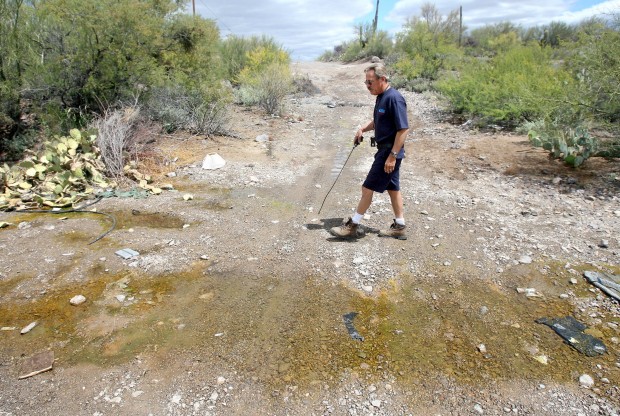
Later that morning, Almodova, responding to a complaint, visited a southwest-side wash near the Tucson Mountains where water from a 12-inch, underground city water main was leaking into the desert.
The water, near West 36th Street and Westover Avenue, was causing problems for cars, and a garbage truck almost got stuck there, Almodova said. The wash was saturated, full of algae, and the main had been leaking for probably a month, he said.
Because it's a city water leak, no citations are possible, but Almodova phoned in a work order to have the main fixed. Another work order had been issued for that site earlier, so it should be done soon, said Tucson Water spokesman Fernando Molina, adding, "It depends on our workload."
Contact reporter Tony Davis at tdavis@azstarnet.com or 806-7746.


