

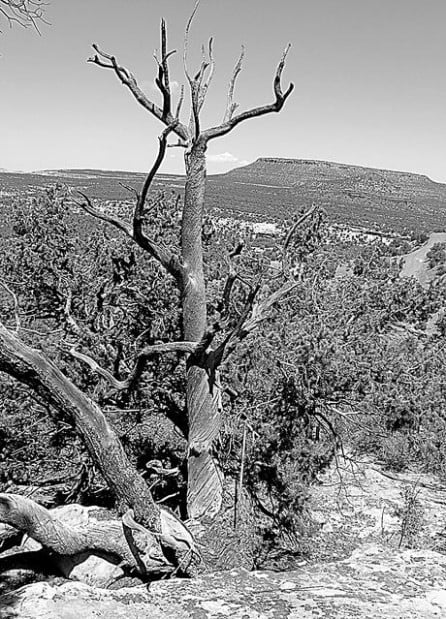
A new UA study uses tree-ring data to reconstruct Colorado River flows over the past 500 years. The study could have a significant impact on water use in the West and further emphasizes the need for flexibility in managing the resources, according to scientists and policy experts who study the Colorado River basin.
The study found several periods of more severe and longer-lasting drought than the region has experienced in the past century. The findings provide further indications that the data used for the 1922 Colorado River Compact overestimated the Colorado's average water flow, with water allocations to the seven Western states that share the river based on one of the wettest periods in the past 500 years.
"The long-term perspective provided by tree-ring reconstructions points to a looming conflict between water demand and supply in the upper Colorado River basin," the study said.
People are also reading…
Updating the University of Arizona's groundbreaking 1976 study of tree rings in the Colorado basin, the new work reconstructed the river flows back four centuries before the gauge record and found eight periods of drought of equal or greater severity to the most recent drought, roughly from 1999 to 2004, said Dave Meko, one of the study's authors.
"The other issue on the droughts is the tree-ring records show periods of dry conditions that lasted longer than the observed record," said Meko, an associate research professor of dendrochronology.
The 1922 Colorado River Compact between Arizona, California, Colorado, Nevada, New Mexico, Wyoming and Utah determined how much of the Colorado River water each state would get, dividing them between upper- and lower-basin states. The Boulder Canyon Project Act of 1928 ratified the compact and apportioned the lower basin's 7.5 million acre-foot annual share of the water. Arizona's share is 2.8 million acre feet, enough to meet the needs of 5.6 million four-person families for a year.
"For a long time, many of the states in the basin have assumed that just the historical gauge record is adequate for modeling purposes," said Brad Udall, managing director of the Western Water Assessment, which partially funded the study. "It's not adequate. We need to consider hydrological stresses on the system commonly like what we have just seen and expect those things are quite frequent."
The study, a collaboration between the University of Arizona's Laboratory of Tree-Ring Research, the National Oceanic and Atmospheric Administration, the U.S. Geological Survey and the University of Colorado, is published in this month's issue of Water Resources Research.
While the new reconstructions estimate the average water flow at 14.6 million acre-feet, compared to the 1976 study's estimate of 13.5 million acre-feet, the longer historical average remains below the 15.2 million acre-feet recorded by stream gauges from 1906 to 1995.
The researchers compared tree-ring widths from 1906 to 1995 with the stream flows recorded by gauges along the river as a way to calibrate the tree rings, then applied the statistical comparison to the tree rings dating back to the late 1400s.
The core samples used in the study were taken from about 1,200 trees in 60 areas throughout the Colorado River basin. The update of the 1976 study gives more precise results, filling in gaps to provide a more accurate picture overall of the Colorado region, Meko said.
The new work had 40 more years of tree-ring data to build a more accurate statistical model from comparisons to the gauge records, plus expanded tree-ring site coverage of the basin for a more reliable sample.
The study zeroed in on a drought period of about 20 years in the late 1500s, a much longer drought cycle than contained in the gauge records of last century.
"There were much bigger swings in the reconstructed flows at some periods of the record than at others," Meko said. "We don't know if we're going to move into a really long-lasting dry period or if it may go back to more rapid switching back and forth between wet and dry periods."
The researchers are trying to reconstruct the water flows even further back into the past by expanding the tree-ring data to include core samples from dead trees, preserved pieces of trunks and standing snags known as remnant wood, Meko said.
The reconstruction has reached the limit of living trees, but using the evidence from remnant wood, researchers can see growth patterns about 200 years further into the past. The wood, however, is more difficult to find and will yield a spottier record.
"I think this paleo record is a good point to start to talk about stresses on the river greater than we've seen in the past," said Udall of the Western Water Assessment, a joint climate assessment venture between the University of Colorado and the National Oceanic and Atmospheric Administration.
"To date our reservoirs have been big enough to allow us to deal with these periods of time when we haven't had enough," he said. "There will come a time in the future that will not be true."
The West has to be prepared to modify its water use, shorting some things to allow more valuable uses to continue at times of drought, Udall said.
"There's a lot you can do actually," Udall said. "The true gauge of our future success in water management is how flexibly we design our water institutions."
Fernando Molina, conservation program manager for Tucson Water, said he hadn't seen the study but that long-range planning is crucial to the agency.
Tucson Water uses about half its allocation from the Central Arizona Project, a 336-mile long system that brings Colorado River water to Pima, Maricopa and Pinal counties.
"On the user end, if we start look at shortages on the Colorado, if there's any cutbacks on there, we need to be prepared to deal with that," he said.
Tucson Water stresses conservation programming, Molina said, as well as looking into long-range supply alternatives including using groundwater from other areas, negotiating deals for a greater share of Colorado water and potentially using effluent as a potable supply.


