

FLORIDA PANTHER NATIONAL WILDLIFE REFUGE, Fla. — Schoolteacher Theresa Ryan sensed an eerie presence behind her as she sat at a picnic table at her boyfriend's rural home. Then she heard the breathing.
"I turned around and there was a panther 15 feet away. We were face to face," she said. "It had no place to go except at me or by me."
She flailed her arms and screamed to scare the cat. "It just sauntered away. No hurry. It was never afraid," she said.
For decades, such encounters with Florida panthers were extraordinarily rare, like the endangered animals themselves. But in recent years, panthers have rebounded from the brink of extinction to about 100 on the southwestern edge of the Everglades, prompting officials to warn residents to be aware of the cats and to keep their children close at dusk and dawn.
People are also reading…
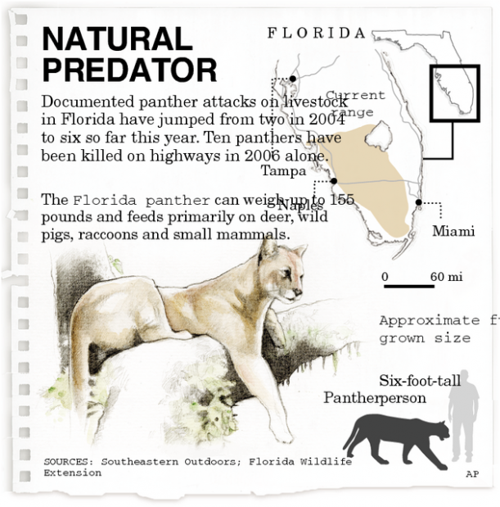
The big cats have killed emus from a zoo, and goats and dogs from rural backyards. Documented panther attacks on livestock jumped from two in 2004 to six so far this year, and 10 panthers have been killed on highways this year alone.
There has never been a documented attack on a human in Florida.
But biologists fear the increased panther encounters may be short-lived as the cats' remaining habitat — 2.5 million acres in the Florida Panther National Wildlife Refuge, Big Cypress National Preserve, Everglades National Park and a few strands of wild state land — becomes surrounded by development.
"The way we're building, we're going to push the panthers out," said biologist Larry Richardson of the U.S. Fish and Wildlife Service. "If we build out even half the potential of what the state says we can, forget about the panthers."
Florida panthers, which can weigh up to 155 pounds, are one of several subspecies of cougar in the United States and the last type still roaming east of the Mississippi. Thousands once ranged through the Southeast.
By the 1950s, the panther had been hunted to near-extinction, leading to their protection, beginning in the 1970s, under the federal Endangered Species Act.


