

Here is one stark sign of the prolonged drought in Southern Arizona: Even some cacti and desert trees are withering from lack of moisture.
Native plants are "definitely seeing the effects of the minimal amount of rain we've had this year" - a scant 0.68 of an inch, said George Montgomery, curator of botany at the Arizona-Sonora Desert Museum.
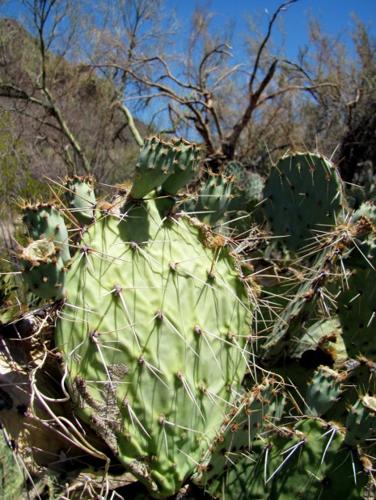
"Englemann's prickly pear are definitely drought stressed," Montgomery said. "We're seeing wrinkled pads. As the pads lose water, they can start to droop over and therefore get sunburned. If they sunburn, then the pad isn't photosynthetic because the cells are killed."
Eventually, prickly pears can lose their pads, "and whole trunks can break off and die," Montgomery said. In some cases, that can lead to the death of the plant.
Other species of desert plants also are showing effects of the drought. Among them:
People are also reading…
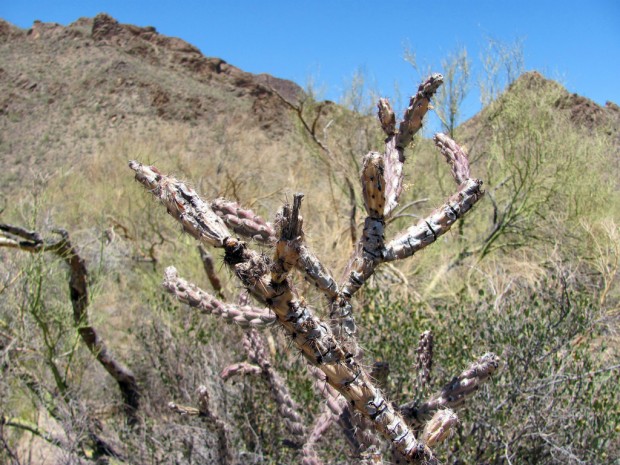
• Cholla cacti
"Chollas look dehydrated," Montgomery said. "I'm not seeing branches dying yet, but they're definitely not plump" with moisture.
He said some cholla species, such as pencil cholla and Christmas cholla, are showing drought damage.
"They are smaller and have less water storage," Montgomery said. "I'm seeing individual segments die on them - but not necessarily the death of the plant."
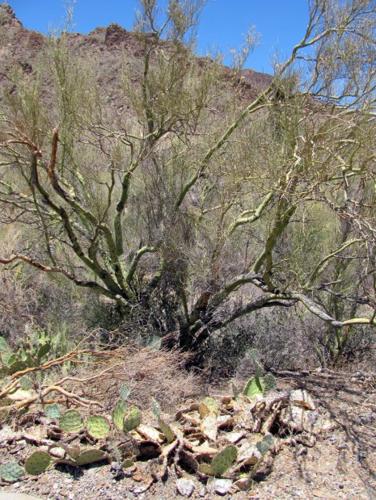
• Palo verde trees
"I am seeing twig death happening on palo verdes," Montgomery said, noting that drought and natural aging can be factors in twig death.
"We know that in drought, palo verdes will lose their leaves," he said. "In (prolonged) drought, twigs will die, and in extreme drought whole branches will die."
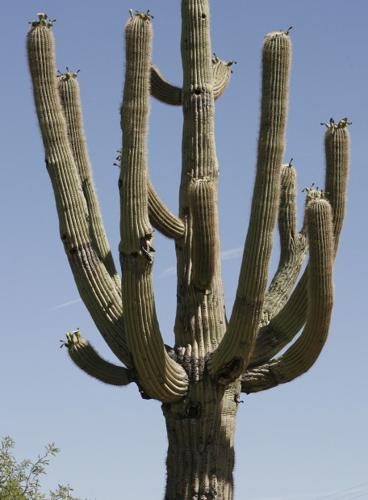
• Saguaros
Flowering of saguaros began earlier than normal this year, Montgomery said.
"They seem to have finished flowering and are fruiting," he said. "It seems as if there was a shift forward this year. It could be related to drought or last year's freeze."
SURVIVAL STRATEGIES
Plants native to the Sonoran Desert are hardly strangers to drought - and they've come up with a botanical version of strategies for survival.
"These plants are going through a cycle - these very dry conditions - that their populations have probably gone through innumerable times," Montgomery said. "Through their evolutionary adaptations, they are able to endure."
Among the adaptations:
• Many cacti, including saguaros, have a smooth, almost waxy surface that helps them retain moisture.
• Plants such as jojoba have leaves of a color that reflects rather than absorbs light.
• Palo verde trees, chollas and other desert-dwelling species have adapted in a way that allows them to lose twigs, branches or arms while remaining alive.
The bottom line, Montgomery said, is that severe drought could damage or kill many plants without wiping out a species.
"We are seeing individual plants and parts of individual plants die - but we're not seeing whole populations die as a result of the drought," he said.
WHETHER TO WATER
Many of us wonder whether we should water native desert plants growing in our yards in times of extreme drought.
"It's OK to water native plants, but don't do it every week," said Jean Lewis, a Pima County master gardener with Arizona Cooperative Extension.
Lewis said it's not harmful - and might well be beneficial - to give plants such as palo verde trees, prickly pear cacti and saguaro cacti a long soaking drink in a dry spell such as the one we're in now.
"But it's really important that they dry out between waterings," she said. "June is usually a bone-dry month. It's a great month to water those native desert plants and then let them go until we get monsoon rains."
Overwatering of native plants, Lewis said, could cause roots to rot. Rotted roots could make large plants such as saguaros vulnerable to falling over in a severe storm.
On StarNet: Read more environment-related articles at azstarnet.com/news/science/environment
saguaro cactus
The Sonoran Desert's iconic plant began flowering earlier than normal this year.
palo verde tree
In dry conditions, the plant tends to drop its leaves, but in a prolonged drought, twigs and branches can die.
cholla cactus
Cholla, especially the smaller species, are showing damage as they have less water storage capacity.
Englemann's prickly pear
When prickly pear wrinkles and starts to droop, it becomes vulnerable to sunburn.
Contact reporter Doug Kreutz at dkreutz@azstarnet.com or at 573-4192.


