

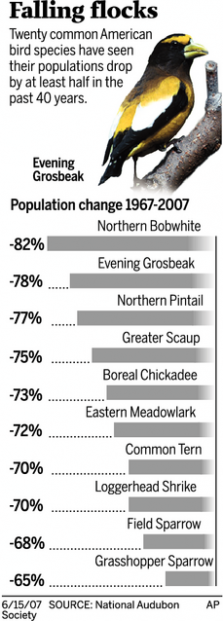
WASHINGTON — The populations of 20 common American birds — from the fence-sitting meadowlark to the whippoorwill with its haunting call — are half what they were 40 years ago, according to an analysis released Thursday.
Suburban sprawl, climate change and other invasive species are largely to blame, said the study's author, Greg Butcher of the National Audubon Society.
"Most of these we don't expect will go extinct," he said. "We think they reflect other things that are happening in the environment that we should be worried about."
Last month a different group of researchers reported that seven species had dramatically declined because of West Nile virus. The species harmed by West Nile are different from those listed in the new study — except for the little chickadee, hard-hit on both lists.
Many of the species listed as declining in the new study depend on open, grassy habitats that are disappearing, said Butcher, Audubon's bird conservation director.
People are also reading…
Some of the birds, such as the evening grosbeak, used to be so plentiful that people would complain about how they crowded bird-feeders and finished off 50-pound sacks of sunflower seeds in just a couple days. But the colorful and gregarious grosbeak's numbers have plummeted 78 percent in the past 40 years.
For the study, researchers looked at bird populations of more than half a million that covered a wide range. They compared databases for 550 species from two different bird surveys — the Audubon's own Christmas bird count and the U.S. Geological Survey's breeding-bird survey in June. The numbers of 20 different birds were at least half what they were in 1967.
Today there are 432 million fewer of these bird species, including northern pintail, greater scaup, boreal chickadee, common tern, loggerhead shrike, field sparrow, grasshopper sparrow, snow bunting, black-throated sparrow, lark sparrow, common grackle, American bittern, horned lark, little blue heron and ruffed grouse.


