

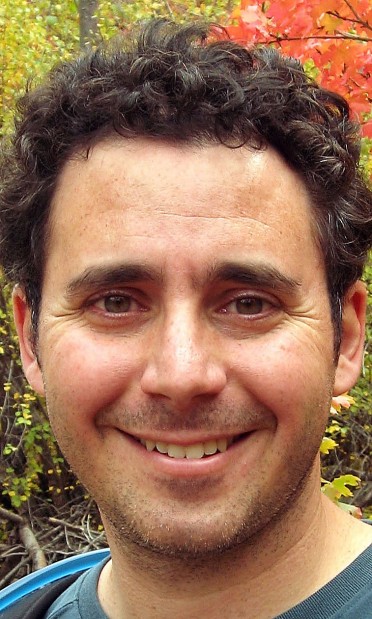
Mitch Tobin spent five years climbing mountains, looking at birds, walking the desert, hiking the Grand Canyon and - once in awhile - sitting behind a computer as an environmental reporter for the Arizona Daily Star.
He left the paper in 2006 for San Francisco. But the fruits of much of his labor here are in a new book, "Endangered: Biodiversity on the Brink" (Fulcrum Press), about the plight and future of endangered species in the Southwest.
In the words of the dust jacket, Tobin, who just turned 40, used the Southwest, "America's hottest, driest, fastest-growing region, as a snapshot of the complex and myriad issues confronting imperiled species." The book tells stories about the Mexican gray wolf, the Sonoran pronghorn, the California condor, the Chiricahua leopard frog and the lesser long-nosed bat, among others.
These days, Tobin works as a consultant for California Environmental Associates in San Francisco. Working from Denver, he helps foundations that finance nonprofit environmental programs evaluate the effectiveness of their grants. He also works regularly with a California Environmental Associates client called Climate Works, which supports policies to cut greenhouse gas emissions.
People are also reading…
But while he is clearly an environmental advocate, his book casts a sometimes skeptical eye at environmentalists and he can be sympathetic with ranchers and other interest groups with whom environmentalists often lock horns.
The Star talked with Tobin when he was in Tucson last week promoting his book.
Q. What made you decide to write this book?
A. In 2004 I did a yearlong series for the Star on endangered species. It planted the seed of doing something bigger and writing a book on the Endangered Species Act.
The idea was that the Southwest was a really good place to examine these issues of biodiversity, conservation and the Endangered Species Act because we have a lot of endangered species, and we've been ground zero for conflicts over the Act. Most of the book is based on my time working as a journalist in Arizona.
Q. Why focus on the Endangered Species Act?
A. It didn't take long on the environmental beat to realize that it was the biggest hammer in the environmental toolbox. It is a law that has real teeth and real power.
Q. One of the biggest players in endangered species issues nationally is Tucson's Center for Biological Diversity, which you wrote about quite a bit in the book. Give me your take on them.
A. I think they do a lot of good work. They hold the government's feet to the fire and force them to obey the law. The reason they've won so many court cases is that time and time again, the federal government has not lived up to its obligations under the Endangered Species Act. Their work has led to the listing of about one quarter of the species now listed.
But do I agree with all of the center's positions? No. I don't agree with them on the use of the Endangered Species Act to regulate greenhouse gases, for instance. I agree the polar bear (which the center got listed as threatened) should be listed. I agree that global warming is a huge threat to the species. But I don't agree that the Endangered Species Act is a way to regulate the energy economy.
(The Center's view is that because Congress and other agencies haven't regulated greenhouse gases, their only option is to sue to get them regulated under the Endangered Species Act.)
Q. Give me some impressions of ranchers.
A. Ranchers are not a monolith. A study that I discussed in the book analyzed all the federal grazing permittees nationally. It showed that there are a lot of different types of ranchers. Some people treat it as a hobby or tax write-off. For some, it is their primary source of income.
There are some ranchers who are concerned about endangered species and try to manage livestock to take care of them. I write about the leopard frog, in which ranchers are essential to its conservation because there are so many in rancher stock ponds.
Having said that, there are a lot of ranchers who are outright hostile to endangered species. You see that particularly for the Mexican gray wolf. The ranchers feel like this program was thrust upon them and a lot of them will never, ever support the idea of bringing back wolves in the Southwest.
I am somewhat sympathetic to them in that it has made their lives more difficult in a business already challenging. But something that always seems to get lost in the debate is that the wolf's recovery area is almost entirely public land. It would be a lot different if those ranchers were already grazing their cattle on private land. That federal land belongs to all of us.
Q. Name one thing you want readers to take away from this book.
A. Unless we get serious about tackling greenhouse gas emissions and avoiding the worst effects of climate change, even the Endangered Species Act, our most powerful environmental law, will be helpless to prevent some species from going extinct.
Another main message is that too often, people only talk about the costs of protecting endangered species and the negative economic impacts. But that neglects that protecting biodiversity and preventing extinctions generates a lot of benefits . . . because we rely on plants and animals for our survival.
Contact reporter Tony Davis at tdavis@azstarnet.com or 806-7746.


