

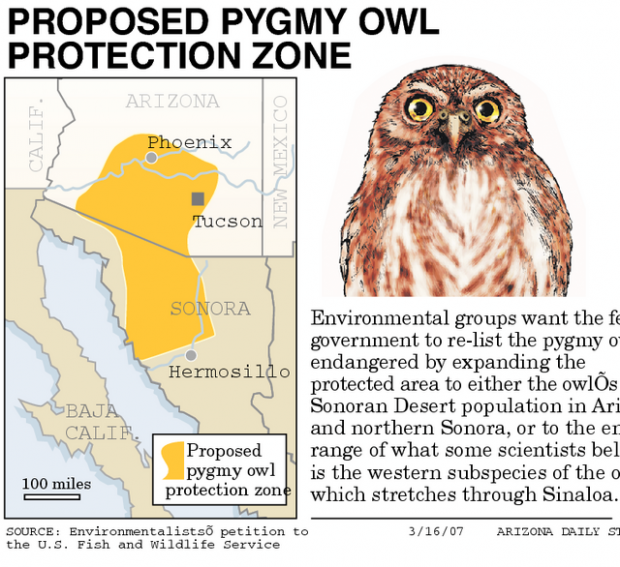
After a federal judge upheld removal of the pygmy owl from the endangered species list, environmentalists are now asking the U.S. government to classify the bird as endangered in both Arizona and northern Mexico.
Two groups, Defenders of Wildlife and the Center for Biological Diversity, filed their petition Thursday with the U.S. Fish and Wildlife Service.
Although legally the United States cannot protect species living in another country from harm there, it can stop importation of endangered species from other countries.
There's precedent for this. Some other federally protected species live in two countries, including the jaguar in the United States and Mexico, and the woodland caribou and Northern spotted owl in the United States and Canada.
The environmental groups are trying to get around a common argument made by critics that it made no sense to protect cactus ferruginous pygmy owls living in Southern Arizona when the species is far more abundant in Mexico.
People are also reading…
The environmentalists say the bird deserves binational protection because a study by two University of Arizona researchers showed its numbers are dropping in northern Sonora.
"The pygmy owl is threatened both in Sonora and Arizona and protection should never have been removed," said Noel Greenwald, a conservation biologist with the Center for Biological Diversity.
With lots of desert in Mexico being converted to non-native grasses for livestock, "It's a pretty grim picture for the pygmy owl," Greenwald said.
Fish and Wildlife, which took the bird off the endangered species list, and an attorney for the Southern Arizona Home Builders Association, which sued to remove it from the list, said they can't comment on the petition until they've had time to read it. The wildlife service legally has 90 days to respond to the petition.
Last week, U.S. District Judge Susan Bolton of Phoenix dismissed a lawsuit challenging the wildlife service's April 2006 decision to delist the pygmy owl. That suit had been filed by the two environmental groups.
Since 1996, authorities have found anywhere from a dozen to 41 adult pygmy owls a year in Southern Arizona. Last year, surveyors spotted 28 owls.
Bolton concluded that contrary to environmentalists' claims, the service had not disregarded and ignored scientific researchers and its own staff scientists in deciding to remove the owl from the list. The judge sided with the service that the loss of Arizona owls would not significantly reduce the range of the entire species, which also lives in South Texas and eastern and western Mexico.
Norm James, a Phoenix attorney for the home builders, said the owl appears to be more widespread in Arizona than when it was listed as endangered a decade ago.
"We've been mired in this argument for 10 years. It's time for everyone to concede that there is no environmental benefit to the listing, and I am glad the court concurred," said National Association of Home Builders President Brian Catalde.
Effects of delisting the pygmy owl
It freed up hundreds to thousands of Northwest Side acres for future development.
It eliminated previous federal requirements that development in that area needing a federal permit had to undergo environmental reviews lasting a few months to two years.
It voided 17 previous federal agreements with developers that had set aside large amounts of Northwest Side land as open space.
Source: U.S. Fish and Wildlife Service


