

With our prenatal vitamins and sonograms and epidurals, it's hard to fathom how women got through childbirth in a time when people still crafted toothbrushes out of twigs.
Given our contemporary have-it-your-way ability to personalize music and lattes, it's no wonder there is rigorous debate about the choices women make, from how we give birth, to whether we nurse, to when we go back to work.
Those choices vary widely, notes the U.S. Centers for Disease Control and Prevention.
Caesarean sections increased 46 percent over the last decade, accounting in 2005 for a record high 30 percent of births.
At the same time, midwives, for a time relegated to the stereotype of crystal-wearing earth mothers, are now more accepted, attending 8 percent of U.S. births in 2003, double the 1990s rate.
People are also reading…
Take your pick: Online you can fork out $30 for an "I love epidurals" tank top, or snap up a baby tee proclaiming "My midwife loves me" for $12.
Melissa Haun, a 41-year-old manager in Tucson, was checking out a breast-feeding Web site when she stumbled on the debate about whether modern women have taken the medicalization of birth too far — a premise explored in a new documentary, "The Business of Being Born."
Produced by talk show host Ricki Lake, the documentary questions whether births should be treated as a natural life process or as an impending catastrophic medical emergency. And, like most documentaries with something to say, it has an answer, alleging births are so heavily managed that natural childbirth is all but extinct in most hospitals.
Disappointed that the 85-minute movie wasn't going to screen in Tucson, Haun decided to sponsor a screening herself herein mid-January.
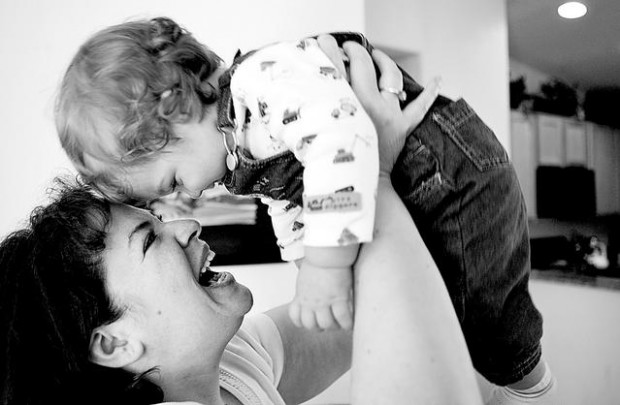
Haun's 1-year-old son, Marshall, sleeps in a crib under a sign that says, "I am a dream come true." Even so, her labor didn't match her ideal.
Given her choice, she would have had an all-natural birth attended by a midwife, but longstanding medical complications mandated a very different experience, complete with a perinatologist, weekly sonograms and a C-section.
The only piece of her birth plan that matched was the music — one of the resident physicians downloaded the Van Morrison hits that played at her wedding 10 years before.
Haun raves about her doctor and said she's reluctant to question the choices other women make. But, she said, she does think women have lost some confidence in their bodies' ability to give birth, so that "pregnancy has become something that's very controlled and monitored and supervised."
Perhaps because of her own experience, she remains captivated by birth stories. They serve as a form of debriefing and help create a kind of intimacy with other mothers, she said. Screening the documentary seemed like a natural way to make connections.
Since Haun has seen only the trailer to the film, she doesn't quite know what to expect, except for the well-publicized fact that the movie shows Lake giving birth in her bathtub. Haun hopes the combination of the screening and a subsequent panel discussion will trigger a dialogue to help women make informed choices.
Renee Palting, a lactation consultant at University Medical Center, is supporting the screening because she sees women every day who haven't taken charge of their health care and don't know where to start. She acknowledges that the film may trigger strong reactions in the audience.
"This film is not the first of its type, but it is well-publicized and it has been very controversial," Palting said. "Some people have complained that it's not pro-hospital. Some have said it's not pro-home enough. But for me, the purpose of having this film here is not to be pro-anything except for pro-education. Women need to know the full spectrum of what the possibilities are, and they need a place to start so they can ask questions."
America doesn't have a lock on all of the answers.
The CIA World Factbook shows that 41 other countries do better at keeping babies alive in their first year. America has 6.3 infant deaths per 1,000 live births. Singapore does the best, at 2.3, Canada weighs in at 4.6 and the United Kingdom at 5. To be fair, though, the countries without as much readily available medical intervention have staggering death rates. Angola's rate is 184. Afghanistan's is 157.
Medical intervention made a difference for Amy Robinson, a 32-year-old University of Arizona law student who plans to see the film.
She so wanted a natural birth and the baby-bonding time immediately afterward that she persisted through a difficult labor for 27 hours before relenting and going to the hospital. Completely tapped out, she ended up having an epidural, an episiotomy and a vacuum assist over the following seven hours before daughter June arrived.
She's thankful for the assistance, but still wishes hospitals were stronger advocates for natural processes. She wishes her baby had been able to bond with her immediately instead of being whisked away for tests. She wishes that the choice to use formula or to nurse had been presented less objectively and that the health benefits of breast-feeding had been pushed. She wishes more women would feel empowered to stand up for the birth experience they want.
"The whole mentality of doctors are like gods and you should do whatever they say might have had a stronger hold a generation ago than it does now, but we're still dealing with the effects of that," Robinson said.
"If we'd grown up with different birth stories and weren't made so afraid of it, things might be different."
"Too posh to push"?
Given that the World Health Organization recommends that C-sections make up 15 percent of all births and less than 10 percent in Westernized nations, there is a growing debate about the trend of women seeking surgery to avoid the unpredictability of vaginal childbirth. With a growing number of high-profile celebrity C-sections, from Victoria Beckham to supermodel Claudia Schiffer, British tabloids even coined the phrase "too posh to push."
In 2006, Pima County's C-section rate was lower than the nation's, at 22.7 percent, said Lisa Hulette, a project manager with the county Health Department.
Take a closer look at the numbers and an interesting trend emerges. In 2003, when the overall percentage was 23 percent, C-sections made up nearly 40 percent of births among residents of the Foothills zip code of 85749. The second-highest percentage, at 30 percent, was the other Foothills zip code, 85750. Midtown's 85719, by contrast, was 21 percent.
The American College of Obstetricians and Gynecologists has attempted to identify what's driving the national increase in C-sections.
Aside from patient requests, researchers note there are simply more higher-risk deliveries linked to trends in obesity, women having children later in life and fertility treatments leading to multiple babies. And once a woman has had a C-section, she has a pretty good chance of having another one because of risks of uterine rupture or other complications.
While researchers study the trend, the American College advises that all Caesarean sections be performed for medical reasons, said spokeswoman Stacy Brooks.
The college's position is that women who seek surgery in the absence of any medical indication should understand that it may lead to a higher risk of infection, scar tissue, blood clots, complications from anesthesia and the potential for future Caesareans.
IF YOU GO
What: Your chance to see the documentary "The Business of Being Born" before it comes out on DVD in March.
When: The screening, followed by a panel discussion, will take place at 2 p.m. Jan. 19.
Where: DuVal Auditorium at University Medical Center, 1501 N. Campbell Ave.
Admission: Sponsors suggest a $5 donation to offset the cost of bringing the movie to Tucson.


