

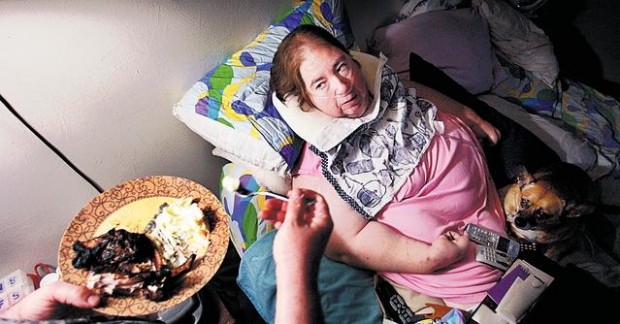
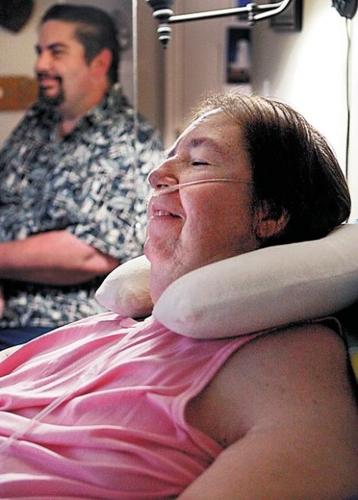
Nancy Naugles is at the center of a health-care tug of war.
She and her husband, Nick Cosentino, have health insurance through Medicare, but they can't afford the $3,873 co-payment that their Medicare provider is requiring for the new, $19,000 power wheelchair that she qualified for earlier this year.
The 51-year-old Tucsonan can't sit in her current wheelchair, which is 10 years old, for longer than four hours or so without being in excruciating pain. It no longer fits her properly.
The co-payment is just 20 percent of the wheelchair's cost — standard for Medicare. But it's a fortune to Naugles and Cosentino, who became so mired in debt last year year that in January they filed for Chapter 7 bankruptcy. They say medical expenses were the cause.
"We were so embarrassed by the bankruptcy," Cosentino said. "We really haven't told people about that."
People are also reading…
Their story is not unique. A recent report by researchers at Harvard Medical School and Harvard Law School said that medical bills were the source of 62 percent of personal bankruptcy filings in the United States in 2007.
"We hear so much about the 47 million who are uninsured, but most people do have health insurance. It's a question of what we face and how unaffordable it is if we are really sick," said Monica Sandschafer, an Arizona organizer for Health Care for America Now, grass-roots group advocating health-care overhaul.
Naugles, who has been mostly bedridden since 2005, suffers from a rare congenital orthopedic disease called arthrogryposis, from severe scoliosis and from a constricting lung condition that leave her unable to walk on her own. She needs an oxygen tube to breathe and a wheelchair to get around.
Naugles has been covered by Medicare for more than a decade. She's one of about 5 million Americans under 65 who qualify for Medicare coverage because they are totally and permanently disabled. She's been on Medicare since 1998, but that federal coverage did not pay for all the costs associated with the neck surgery she had in 1999, surgery she had for a kidney stone last year and numerous hospitalizations for breathing problems and cellulitis. There are costs associated with her prescriptions and oxygen supply.
In 2002, the Commonwealth Fund and the Henry J. Kaiser Family Foundation issued a report that said the non-senior, disabled Medicare population is more likely than the elderly to live in poverty, to be in poor health and to experience difficulties living independently and performing basic daily tasks.
To compound the couple's troubles, Cosentino has a congenital heart problem called an atrial septal defect that required an implant last year. Cosentino, 50, was covered by his employer-sponsored insurance plan at the time, but the co-payment was $2,500, he said.
Cosentino works full time as a medical assistant, earning $12 per hour (about $25,000 per year), and Naugles receives $340 per month from Social Security. Until recently, Cosentino was in a job that paid $11 per hour. He took the new position because it meant an increase in salary, but at the moment he has no health insurance.
He'll have it from his new employer after three months, but in the meantime he's shopping around for a short-term plan. Coverage through COBRA — the Consolidated Omnibus Budget Reconciliation Act of 1985, which extends health insurance from former employers for 18 months, is too costly, he said.
He had looked into President Obama's stimulus subsidy for COBRA, but it applies only to people who were laid off.
The bankruptcy wiped out their debts, but it also ruined the couple's credit rating, so they can't put the wheelchair co-payment on a credit card or take out a loan for it.
"We are trying," Cosentino said. "We've started a savings account. So far it's $150, but we have one."
Naugles, who has worked in an insurance office and for a market-research firm, said she wants nothing more than to get out of the house every morning.
"I'm not this person," she said. "I used to be very independent."


