

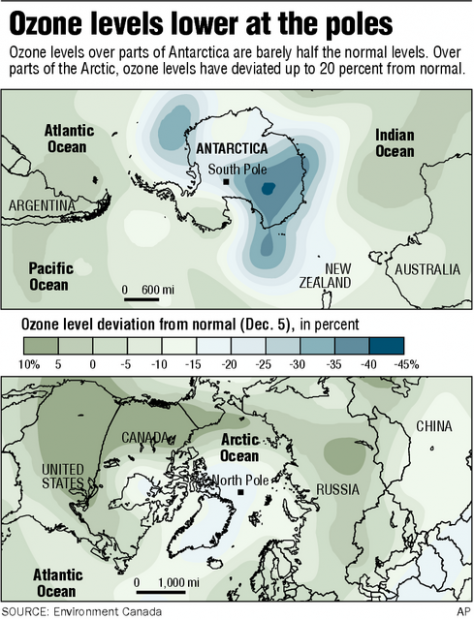
SAN FRANCISCO — The layer of ozone in the earth's upper atmosphere, which protects life from harmful ultraviolet radiation but which has been damaged by artificial chemicals, may take a decade or two longer to recover than previously thought, scientists reported Tuesday.
Until now, the ozone layer had been expected to return to its 1980 condition by about 2050. But at a meeting of the American Geophysical Union here, scientists said new computer simulations suggested that continuing use of the chemicals — chlorofluorocarbons, or CFCs — would delay the recovery until about 2065.
Despite a ban on producing the chemicals in industrialized countries and the ready availability of substitute chemicals, the United States and Canada still account for about 15 percent of current emissions.
"This is somewhat surprising," Dale Hurst, a scientist with the National Oceanic and Atmospheric Administration's Earth System Research Laboratory in Boulder, Colo., said at a news conference at the meeting. "We would have expected the reservoirs of these chemicals exhausted by 2003."
People are also reading…
A slower recovery would expose people living in the high latitudes to somewhat higher levels of ultraviolet light, which causes skin cancer. The scientists did not try to predict the health effects. Indeed, Hurst said, they "may be nothing to most people."
A large hole in the ozone layer opened over Antarctica in the 1980s. The hole closed during the summer months, then reopened each winter, becoming larger and larger, finally reaching millions of square miles in size.
Scientists found that chlorofluorocarbons, which were used in aerosol cans, refrigerators and air conditioners, set off chemical reactions that destroy ozone. The same chemicals also cause the ozone to thin over the Arctic during winter months.
NASA announced Tuesday that this year's Antarctic ozone hole averaged 9.4 million square miles, or about the size of North America, between early September and mid-October. That is smaller than in recent years, and NASA scientists said it would have been smaller still except for colder-than-normal temperatures, which increased the rate of ozone destruction.
The worst year for ozone destruction was 1998, when the hole averaged 10.1 million square miles over the same period.


