

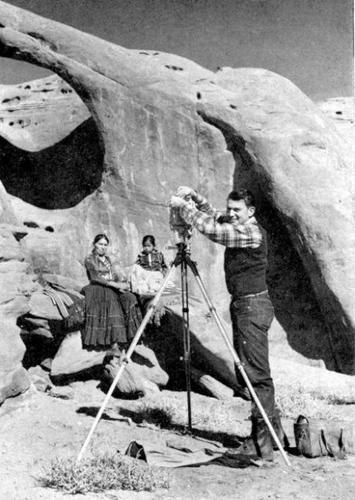
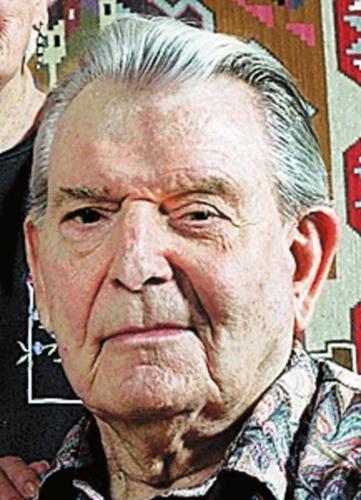
Ray Manley, whose iconic photographs of Arizona's land and people helped shape the worldwide image of the Grand Canyon State and lured untold numbers of travelers to it, died Saturday at his Tucson home. He was 84.
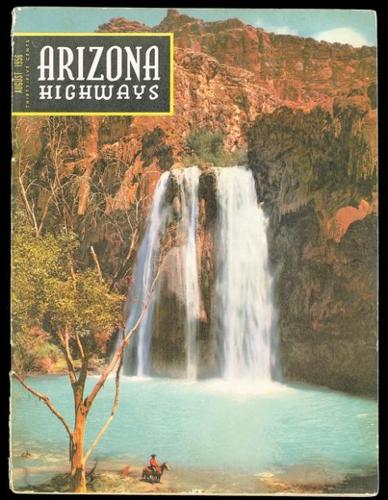
Manley's color-drenched landscape portraits appeared at least yearly in Arizona Highways magazine from 1944 to 1988. Several editions were devoted exclusively to his work. Manley helped define the magazine's photographic style, said Peter Ensenberger, the magazine's director of photography.
Throughout those decades, if you described a particularly vivid scene of sun-lit clouds on the horizon as a "Ray Manley sunset," Arizonans knew what you meant.
Manley never made a name for himself in museum circles, as did some contemporary Highways photographers, such as Ansel Adams and Josef and David Muench. Manley was a commercial photographer, said longtime partner Naurice Koonce, who never aspired to hang his work in any gallery but his own.
People are also reading…
Manley was born in Cottonwood on Sept. 4, 1921, and began photographing the red rocks of the Verde Valley as a boy, earning a Boy Scout merit badge for his efforts.
He sold his first photograph to Arizona Highways while still a student at Arizona State College at Flagstaff, now Northern Arizona University. He married Ruth, who was also a student at Arizona State College, in 1942, shortly before joining the U.S. Navy. He used that published photograph to get himself assigned to the Navy's photography school, he told an interviewer in 1978.
After his Navy stint, Manley and Ruth moved to Tucson for a job with Western Ways Photography, joining Koonce, who already worked there.
"We liked each other immediately," said Koonce.
"We did a little bit of everything, mostly commercial photography, but what he really liked was scenic work, taking pictures of sunsets and everything. He had a lot of work in Arizona Highways. I just sort of grabbed onto his shirttails," said Koonce.
Manley's photos appeared in National Geographic, the Saturday Evening Post, Life, Popular Science and many other magazines. In 1953, Koonce and Manley opened their own business. "We called it Ray Manley Studios. By that time, he had such a name, it's worked out real well."
Manley worked to get his results, Koonce said. One particularly famous sunset shot in Monument Valley on the Navajo Reservation required a long horseback ride to "a little cliff" and a return in darkness.
Manley didn't like the results, said Koonce, "so he hauled all the way back there, and this time he and Ruth stayed out all night and got a sunrise, too."
Monument Valley was his favorite spot in Arizona, Manley told the Arizona Daily Star in 1978. At the time, he and Ruth had logged 83 trips there.
Manley never could sit still, said his daughter Carolyn Robinson. Every summer, the day after school ended, the family would take off in a travel trailer and hit the West's national parks and forests, she said, heading for Yellowstone, Glacier and up into the Canadian Rockies.
He traveled the world as well, taking photographs and returning later with tour groups he and Ruth led after they formed Ray Manley Travel, a business Carolyn Robinson continued to run until last year.
Robinson said her father died in his sleep early Saturday morning. He had been paralyzed on his right side and unable to speak since a stroke in 1997.
She said the family piled the home "three deep with pictures of his world trips" and her father never became angry or resentful, confined to the Foothills home he had sited so that a picture window framed the Catalina Mountains.
In addition to his photography and film travelogues, Manley promoted tourism at the civic level as president of Tucson's Tourism Bureau in the 1970s.
Manley's legacy lives on in Arizona Highways, said Ensenberger, who said he still strives to mix in richly colored landscapes and romanticized images of the West with photography more relevant to younger readers.
"One of the styles he made famous was his cowboy and ranching profiles, those shots around the campfire always beautifully lit, it looked, just by the campfire, but he had actually lit it with hidden strobes."
"He was a very versatile photographer. We still have his prints hung throughout the building."
Manley also "contributed as much as any one individual to the promotion and exposure of Native American arts and crafts," said Steve Getzwiller, who collaborated with Manley on the book, "The Fine Art of Navajo Weaving."
Manley followed that up with a book on the faces of Navajo elders. "He showed the native people a great respect," said Getzwiller.
"He was extremely well known on the Navajo and Hopi reservations and very highly regarded," said Getzwiller, owner of Nizhoni Ranch Gallery in Sonoita, who has spent the past 34 years trading on those reservations.
Manley was author of eight books and several films. Some of his short films on Mexico were shown on PBS, Koonce said.
"He was a big guy, an outdoor guy, the most honest guy in the world. We ran a business together for 15 or 20 years on a handshake," said Koonce. "It's been a long, happy tour."
In a 1989 Arizona Daily Star story, Manley shared a letter he had written to his children before leaving on a potentially perilous trip:
"Should anything happen to me, don't feel sorry for me for I have lived and seen more than 95 percent of the people on this Earth.
"Who else has traveled the world seven times and to all the South American, South Pacific places and gotten paid well to do it and enjoyed it as much or more than any tourist?"
On StarNet Find a slide show of Ray Manley's photos at azstarnet.com/slideshows
● A memorial service for friends and family of Ray Manley will be held at 1 p.m. Tuesday at Northminster Presbyterian Church, 2450 E. Fort Lowell Road.
Manley is survived by his wife, Ruth; daughter, Carolyn (Patrick) Robinson; son Alan (Claudia); five grandchildren and six great-grandchildren.


