

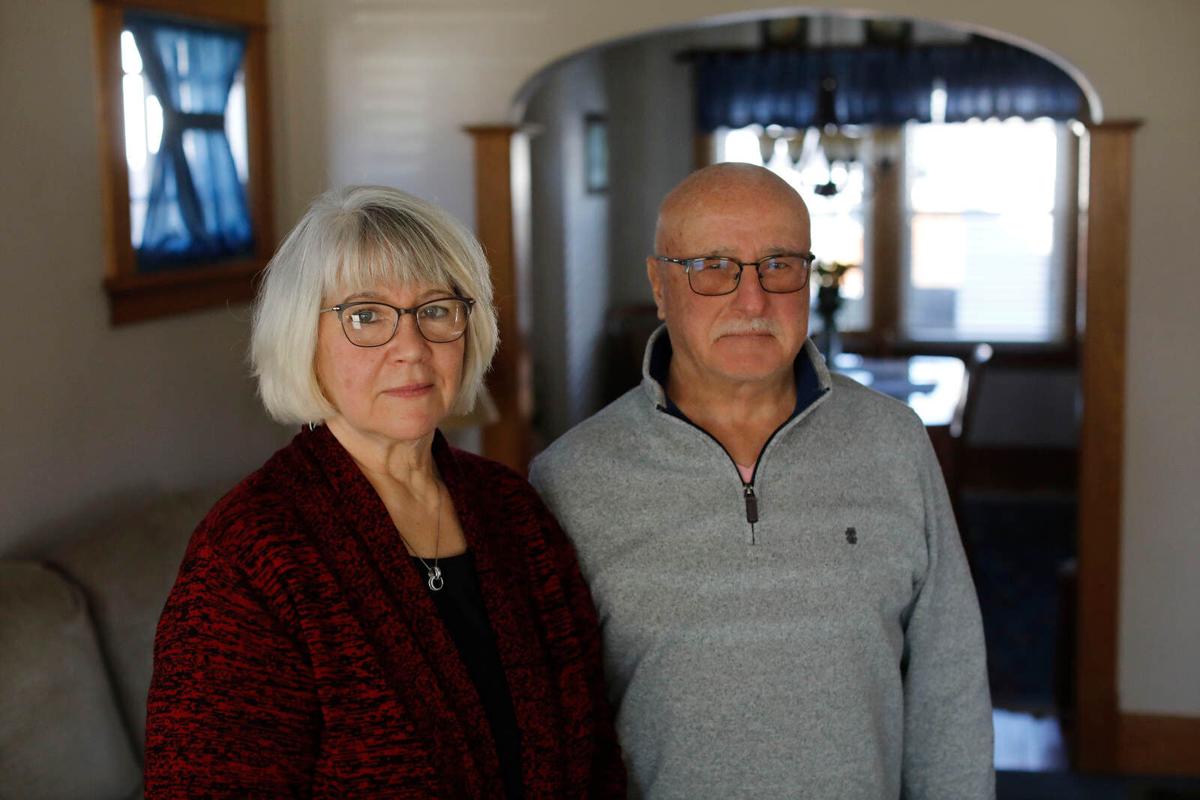
Gail and Jerry Tiedemann have owned a summer place at Canada's Pleasant Beach, only 20 miles from their Kenmore home, for a quarter century – and they're used to having friends over, not raccoons.
But all that changed last year.
"My neighbor called me to tell me there was a raccoon crawling up our screened-in porch," said Gail Tiedemann, 68. "We've never had raccoons at our cottage before. But now, because nobody's around, all these crazy things are happening."
To hear people like the Tiedemanns tell it, the craziest thing of all is that, amid the pandemic-driven U.S.-Canadian border shutdown that's soon to enter its 12th month, they're not able to visit the properties that have been their second homes for years, if not generations.
"We can go there and quarantine for 14 days," Gail Tiedemann said. "Why can't we get over?"
People are also reading…

"I remember those first weeks thinking: OK, well, we'll just give it a couple of weeks, and it's going to be OK; this can't last that long," Elizabeth Switzer said. "And then it just kept going and going and going."
The answer to that question, of course, is the Covid-19 pandemic, and the near-total border shutdown both the U.S. and Canada imposed last March. And if anything, the border is about to get tighter, with Canada announcing last week that it will require negative Covid-19 tests for Canadian snowbirds returning home from points south.
Nevertheless, Rep. Brian Higgins of Buffalo – the Democratic co-chair of the Northern Border Caucus – said both countries need to take a close look at the issue of Americans who own property in Canada, and vice versa.
"A lot of people from Buffalo bought cottages, a lot of people bought homes over there," Higgins said. "And they've been denied access to them. And, you know, when you really think about it, common sense would dictate that if you follow proper protocols, then you could safely go and visit and maintain your property without being exposed to a lot of people."
Elizabeth Switzer, who has been unable to see her fiance in person for almost a year due to the U.S.-Canada border closure, talks about the difficulties of being in a forced long-distance relationship and rescheduling her wedding to Paul, a Canadian citizen in a PhD program at McMasters University in Hamilton, Ont. which would be less than an hour drive away under normal circumstances.
The hassles
It's difficult to determine exactly how many Buffalo-area residents own second homes in Canada, but Higgins said about 125 such people have contacted his office since the border shutdown began. And judging from what the congressman hears from constituents in his district, he said he suspects the actual number of Western New Yorkers with cottages or trailers or full-fledged homes in Southern Ontario to be far larger than 125.
Many of those people, like the Tiedemanns, bought into a lifestyle years ago. They would decamp to their three-bedroom cottage and essentially live there every summer, hosting regular get-togethers for their friends.
"It was a social place for us," Gail Tiedemann said. "We always had a great time."
For now, though, that cottage is both a worry and a hassle. The water at their summer place gets turned on every April, and it happened without them there last year. So when neighbors checked on the house a couple of weeks later, they found that a leak had flooded the kitchen, forcing the neighbor to bring in a sump pump to clean out the place.
Sheila and Stan Pingelski of Buffalo can sympathize with the Tiedemanns. The Pingelskis own a four-bedroom place right on the beach in Fort Erie, and they know how the weather is battering it only through the good grace of their neighbors.
The vicious Halloween storm of 2019 wrecked the retaining wall that separates their house from the beach, and while they were able to hire a contractor to repair it, they've never been able to check out how good a job the contractor did. Then on top of that, another windstorm blew through last year, and their neighbor sent them pictures showing that tiles had blown off their roof. So now the Pingelskis are contemplating a roof replacement from afar – and wondering if the mice that show up every once in a while in the winter have the full run of the place now.
"It's nerve-wracking, to say the least," said Sheila Pingelski, 57.
And for Jeff Hause, the border shutdown has been not only nerve-wracking, but expensive. He and his wife are retired and living in Punta Gorda, Fla., but they would make extended visits to their manufactured home in Sherkston so that Jeff's wife, Kathleen, could visit her mother in a nursing home in Orchard Park. Unable to do that last year, the Hauses bought a motorhome and spent the summer in New York State campgrounds, all so Kathleen could be close to her mother.
"Now with this border closure I had to go out and spend a lot of money on a motorhome, which I wasn't planning on doing, so that I could go up there and she could visit her mom," said Hause, 69. "So it's kind of a hassle from that standpoint."
The solutions
While there's no sign of any imminent end to the border shutdown, cottage owners can take heart in two things. First, the Biden administration and the Canadian government are at least talking about a joint approach to the border and its eventual reopening. For another, the Northern Border Caucus is continuing to put on the pressure for a loosening of the border restrictions: Higgins, for example, said he's been contacting Biden officials daily about the issue.
The caucus's newest member, Republican Rep. Chris Jacobs of Orchard Park, is on board, too.
"Cross-border families and property owners have faced restrictions for nearly a year as a result of Covid-19," Jacobs noted. "My first priority is working with my colleagues, the Biden administration and our Canadian counterparts to open the U.S.-Canadian border with a safe and fair set of standards for both nations.”
The border remains shut to nonessential travel, but owners of property in Canada said it makes sense for both nations to simply broaden their definition of who's allowed to cross.
For example, Ben Dunkle, a Canisius College professor with a family place in Crystal Beach, said the two governments might want to open the border to people who have been vaccinated.
"If I was vaccinated, I can't see any reason I wouldn't be able to cross the border," said Dunkle, 49. "That could even be the best-case scenario."
For now, though, Western New Yorkers who own property in Canada can only speculate about when and how the border will be reopened.
JoAnn Boehm of the Town of Tonawanda, whose parents built a cedar cottage in Ridgeway in 1963, has spent time there nearly every summer of her life. But now she has no idea when she'll see the place again.
"We have not heard anything about what we will need to do to be able to cross," said Boehm, 62. "Will we need proof of vaccination? Proof of a negative test? If we are last in line to get vaccines, age-group wise, will we even get over there this spring and summer? Will we have to quarantine on either side of the bridge?"
Several cottage owners said any one of those possible requirements would be fine with them, including a quarantine requirement – which, they said, would be safer than the current policy that lets people fly between Canada and the U.S. but not drive across the border.
"Canadians can fly over here and then drive through seven states to get to Florida, and we can't even take a 30-minute drive to get over there and check on our cottages," said Tom Eimiller, 73, of West Seneca, whose family has owned cottages at Pleasant Beach since 1956. "All we want to do is check on our cottages and do repairs. We could have mice in there or animals living in it, you know?"


