


When Phil McConkey was growing up on Buffalo’s West Side, he dreamed of catching a touchdown pass in the Super Bowl. His wish came true.
This was against all odds. Naysayers told him he was too small to play football at Canisius High School, when he weighed 125 pounds, and at the U.S. Naval Academy, when he weighed 145 — and for the New York Giants, when he weighed 158.
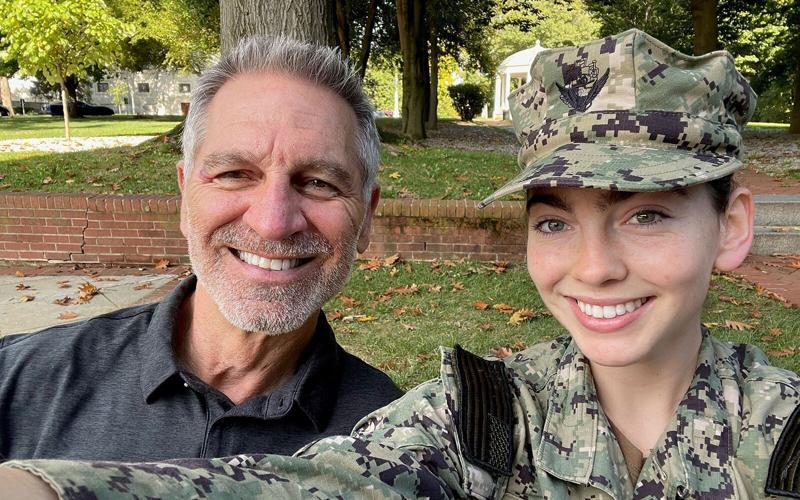
As it happens, this summer he had another wish come true: His daughter, May McConkey, is a Navy plebe. And Saturday she will be among the brigade of Midshipmen who march into MetLife Stadium for the Army-Navy football game.
“I could not be more proud,” Phil says.
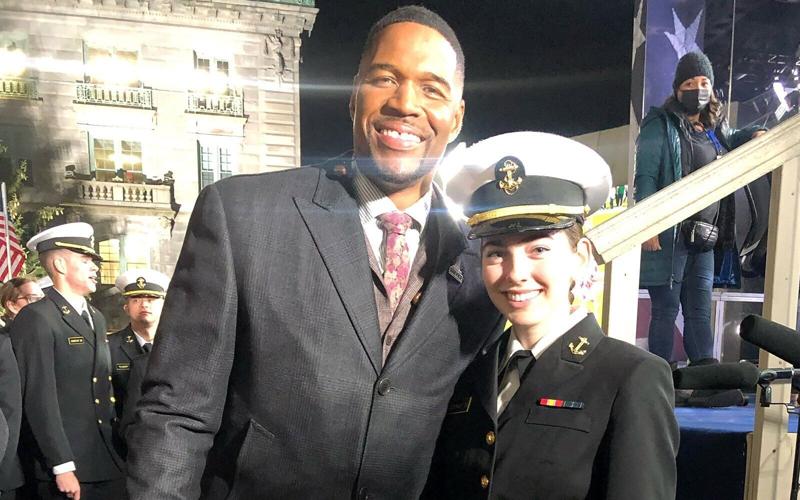
Last month, when Fox did its NFL pregame show at the Naval Academy, May approached Michael Strahan, the former Giants star who is now an anchor for "Good Morning America" and an analyst for "Fox NFL Sunday." May pointed to her nameplate. He knew her immediately. They have a lot in common: One is a Giants legend — and the other the daughter of one.
People are also reading…
“He gave her that big, gap-toothed smile,” Phil says. “He texted me to say he had seen her. He is a real dude. Fame has not jaded him at all.”
McConkey confesses that he cried in July when he and his wife, Erin, dropped off their only child at the waterfront campus — known affectionately as The Yard — in Annapolis, Md.
“May had options, she could have gone almost anywhere,” he says. “It wasn’t like that for me.”
Joe McConkey, Phil’s father, was a Buffalo cop who worked side jobs to send his kids to Catholic schools. There was no money for college. Phil made All-Western New York and all-state football teams, but he had no scholarship offers. The rap was his size, of course. Then Navy came along.
For those who can get in, the Naval Academy is a free ride, though only in the tuition sense. Otherwise, the academic and physical rigors are famously difficult.
“It is the hard way to go about your college days,” McConkey says. “May didn’t have to do it. But she embraced it — and embraced it enthusiastically. A whole heck of a lot more than I did, that’s for sure.”
May is enjoying the camaraderie of her accomplished classmates, Phil says. “These kids are amazing. Spend any amount of time with them and they will give you great hope for our future.”
Phil and Erin live in San Diego, where he ended his six-season NFL career in 1989 with the Chargers. That, of course, is the franchise the Bills beat in AFL title games in 1964 and 1965. Phil, as a boy of 8 and 9, would toss a football high in the air, pretending he was quarterback Jack Kemp — and then catch it as he dove headlong into a snow bank, imagining himself as wide receiver Elbert Dubenion.
Phil wept the next season when the Bills lost to the Kansas City Chiefs for the right to play in the first Super Bowl. He was almost 10. Twenty years later, he caught a TD pass for the Giants in Super Bowl XXI. He ended up playing for four NFL franchises, but still roots for the Bills. “You never forget your first love,” he says.
Competition, too, remains a first love. McConkey runs sprints in Masters Track & Field and reports that he won silver at the last big national meet, before Covid. He turns 65 in February.
“I’m the only guy you will know who can’t wait to get older, because I age up,” he says. “This next season, I’m looking forward to being the youngest guy again.”
The races, too, make him feel young again: “They keep me young. I still get butterflies.”
He says he got that nervous feeling for the first time as a second grader at Annunciation School. It came the night before a school race, and he didn’t know what the feeling was. His father explained it as butterflies — and told him it was a good thing.
“I had them before big games at Canisius, I had them at Navy, I had them before the Super Bowl,” McConkey says. “And I still have them before big races as an old guy.”
He is president of Academy Securities, a financial-services company in San Diego. “We hire, train and mentor military veterans for careers in financial services,” he says, “as well as serving our Fortune 500 companies, municipalities, and investors.”
The finance guy with a Super Bowl ring could afford to rest on his laurels, but he is on the track nearly every day instead. He simply can’t stop running.
“I learned that I am comfortable being uncomfortable, because it is uncomfortable training like that,” he says. “And I get uncomfortable when I am too comfortable, which is kind of weird.”
Now he sees those same traits in May. He was 46 when she was born: an older first-time father in the same way that he was an older first-time pro. McConkey was a rookie at 27 — the first Midshipman since Roger Staubach to reach the NFL after a full hitch in the Navy. He got the tryout only because one of his old Naval Academy coaches, Steve Belichick, called his son, who was the Giants’ defensive coordinator. Yes, the son was Bill Belichick.
“I hadn’t played football in five years,” McConkey says. “I had nothing else lined up. I was chasing the dream.”
Coach Bill Parcells liked McConkey’s sure-handed toughness and he made the team. Then, in Super Bowl XXI, against the Denver Broncos, McConkey was open on a flea flicker and hightailed it for the end zone. He remembers thinking: “This is it. I’m going to score a touchdown in the Super Bowl.”
He got hit at the 4, somersaulted through the air — and wound up one yard shy of his dream. Giants running back Joe Morris swept in on the next play.
Ah, but in the fourth quarter Giants quarterback Phil Simms tossed a six-yard pass to tight end Mark Bavaro in the end zone. The ball glanced off Bavaro’s hands. And then:
“I could see it tumbling down to me,” McConkey says, “like a snowflake in the sky.”
He slid to his knees — and caught it by his fingertips.
Touchdown.
Some dreams, like that one, you think about all your life. Others you never see coming.
“I was in the last all-male class at the Naval Academy, the class that entered in the summer of 1975,” McConkey says. “The first class with women came the next summer. Think about this: There were 84 women among 4,400 Midshipmen that year. I saw how tough and resilient and incredible those women were. I had a front-row seat to it. They are the heroes who paved the way for my daughter to go on her journey.”
Sydney Barber is a second lieutenant in the Marine Corps who graduated in May as the first Black female brigade commander in Naval Academy history. She ran track for Navy as a sprinter and hurdler, and Phil met her at a competition in San Diego. He became a mentor for her, and she became an inspiration for May.
And now May is an inspiration for her father.
“When I was growing up on the West Side,” McConkey says, “I dreamed of becoming a pilot and scoring a touchdown in the Super Bowl. Add those things together and it still doesn’t come close to seeing my daughter in uniform at the Naval Academy.”
It is the dream come true he never dreamed of.


