Editor's note: This story is part of 'ESA at 50,' a series that examines the past, present and future of the Endangered Species Act. Often called the "pit bull of environmental laws," the ESA has provided federal protection to nearly 2,000 animals and plants. On its 50th anniversary, it grapples with political uncertainty and unforeseen ecological challenges.
Kristina Harkins climbs trees up to eagle nests quite often for a biologist who doesn’t work with eagles. She does it to find remnants of the birds she does work with — sharp-tailed grouse — after they were an eagle’s meal.

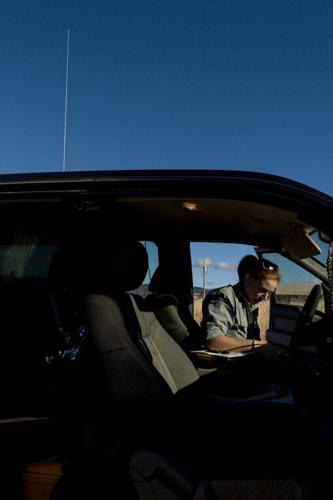
Kristina Harkins, in the driver seat of an FWP truck near the MPG Ranch Nov. 16, listens for signals from radio-collared sharp-tailed grouse using an omnidirectional antenna mounted atop the truck cab.
Harkins helps run Montana’s effort to reintroduce sharp-tailed grouse west of the Continental Divide, where they haven’t lived for decades, starting with the Bitterroot and Blackfoot valleys. The state-led effort kicked off in 2021 with an initial batch of birds relocated from source populations across central and eastern Montana.
People are also reading…
Harkins is one of two field coordinators with the Montana Department of Fish, Wildlife & Parks who implements the capture, relocation and monitoring of the birds, which are known for their energetic mating dances and strong huntable populations in the rest of the state. Most recently, this past spring, 75 additional birds each were dropped in the Blackfoot and Bitterroot sites. Birds could also be placed in the Flint Creek Valley south of Drummond in coming years.
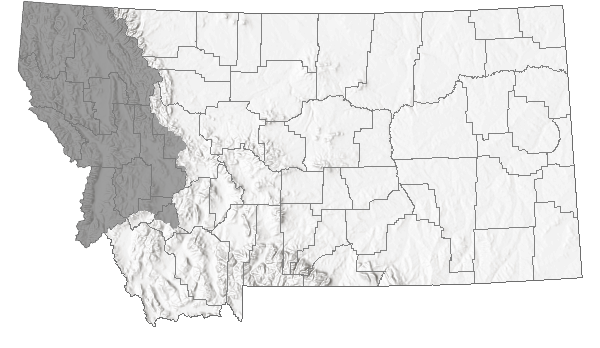
The historical range of the sharp-tailed grouse is shaded in grey on the map. Native year-round, summer, winter, migratory and historical geographic range polygons created by Montana FWP have been defined for most animal species for which there are enough observations, surveys, and knowledge of appropriate seasonal habitat use to define them.
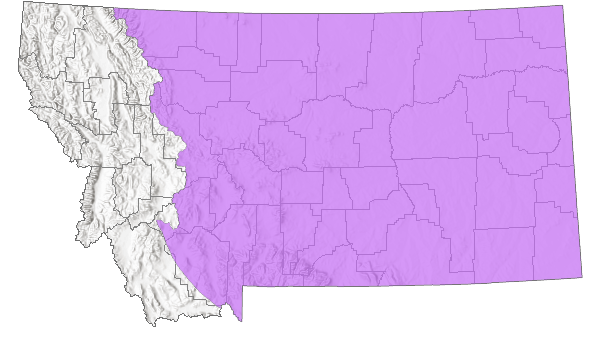
The sharp-tailed grouse year-round range is shown in purple on the map. Native year-round, summer, winter, migratory and historical geographic range polygons created by Montana FWP have been defined for most animal species for which there are enough observations, surveys, and knowledge of appropriate seasonal habitat use to define them.
Meanwhile, on the same landscape, some of the most iconic species that have returned from the brink were recovered, or are still being recovered, under the federal Endangered Species Act. Some are obscure (ever heard of the least tern?). But many — like the bald eagle, grizzly bear or gray wolf — are woven into popular consciousness, folklore and even national iconography.
The ESA turns 50 at the end of December. But despite its high profile, the landmark legislation accounts for only a sliver of species conservation efforts across the nation. Ten times as many species are conserved through state-led efforts than through federal protections under the ESA. Montana’s push to reintroduce sharp-tailed grouse, although local to western Montana, offers a window into how that vast majority of species conservation happens.
According to the U.S. Fish & Wildlife Service, the agency responsible for implementing the ESA, 1,723 species were listed under the law in late 2023. At the same time, according to the U.S. Geological Survey, 17,118 species were listed simply as “species of greatest conservation need” in the states in which they’re found. The sharp-tailed grouse is one of them.
Robert L. Fischman is the George P. Smith, II Distinguished Professor of Law at Indiana University. He specializes in public and environmental affairs and appeared before a congressional committee earlier this year as an expert witness on the ESA.
“The Endangered Species Act only protects that relatively small number of species that are right on the precipice of disappearing,” he said in an interview last month. “The easiest way to prevent species extinctions is to address their conservation needs before they decline to the point at which they're at the point of extinction. If you wait until the species is right on the brink, then there's a lot less room for compromise, collaboration, tradeoff.”

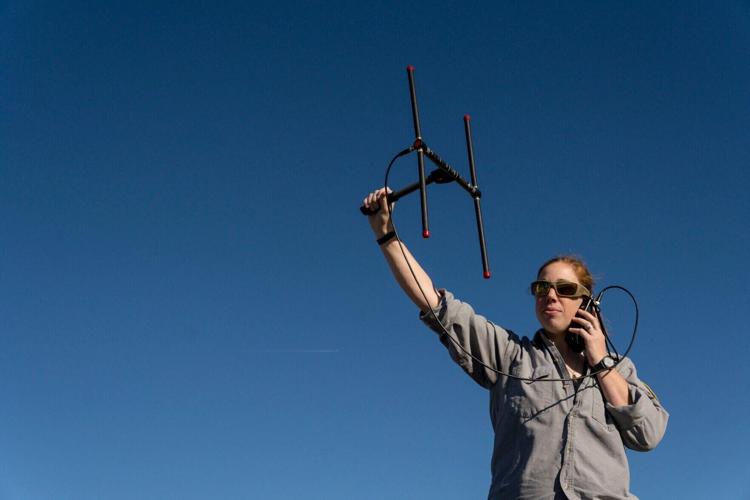
Harkins uses a handheld radio antenna to listen for collared sharp-tailed grouse near the MPG Ranch in the northern Bitterroot Valley on Nov. 16.
Fancy dancing bird
A tubby, brown-and-white mottled bird about the size of a chicken and just heavier than a basketball, sharp-tailed grouse live no longer than seven years. Their time is mostly spent mating, nesting, rearing young or hunkering down through winter to do it all over again. And with heavy predation, they must produce a lot of offspring annually to maintain their numbers — as many as a dozen chicks per brood.
They need prairie clearings for mating rituals (called “leks”), as well as other native grasslands for nesting and rearing broods, and shrubbier areas for winter shelter. Their spectrum of specific habitat needs makes them a so-called “umbrella species:" Conservation of sharp-tailed grouse habitat inherently helps a slew of other species that use one or more of the grouses’ favorite bits.
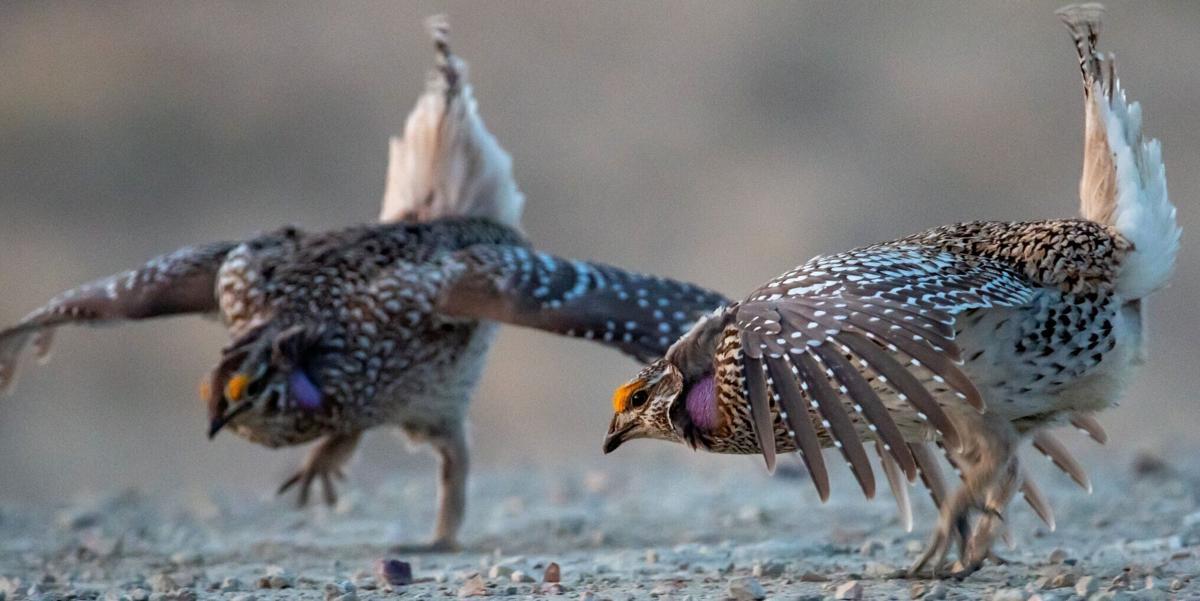
Males’ vibrant mating dance features rapid-fire stomping, up to 20 times per second, that has been woven into Native American dances. Hens are remarkably faithful to their nests, and the birds tend to nest in the same places and reuse the same leks year after year.
Sharp-tailed grouse are also a hallmark of Montana hunting, with an average of more than 40,000 killed annually in the eastern two-thirds of the state. From 2012–22, according to FWP, an average of 8,867 hunters each spent just over six days annually seeking sharp-tailed grouse in Montana. In 2022 alone, which saw above-average hunting for the bird, sharp-tailed grouse hunters spent an estimated $15.7 million in the state.
Those numbers belie a critical aspect of sharp-tailed grouse in Montana: It’s been illegal to hunt the species west of the Continental Divide since 1948, and one hasn’t been spotted west of the divide since at least 2003 — at least not until the reintroduction effort began in 2021.

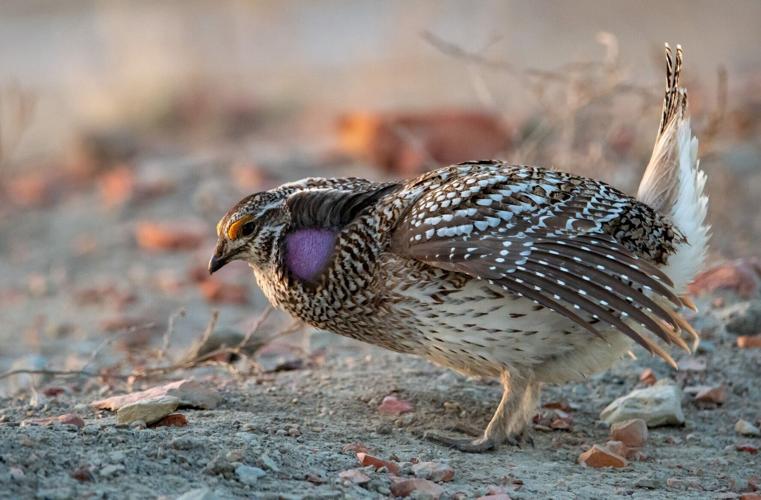
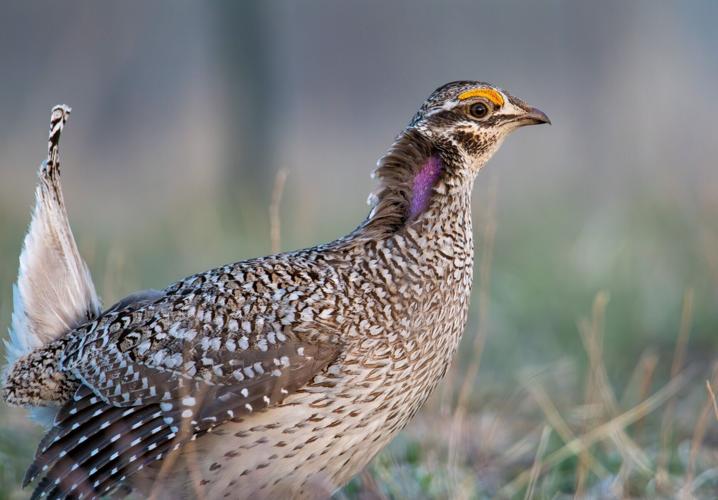
A sharp-tailed grouse stands in a lek in early-morning light in spring 2023.
The birds’ decline in the region was noted as early as a 1921 study. The 1970s construction of the Libby Dam and the resulting Lake Koocanusa in far-northwest Montana submerged a significant swath of their habitat. A compensatory reintroduction effort near Eureka, funded by Bonneville Power and using birds from nearby Canada, failed.
Lance McNew is an associate professor of wildlife habitat ecology at Montana State University. He wrote the 2017 plan for reintroducing sharp-tailed grouse in western Montana, which was adopted by FWP. He oversees the research team studying the project.
He said that scientists aren’t entirely sure why the species disappeared from western Montana, but it likely had to do with habitat loss and fragmentation. Sharp-tailed grouse, he said, not only need specific grassland habitat, but also connectivity between intact habitat patches. Development can turn once-contiguous habitat into sporadic islands of grasslands. So can timber encroachment from a century of wildfire suppression.
In such situations, he said, prairie grouse species like sharp-tails can become a case study for the “extinction vortex” caused by inbreeding among isolated populations.

A sharp-tailed grouse stands near a lek in spring 2023.
Staying away from the brink
A critical difference between federal species conservation and state-led efforts is that the ESA was designed to yank an imperiled species back from the brink before it disappears entirely from its historic range — at least in all or part of the U.S. But state-led efforts like Montana’s grouse reintroduction are meant to make sure a species never gets to that point in the first place.
If Montana has its way, sharp-tailed grouse will never approach that brink.
“The state, without any impetus of any future listing, was motivated to attempt to restore sharp-tailed grouse to western Montana,” McNew noted. “They're simply motivated to make this happen without any threat of listing by the Fish and Wildlife Service.”

Montana Untamed: Often called “the pit-bull of environmental statutes,” the ESA has given federal protection to nearly 2,000 animals and plants.
Fischman said that proactive conservation is the key to preventing an ESA listing.
“That is a recipe for success,” he said. “Starting early gives you more flexibility to experiment, more flexibility to fail and to learn from that failure.”
Where the ESA provides continuity and protection across all the federal lands that comprise nearly 50% of the American West, a state-led effort can provide greater regional or local adaptability. Where the ESA offers stronger regulatory measures to help a species recover, a state-led effort may generate greater local buy-in because of its lower burden — real or perceived — on landowners, businesses and communities.

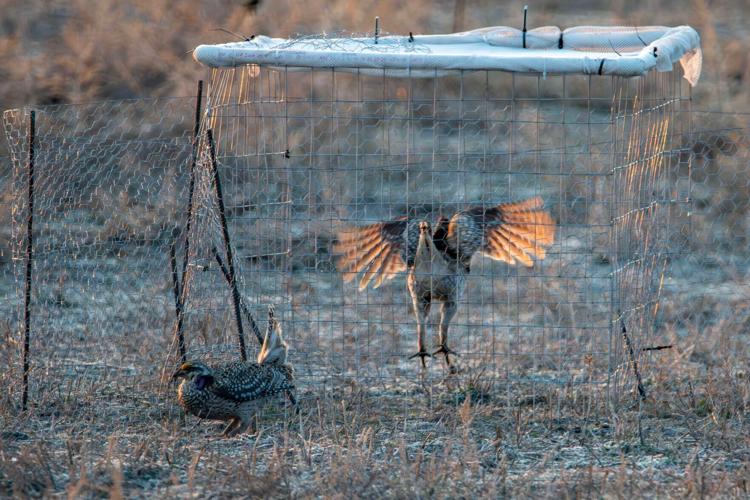
A sharp-tailed grouse trapped near a lek in spring 2023 flaps its wings in early morning light.
In the 1990s, Ben Deeble worked with the few remaining sharp-tailed grouse in western Montana as a graduate student at University of Montana. More recently he’s been involved in the reintroduction effort as president of the nonprofit Big Sky Upland Bird Association, working closely with FWP and McNew’s team.
He said that concerns over federal ESA protections nearly scuttled the effort to return sharp-tailed grouse to the area. Biologists and wildlife managers had long believed that the sharp-tailed grouse once present in western Montana were the Columbian sharp-tailed grouse, one of six sharp-tailed subspecies and the most imperiled of those remaining. (New Mexico’s hueyi, another of the six, is already extinct.)

Explore which species in your state have made the endangered species list.
The Columbian subspecies has mostly disappeared from its native range in Nevada and Oregon, remaining healthy so far only in southern Idaho. The subspecies has twice been petitioned for protection under the ESA. FWS declined to list the subspecies in 2000 and 2006.
Deeble said local governments, businesses and landowners were more likely to oppose an effort to bring in a species that could be listed under the ESA, fearing the additional regulations and land-use restrictions that could come with a listing. And it would mean a lot more work for FWP and FWS.
“It created sensitivities when you consider moving a petitioned species,” he said, “one that may end up on the endangered species list, into geography that it no longer occupies.”
But Deeble’s research and other subsequent studies found that the grouse historically found west of the divide actually “were all the same subspecies, they were all plains sharp-tails, like the ones that were common in central and western Montana.”
He said that revelation made a future reintroduction “politically simpler” than trying to bring back a bird that might be listed under the ESA.
“For whatever reason, misguided or not, there's really an elevated sense of concern about federal regulation related to wildlife,” Deeble said. “I think that we have the potential for having more diverse partners with the effort being largely state-based.”

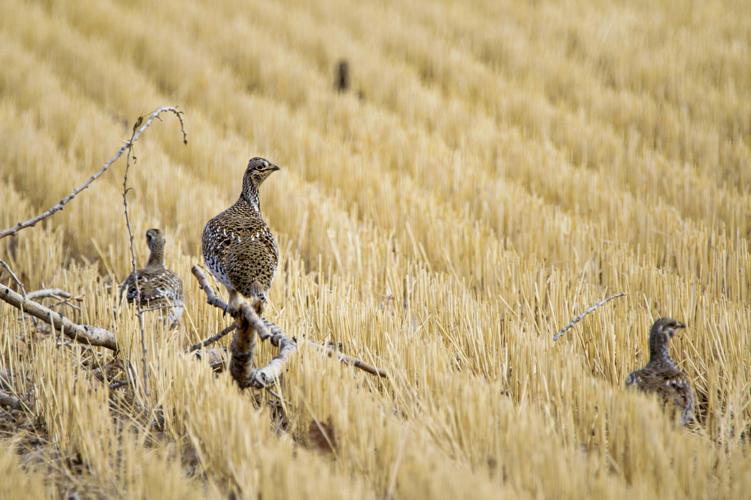
A covey of sharp-tailed grouse wander through the rows of a farmer’s field along South Keller Road to the south of Billings in this photo from 2021.
'Federal agents as villains'
The current effort involves the MPG Ranch near Lolo — the Bitterroot reintroduction site — as well as a collection of private landowners in the surrounding area and in the Blackfoot Valley near Ovando and Helmville. MSU is heavily involved, as is Deeble’s nonprofit and dozens of other volunteers who help with capture and transport.
The project is young, McNew and Harkins said, but an encouraging number of the birds have stayed near their relocation sites, mated, nested and successfully fledged offspring. Although, a few times, Harkins had to don a climbing harness, tie in to a rope and climb up to an eagle nest to retrieve the tracking collar from a predated bird.

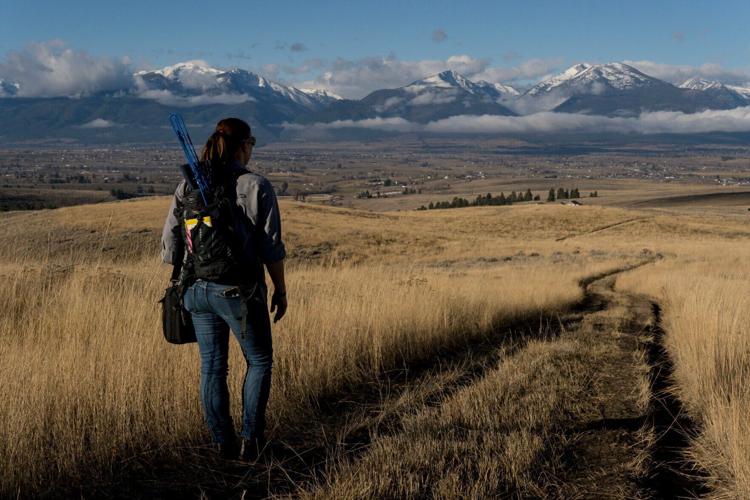
Kristina Harkins of the Montana Department of Fish, Wildlife & Parks walks down a hillside near Ambrose Creek northeast of Stevensville after using a radio receiver to locate sharp-tailed grouse on Nov. 16. Harkins is a field coordinator for FWP's effort to reintroduce the species west of the Continental Divide, where they haven't been seen for decades.
Although they can’t be hunted in western Montana, the presence of sharp-tailed grouse on private or federal land generally doesn’t limit land use the way the presence of a federally protected species might.
“It was a fairly simple pitch to make to landowners,” Deeble said, “who had potentially the most at stake in welcoming this species back to their land.”
Fischman said that resistance to ESA efforts may stem from a variety of forces, from the “general cultural stereotype of federal agents as villains, to the very real economic impacts” of regulations on land use. He said some landowners or managers who worked to maintain quality habitat for a species might feel punished when they’re subjected to additional regulations when a species is listed.
But, Harkins noted, even federal efforts under the ESA can bring in collaboration with local partners. While pursuing a Ph.D. in ecology from the University of Wyoming, she worked with the nation’s most endangered amphibian and mammal: the Wyoming toad and the black-footed ferret. Both are protected under the ESA. But since February, she’s worked full-time on sharp-tailed grouse.
“It’s very similar for collaboration but it’s all managed at the federal level,” she said of the ESA efforts, noting that her work in Wyoming and in Montana both involved extensive cooperation with private landowners. “It’s not good or bad, it’s just different.”
But, she said, ESA protections are designed for nationwide consistency, which can create difficulties when different places have different needs.
Fischman said that FWS is increasingly listing species as “threatened” rather than “endangered” because the less-severe status offers more room for flexibility in management plans. But a state-led plan for a species, he said, “gives you more room to create incentives, less stringent restrictions.”
Plus, Harkins said, a state project doesn’t carry the same high profile or stakes as an ESA listing.

Harkins listens for radio signals from collared sharp-tailed grouse via an omnidirectional antenna atop an FWP truck in the northern Bitterroot Valley on Nov. 16. The truck antenna can pick up more distant signals than handheld antennae but, unlike handheld devices, it cannot indicate the direction a signal is coming from.
“Once something gets put on the ESA they’re so much more visible, and getting them removed from the list can be so much more difficult,” she said. “That is probably the biggest difference” from a state effort. “We have goals, but nobody is going to litigate us if that doesn’t happen.
“The Endangered Species Act is really powerful and legitimately a great tool for recovering species,” she added, “but they’re not supposed to stay there forever.”
Fischman also noted the ESA’s strength over state efforts.
“The chief advantage is that the Endangered Species Act constrains all federal agencies,” he said. “That, immediately, is something that limits further degradation on federal lands. It banks that federal land under more conservation, which may relieve what may otherwise be a burden on private landowners,” except for those who lease or operate on federal lands.

Plus, he noted, “The federal Endangered Species Act has much more powerful limitations on species than state regulations do. The federal law just has tools available, like prohibitions on incidental take, that the state of Montana does not have in its state equivalent of the Endangered Species Act.”
But the ESA’s clout can also be a liability.
“I think, honestly, we would have had an insurmountable hurdle,” Deeble said, “if it turned out that we historically had Columbian sharp-tailed grouse in western Montana that we were trying to reintroduce.”
50 years of the ESA: Explore this series, in photos

Erin Fenger, conflict prevention specialist for Montana Fish, Wildlife and Park, throws old cattle bones into a dump trailer on a ranch outside Valier, Mont. in Sept. 2023. Montana FWP’s prairie bear team routinely picks up bone pits and carcasses from ranches to prevent grizzly bear attraction to the operations.

Henry Becker, pets Zia, an anatolian shepherd, on the Stickleg Ranch outside Conrad, Mont. in Sept. 2023.

Range rider Sigrid Olson rides her horse Jake on public land in search of cattle outside Potomac, Mont. in Oct. 2023.

Range rider Sigrid Olson rides her horse Jake on public land in search of cattle outside Potomac, Mont., in October 2023.

Range rider Sigrid Olson rides her horse Jake on public land in search of cattle outside Potomac, Mont. in Oct. 2023.

A major aspect of Sigrid Olson’s job as a range riding is documenting the condition of cattle on the range and signs of predators in the area. She produces a report from her notes that she shares with producers and wildlife agencies.

Range rider Sigrid Olson poses for a portrait after a day of range riding outside Potomac, Mont. in Oct. 2023.

Range rider Sigrid Olson loosens the saddle on her horse Jake after a day of range riding outside Potomac, Mont. in Oct. 2023.
Kristina Harkins of the Montana Department of Fish, Wildlife & Parks walks down a hillside near Ambrose Creek northeast of Stevensville after using a radio receiver to locate sharp-tailed grouse on Nov. 16. Harkins is a field coordinator for FWP's effort to reintroduce the species west of the Continental Divide, where they haven't been seen for decades.
Harkins uses a handheld radio antenna to listen for collared sharp-tailed grouse near the MPG Ranch in the northern Bitterroot Valley on Nov. 16.
Kristina Harkins, in the driver seat of an FWP truck near the MPG Ranch Nov. 16, listens for signals from radio-collared sharp-tailed grouse using an omnidirectional antenna mounted atop the truck cab.

Male sharp-tailed grouse dance on a lek in early morning light in spring 2023.

An estimated 300 wolverines prowl the snowy elevations of the Rocky Mountains in Montana, Idaho, Wyoming and parts of Washington, Utah and Colorado. Their hard-to-find nature has challenged the ability of biologists to confirm wolverines' population in the Lower 48 states.

A wolverine triggers a remote camera in the Helena National Forest. The elusive carnivore depends on deep snow for breeding and scavenging food. Climate change and habitat fragmentation have made it a candidate for listing under the Endangered Species Act on its 50th anniversary.

Staff from the Montana Department of Fish, Wildlife & Parks re-introduced Arctic grayling in French Creek in the Mount Haggin Wildlife Management Area in early October 2023. The fish have genetic ties to river-dwelling Arctic grayling in the Big Hole River. French Creek is a tributary to the river.

Fish, Wildlife and Parks Fisheries Biologist Jim Olsen, right, and Region Three Supervisor Marina Yoshioka hold buckets for transporting Arctic grayling during a repopulation project on French Creek on Oct. 2 in the Mount Haggin Wildlife Management Area.

Fish, Wildlife & Parks fisheries technician Lance Breen releases Arctic grayling into French Creek during a repopulation project in the fall of 2023 in the Mount Haggin Wildlife Management Area near Anaconda.

Fluvial Arctic Grayling

Fluvial Arctic Grayling

It's unusual to see Park Service personnel, or anyone, in Yellowstone National Park carrying a weapon. But this summer a crew used an air rifle to shoot darts to collect DNA samples from bison. The sampling is a small part of the work being conducted as the animals are considered for protection under the Endangered Species Act.

Bison close up in a snow storm in Yellowstone National Park.

Bison herd with calves in Lamar Valley of Yellowstone National Park.

A herd of bison in Yellowstone National Park.

A bison cow and calf walk in the road in Yellowstone National Park.

A herd of bison move through the Lamar Valley in Yellowstone National Park.

Cow and calf run through the sage in Lamar Valley in Yellowstone National Park.

The ancient bison, Bison antiquus, was taller, had longer horns, and was 25% more massive than living American bison (Bison bison). It was roughly 7.5 feet tall and 15 feet long, weighing approximately 3,500 pounds. Bison had bone horn cores on their skull that served as a base for a longer horn made of keratin, the protein that makes up our fingernails. The span of the horns of Bison antiquus was approximately 3 feet.

Attorney and former Boone and Crockett Club president Lowell Baier spent seven years compiling the "Codex of the Endangered Species Act," reviewing its 50 years of impact.

Wesley Sarmento, prairie bear specialist for Montana Fish, Wildlife and Parks, left, talks with Jennie and Seth Becker on the Stickleg Ranch outside Conrad, Mont. in Sept. 2023.