

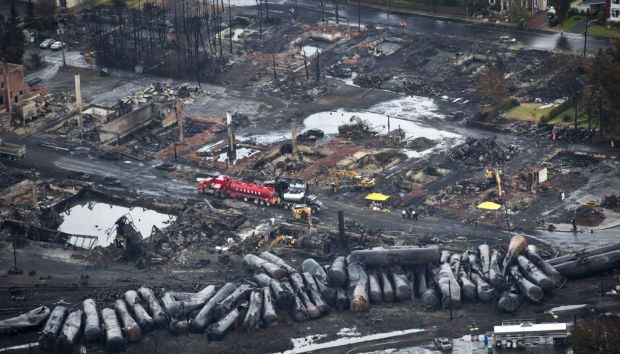
LAC-MEGANTIC, Quebec - Canadian authorities said Tuesday they have opened a criminal investigation into the fiery wreck of a runaway oil train in this small town as the death toll climbed to 15, with dozens more bodies feared buried in the burned-out ruins.
Quebec police Inspector Michel Forget said investigators have "discovered elements" that have led to a criminal probe. He gave no details but ruled out terrorism.
The death toll rose with the discovery of two more bodies Tuesday. About three dozen more people were missing. The bodies that have been recovered were burned so severely they have yet to be identified.
Investigators zeroed in on whether a fire on the train a few hours before the disaster set off a deadly chain of events that has raised questions about the safety of transporting oil in North America by rail instead of pipeline.
People are also reading…
The unmanned Montreal, Maine & Atlantic Railway train broke loose early Saturday and sped downhill in the darkness nearly seven miles before jumping the tracks at 63 mph near the Maine border. All but one of the 73 cars were carrying oil. At least five exploded.
Rail dispatchers had no chance to warn anyone during the train's 18-minute journey because they didn't know it was happening, Transportation Safety Board officials said Tuesday. Such warning systems are not in place on secondary rail lines, said safety board manager Ed Belkaloul.
The derailment and explosions destroyed about 30 buildings, including the Musi-Cafe, a popular bar that was filled at the time, and forced about a third of the town's 6,000 residents from their homes.
Resident Gilles Fluet saw the approaching train.
"It was moving at a hellish speed," he said. "No lights, no signals, nothing at all. There was no warning. It was a black blob that came out of nowhere."
He had just said goodbye to friends at the Musi-Cafe and left. "A half-minute later, and I wouldn't be talking to you right now," he said.
"There are those who ran fast and those who made the right decision. Those who fooled around trying to start their cars to leave the area, there are probably some who burned in them," Fluet said. "And some who weren't fast enough to escape the river of fire that ran down to the lake, they were roasted."
The same train caught fire hours earlier in a nearby town, and the engine was shut down - standard operating procedure dictated by the train's owners, Nantes Fire Chief Patrick Lambert said.
Edward Burkhardt, president and CEO of the railway's U.S.-based parent company, Rail World Inc., suggested that shutting off the locomotive to put out the fire might have disabled the brakes.
"An hour or so after the locomotive was shut down, the train rolled away," he told the Canadian Broadcasting Corp.
Lambert defended the fire department. "The people from MMA told us, 'That's great - the train is secure. There's no more fire. There's nothing anymore. There's no more danger,'" Lambert said. "We were given our leave, and we left."
Transport Canada, the government's transportation agency, said Tuesday there are no rules against leaving an unlocked, unmanned, running locomotive and its flammable cargo on a main rail line uphill from a populated area. Officials also said there is no limit on how many oil-filled, single-hull tank cars a train can pull.
Transportation Safety Board investigator Donald Ross said the locomotive's black box has been recovered but cautioned that the investigation was still in its early stages.
"It was moving at a hellish speed. No lights, no signals, nothing at all. There was no warning. It was a black blob that came out of nowhere."
Gilles Fluet, Lac-Megantic resident on runaway tanker cars


