

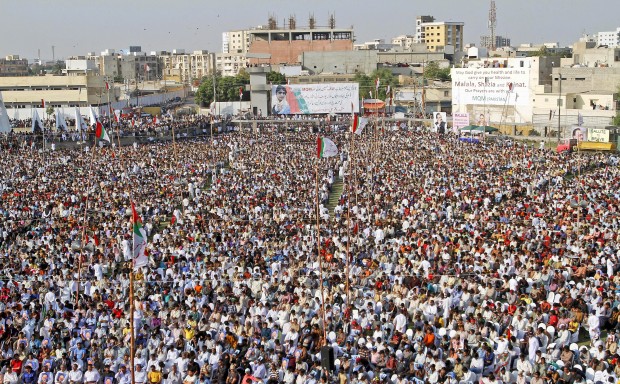
KARACHI, Pakistan - Tens of thousands rallied in Pakistan's largest city Sunday in the biggest show of support yet for a 14-year-old girl who was shot and seriously wounded by the Taliban for promoting girls' education and criticizing the militant group.
The Oct. 9 attack on Malala Yousufzai as she was returning home from school in Pakistan's northwest horrified people inside and outside the country. At the same time, it gave hope to some that the government would respond by intensifying its fight against the Taliban and their allies.
But protests against the shooting have been relatively small until now, usually attracting no more than a few hundred people. That response pales in comparison to the tens of thousands of people who held violent protests in Pakistan last month against a film produced in the United States that denigrated Islam's Prophet Muhammad.
People are also reading…
Demonstrations in support of Malala - and against rampant militant violence in the country in general - have also been fairly small compared with those focused on issues such as U.S. drone attacks and the NATO supply route to Afghanistan that runs through Pakistan.
Right-wing Islamic parties and organizations in Pakistan that regularly pull thousands of supporters into the streets to protest the U.S. have less of an incentive to speak out against the Taliban. The two share a desire to impose Islamic law in the country, even if they may disagree over the Taliban's violent tactics.
Pakistan's mainstream political parties are also often more willing to harangue the U.S. than direct their people power against Islamist militants shedding blood across the country - partly out of fear and partly because they rely on Islamist parties for electoral support.
One of the exceptions is the political party that organized Sunday's rally in the southern port city of Karachi, the Muttahida Quami Movement. The party's chief, Altaf Hussain, criticized both Islamic and other mainstream political parties for failing to organize rallies to protest the attack on Malala.
He called the Taliban gunmen who shot the girl "beasts" and said it was an attack on "the ideology of Pakistan."
"Malala Yousufzai is a beacon of knowledge. She is the daughter of the nation," Hussain told the audience by telephone from London, where he is in self-imposed exile because of legal cases pending against him in Pakistan. His party is strongest in Karachi.
Many of the demonstrators carried the young girl's picture and banners praising her bravery and expressing solidarity.
The leaders of Pakistan's main Islamic parties have criticized the shooting, but also have tried to redirect the conversation away from Taliban violence and toward civilian casualties from U.S. drone attacks.
Cyril Almeida, a columnist for Pakistan's Dawn newspaper, said this type of "obfuscation" prevents Pakistanis from seeing "there is a continuum from the religious right to violent Islamism."
"The religious right creates an enabling environment for violent Islamism to recruit and prosper. And violent Islamism makes state and society cower and in doing so enhances the space for the religious right," Almeida wrote in a column Sunday.


