

FUKUSHIMA, Japan - Japan announced the first signs that contamination from its tsunami-crippled nuclear complex has seeped into the food chain, saying that radiation levels in spinach and milk from farms near the facility exceeded government safety limits.
Japanese officials insisted that the small amounts of radiation - with traces also found in tap water in Tokyo - posed no immediate health threat. They also said the situation at the Fukushima Dai-ichi plant, while still unpredictable, appeared to be coming under control after near-constant dousing of water to prevent spent fuel rods from burning up.
Emergency teams using an unmanned vehicle to spray water targeting the most at-risk of the plant's six reactors launched a new round today - aimed at the plant's Unit 4 - while moving to switch power back on for the first time since a March 11 earthquake and tsunami knocked out the plant's crucial cooling systems.
People are also reading…
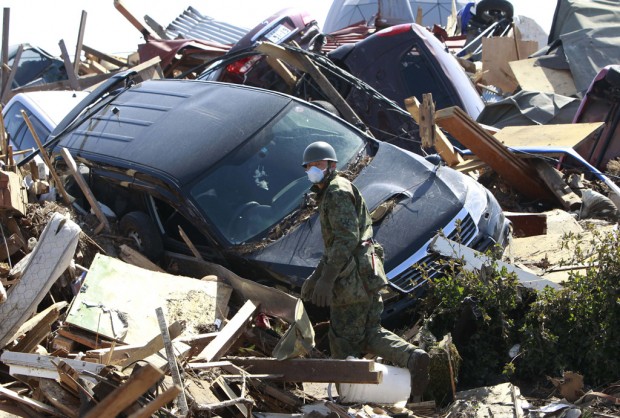
Japan has been struggling with an overwhelming chain of disasters prompted by the 9.0-magnitude quake. The quake spawned a tsunami that ravaged Japan's northeastern coast, killing more than 7,000 people and knocking out cooling systems at the plant, prompting overheated reactors and fuel to leak radiation.
More than 10,900 people are still missing, and more than 452,000 are living in shelters.
The government's top spokesman, Chief Cabinet Secretary Yukio Edano, said at a news conference Saturday that tainted milk and spinach were collected from several farms ranging from 20 miles to 75 miles from the reactors.
After the announcements, Japanese officials immediately tried to calm an already-jittery public, saying the amounts detected were so small that people would have to consume unimaginable amounts to endanger their health. "Can you imagine eating one kilogram of spinach every day for one year?" said State Secretary of Health Minister Yoko Komiyama. One kilogram is a little over two pounds.
Edano said someone drinking the tainted milk for one year would consume as much radiation as in a CT scan; for the spinach, it would be one-fifth of a CT scan. A CT scan is a compressed series of X-rays used for medical tests.
Minuscule amounts of radioactive iodine also were found in tap water Friday in Tokyo and elsewhere in Japan - although experts said none of those tests showed any health risks. The Health Ministry also said that radioactive iodine slightly above government safety limits was found in drinking water at one point Thursday in a sampling from Fukushima prefecture, the site of the nuclear plant, but later tests showed the level had fallen again.
An expert in the United States also said the risk from the radiation levels in food appeared limited and urged calm. "The most troubling thing to me is the fear that's out of proportion to the risk," said Dr. Henry Duval Royal, a radiologist at Washington University Medical School.
The areas where the spinach and milk were sampled are rich farm country also known for melons, rice and peaches, so the contamination could affect food supplies for large parts of Japan.
More tests were being done on other foods, Edano said, and if they show further contamination, then food shipments from the area would be halted.
Farmers worried that the crisis would crush demand, even for crops unaffected by the crisis.
"There will probably be damaging rumors," said a tearful Shizuko Kohata, 60, a farmer who was evacuated from a town near the nuclear plant by bus. She was staying at a sports arena just north of Tokyo. "I grow things and I'm worried about whether I can make it in the future."
Iodine levels in the spinach exceeded safety limits by three to seven times, a food safety official said. Tests on the milk done Wednesday detected small amounts of iodine-131 and cesium-137. High levels of iodine are linked to thyroid cancer, one of the least deadly cancers if treated. Cesium is a longer-lasting element that affects the whole body and raises cancer risk. But only iodine was detected Thursday and Friday, a Health Ministry official said.
The Health Ministry said iodine levels slightly above the safety limit were discovered Thursday in drinking water samples from Fukushima prefecture. On Friday, levels were about half that benchmark; by Saturday, they had fallen further.
More on the Japanese quake / A17


