

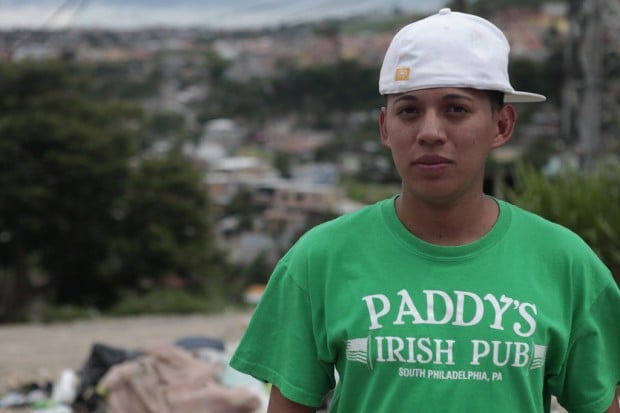
Marlon Roberto Cortes was stocking shelves in the frozen food section of a suburban Boston supermarket when he was summoned to the back office.
An immigration officer was waiting for him and asked to see his ID, which he didn't have. The 20-year-old Honduran was told there was an order to deport him.
Cortes missed, by three months, President Obama's decision last week to allow hundreds of thousands of illegal immigrants no older than 30 with high school degrees and no criminal history a chance to stay and work in the country.
From Guatemala to Argentina, recently deported young people who had dreamed of becoming U.S. citizens reacted to Friday's announcement with a mix of frustration and sadness.
"I am a person who studied, and I wish I could aspire to far greater things," said Cortes. "I'm sad."
People are also reading…
"The country in which I could have had the chance to get ahead is the United States," he added. "I did everything I had to do to get that, and I don't understand why they wouldn't let me ... I feel more American than Honduran."
Yannick Grijalba, an 18-year-old Guatemalan with fluent English who was deported on Wednesday after living 11 years in California, was equally frustrated.
"When I was watching the news today and heard, I just couldn't believe it," he said last week. "I had to turn the TV off."
It's unclear how many deported immigrants just missed their chance like Cortes because there are no available statistics that classify them by age or education.
The United States deported 396,906 people from Oct. 1, 2010, through Sept. 30, 2011. But one can spot the young and recently deported on Latin America's streets, where they sometimes fumble with their Spanish and have trouble fitting in.
On his first day back in Tegucigalpa, Cortes had to wake up before 5 a.m. to work with his grandparents selling baleadas, wheat tortillas stuffed with beans and meat, outside a hospital.
He said he has been stopped a couple of times by men on the streets of Honduras, which has a gang problem and among the world's highest homicide rates. "I don't even know the words, the rules and the signals they make," he said. "I am afraid to be on the streets alone.
"And if someone says I am a gringo, it is very dangerous for me because they will think I have money and will assault me."
Cortes noted that he graduated from a Chelsea, Massachusetts high school and would have met all the criteria of the new U.S. policy, which says that the immigrant must have been brought to the U.S. before they turned 16, be no older than 30 and have been in the country for at least five continuous years.
Now back in Honduras, Cortes calls his mother's cell phone every week or so to talk with her and his younger sister in the U.S, and tries to keep in touch with them and others on Facebook.
In Grijalba's case, his family flew from Guatemala to New York City with tourist visas in 2000.
The family later moved to Fairfield, California, where Grijalba became an honor-roll student and competed on the wrestling team at a local high school. Halfway through his junior year, he got into a fistfight with a boy from school over a girl. It led to an assault charge in juvenile court.
Grijalba kept on studying at the juvenile detention center and was hoping to graduate so he could go to a community college and earn a degree as a mechanic.
Immigration officers deported him weeks before he finished his classes.
Jobless and with no money, Grijalba is now back in Guatemala City, a place he barely recognizes, living downtown with an aunt, two uncles and a cousin.
"Everything is just really different here," he said. "My uncle took me around the city and everything here looks rundown with cracks on the walls and the dogs are so skinny."
"There are also guards with shotguns everywhere," he added. "Yesterday I had to go get Guatemalan documents. There were even guys with shotguns there."
Grijalba was noticeably awkward, in what is now a foreign country for him, from the moment he stepped off the plane at a Guatemalan Air Force base.
As the other deportees scrambled off the aircraft, Grijalba had the measured saunter of a high school kid in his baggy pants and Air Jordans as pre-recorded marimba music blasted from airport speakers.
Foreign Ministry officials then gave him and the other deportees their first meal back home: a bread roll and a paste of refried black beans, along with a juice box and a speech about how they will always be welcome in their native Guatemala.
Grijalba said he can't pursue a college degree in the country of his birth because he needs to work. His best bet, he said, is to apply for a job at a call center because English is his main language.


