

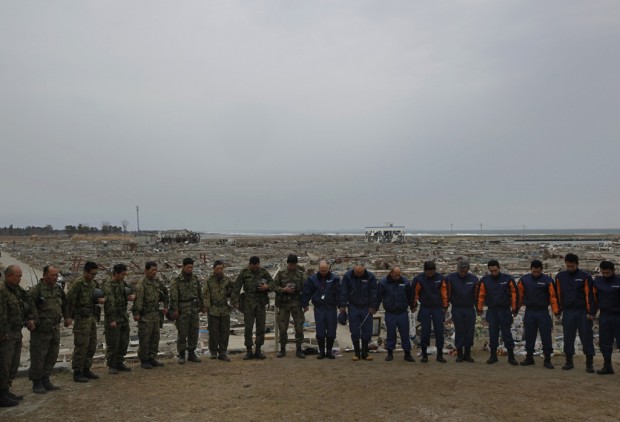
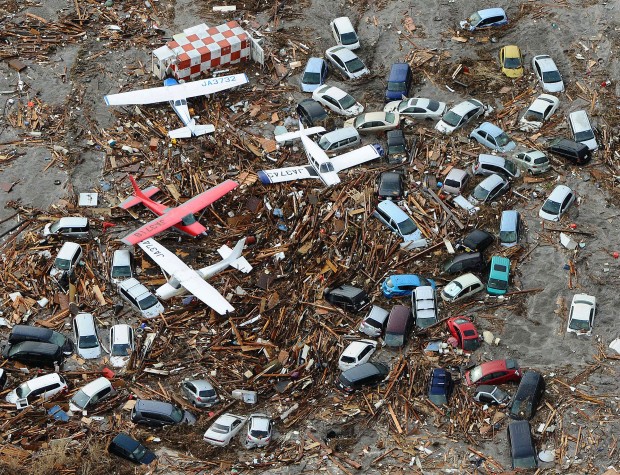
TOKYO - Japan's northeastern coast was a swampy wasteland of broken houses, overturned cars, sludge and dirty water today as the nation awoke to the devastating aftermath of one of its greatest disasters, a powerful tsunami created by one of the strongest earthquakes ever recorded.
The death toll from Friday's massive magnitude 8.9 quake stood at more than 400, but an untold number of bodies were believed to be lying in the rubble and debris, and Japanese were bracing for more bad news as authorities tried to reach the hardest-hit areas.
Aerial footage showed military helicopters lifting people on rescue tethers from rooftops and partially submerged buildings surrounded by water and debris. At one school, a large white "SOS" had been spelled out in English.
The earthquake that struck off the northeastern shore was the biggest recorded quake ever to hit Japan. It ranked as the fifth-largest earthquake in the world since 1900 and was nearly 8,000 times stronger than one that devastated Christchurch, New Zealand, last month, scientists said.
People are also reading…
Chief Cabinet Secretary Yukio Edano said an initial assessment found "enormous damage," adding that the Defense Ministry was sending troops to the hardest-hit region.
The official death toll stood at 413, while 784 people were missing and 1,128 injured. Police said 200 to 300 bodies were found along the coast in Sendai, the biggest city in the area. Authorities said they weren't able to reach the area because of damage to the roads.
Black smoke could still be seen in the skies around Sendai, presumably from gas pipes snapped by the quake or tsunami.
Early this morning, Atsushi Koshi, a 24-year-old call center worker in the coastal city of Tagajo, about 10 miles east of Sendai, said his cousin remained trapped on the roof of a department store with about 200 to 300 other people awaiting rescue. The store wasn't far from the port of Sendai, where the tsunami had washed ashore.
The rest of his family was safe, but he wondered what to do, since the house he shares with his parents was tilting from the quake and a concrete block wall had fallen apart.
"If we clean up our house it might be livable, but we're discussing what to do next," he said.
The quake shook dozens of cities and villages along a 1,300-mile stretch of coast and tall buildings swayed in Tokyo, hundreds of miles from the epicenter. Minutes later, the earthquake unleashed a 23-foot tsunami that washed far inland over fields and smashed towns.
The town of Rikuzentakada, population 24,700, in northern Iwate prefecture, looked largely submerged in muddy water, with hardly a trace of houses or buildings of any kind.
The entire Pacific had been put on alert - including coastal areas of South America, Canada and Alaska - but waves were not as bad as expected.
The U.S. Geological Survey said that after the initial huge quake, there were 123 aftershocks off Japan's main island of Honshu, 110 of them of magnitude 5.0 or higher
President Obama pledged U.S. assistance following what he called a potentially "catastrophic" disaster. He said one U.S. aircraft carrier is already in Japan and a second was on its way. A U.S. ship was also heading to the Marianas Islands to assist as needed, he added.
A large fire erupted at the Cosmo oil refinery in the city of Ichihara and burned out of control with 100-foot flames whipping into the sky.
Most trains in Tokyo started running again today after the city was brought to a near standstill Friday. Tens of thousands of people were stranded with the rail network down, and the streets were jammed with cars, buses and trucks trying to get out of the city.
The city set up 33 shelters in city hall, on university campuses and in government offices, but many planned to spend the night at 24-hour cafes, hotels and offices.
The quake struck at a depth of six miles, about 80 miles off Japan's east coast, the USGS said. The area is 240 miles northeast of Tokyo. Several quakes hit the same region in recent days, including one measured at magnitude 7.3 on Wednesday that caused no damage.
"The energy radiated by this quake is nearly equal to one month's worth of energy consumption" in the United States, USGS scientist Brian Atwater told The Associated Press.
Japan's worst previous quake was a magnitude 8.3 in Kanto that killed 143,000 people in 1923, according to the USGS. A magnitude 7.2 quake in Kobe killed 6,400 people in 1995.
Japan lies on the "Ring of Fire" - an arc of earthquake and volcanic zones stretching around the Pacific where about 90 percent of the world's quakes occur, including the one that triggered the Dec. 26, 2004, Indian Ocean tsunami that killed an estimated 230,000 people in 12 countries.
A magnitude-8.8 temblor that shook central Chile in February 2010 also generated a tsunami and killed 524 people.


