

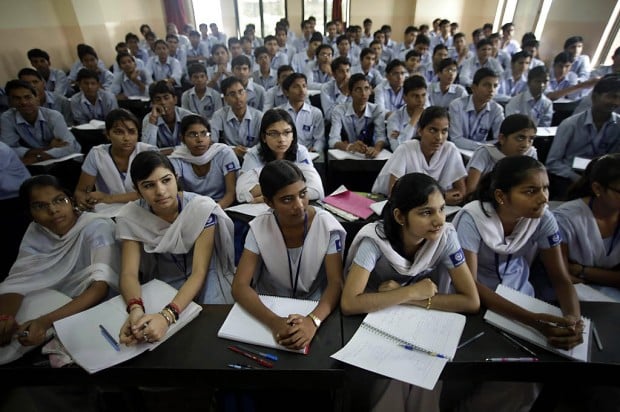
KOTA, India - The teenage boy, with his gentle smile and scraggle of whiskers, stands in the fading light of the day and talks about the college entrance exam that he is certain will change his life.
His name is Vijay Singh. He has been studying since long before dawn, as he has done every day since he arrived in this low-slung city of high school dreamers on the edge of India's northern deserts.
Three months ago he left home, effectively dropped out of high school and entered a highly competitive Kota cram school. For eight months he will study - every morning, every night, every day of the week - for a six-hour test. If he does well, it will propel him up the Indian social ladder.
His target is the Joint Entrance Examination, a multiple-choice test that teases young Indians with the golden ticket of this country's educational system: acceptance to the impossibly exclusive Indian Institutes of Technology.
People are also reading…
Imagine the entire Ivy League distilled into one small network of colleges. Imagine tens of millions of parents dreaming from their children's birth about the joy of acceptance. Imagine if there was no reliable second tier of science-oriented schools. That is the IIT.
Vijay Singh's mother is illiterate. His father, a retired soldier, never finished high school. His older brother is unemployed. In a country obsessed with status and bloodlines, he is from a caste officially termed an "Other Backward Class." Even in the small towns and ragged villages where the family carved out their lives, they didn't amount to much.
After Kota, he says, all that will change.
Cracks in the system
Every year, more than 450,000 students take the IIT exam, hoping for entry to the hallowed public engineering institutes scattered across India. Slightly more than 13,000 passed in 2010, a 3 percent success rate that makes Harvard, with its 7 percent acceptance, look like a safety school.
And for generations, there was little surprise about who got in.
India is a nation where the concept of social mobility barely existed until the last two decades. So the children of farmers spent their lives tilling soil. The children of Indian professionals, by and large, became professionals, too.
The IITs fit right in, as enclaves of the urban, the middle-class and the high-caste.
But over the past two decades, cracks have developed in India's centuries-old social system, forced open by one of the world's strongest economies.
Today, in a country where 300 million people live on less than $1 a day, the economy is growing at nearly 9 percent and the rich shop for Porsches and Louis Vuitton purses. The number of Indian millionaires jumped by 51 percent last year, reaching more than 127,000.
Amid the explosion of wealth and the growing economic divide, such hard-wired traditions as arranged marriages and dowry payments are now openly questioned, at least among the educated elite. Tens of millions of villagers are pouring into cities for better-paying jobs. A few dalits, as India's lowest-caste "untouchables" are now known, have reached corporate boardrooms.
In many ways, India has become a grand contradiction: a rapidly changing country where social mobility is possible, but still hobbled by deeply ingrained class attitudes.
Out of that contradiction has emerged the modern city of Kota and its biggest industry - cram schools.
Today, an estimated 40,000 students arrive here every year from across India to prepare for the IIT test.
They come because getting into IIT means family status and neighborhood bragging rights. A degree from the institutes, which charge barely $1,000 per year, can mean a lifetime of good-paying jobs, whether in engineering, software development or banking. IIT, perhaps more than anything else in modern India, has become the ultimate sign of success.
To critics, the cram schools are part of an educational system that leaves IIT students ill-prepared for anything more complex than memorization and prodigious work.
But about one-third of those who pass the IIT exam are believed to pass through Kota.
"The students think this and the parents think this: 'Once my child is in IIT, then his future is secure,' " says Pramod Maheshwari, the founder of Career Point, one of the city's largest cram schools, with 6,000 students preparing for the IIT exam.
Walk up to nearly any student here, and you'll find a story of pressure and ambition.
"Everybody who comes is here to study," says Singh, whose outward gentleness only partly hides the relentlessness of his ambitions. He comes from a north Indian region best known for bandits and bad soil. He has no desire to return. "The people who come here are the best and I need to compete against the best."
He knows exactly what he would get from a diploma. "If I have been to IIT," he says, "people will look at me with dignity."
So he came to Kota.
An educational destination
A decade ago, this riverside town was known, if at all, for its vast textile mills and high-quality saris. Here power revolved around a handful of executives and the former royal family.
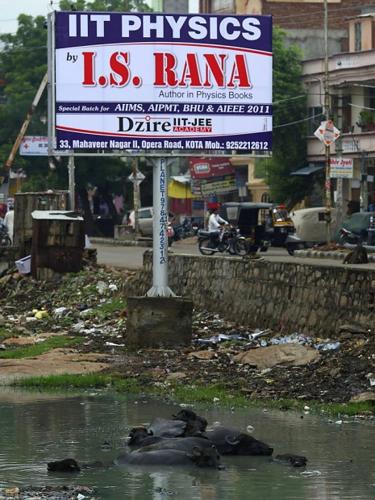
Today, it's an educational destination where ever-expanding schools battle for undeveloped lots, billboards herald the latest saviors ("Shervani Classes: Where Success Speaks for Itself!"), and hostels spill over with anxious students.
The town has no university, no research laboratory, no community of intellectuals. It doesn't have particularly good high schools.
What it has are cram schools.
Kota has more than 100 of them, from fly-by-night, one-teacher operations to marble-floored six-story institutions. It has become synonymous with IIT entry, drilling students in the brutal system of rote memorization at the core of the country's educational system.
As the Indian middle class has grown, cram schools - their proprietors prefer the term "coaching institutes" - have become commonplace. Every Indian city now has at least a couple. Most offer a few hours of classes per week.
But in Kota, it's complete immersion. Classes are normally held six days a week, with practice tests every fourth Sunday. That pace holds steady for the eight months leading up to the IIT exam.
It's a place where school grades, caste and family connections don't matter. If you can afford the fees (up to $1,700) and pass the cram school's own entrance test (the top schools reject about 30 percent of applicants), you're in.
Today, there are so many students that new hostels are built every few months, so many that there are bicycle traffic jams.
But it is a city made for rote learning.
It has no discos, no bar culture, no sports teams. With girls still just a small percentage of the population, both in Kota and at the IITs, the social whirl is nonexistent.
Kota is desperately dull. Deliberately dull.
"My father sent me here because he didn't want me to hang out with my friends, he didn't want me to have fun," says Prashanth Singh, leaving the Delight Cyber Cafe, where teenage boys played video games or watched B-movies with lots of bikinis and bouncing cleavage.
Once, Singh dreamed of becoming an airline pilot, but his father thought differently.
"Engineering," his father said. And in the way of Indian families, Singh is now cramming for engineering.


