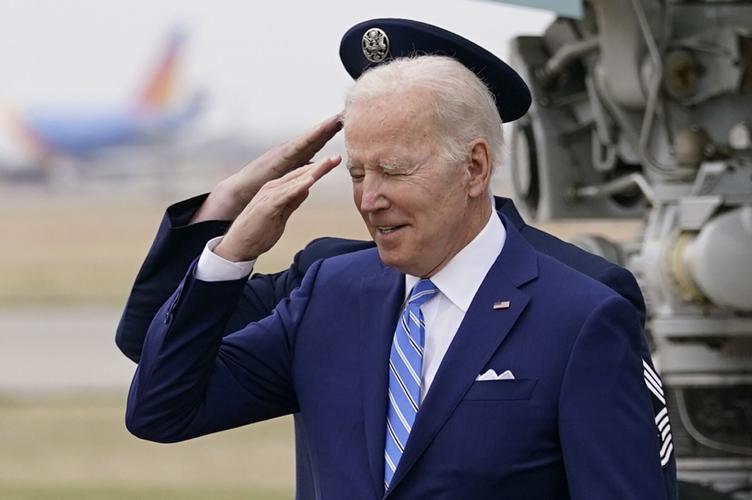
President Joe Biden salutes as he arrives on Air Force One at Des Moines International Airport, in Des Moines Iowa, Tuesday, April 12, 2022, en route to Menlo, Iowa. (AP Photo/Carolyn Kaster)
WASHINGTON (AP) — When President Joe Biden declares Russia's Ukraine war "genocide," it isn't just another strong word.
Calling a campaign that's aimed at wiping out a targeted group "genocide" not only increases pressure on a country to act, it can oblige it to. That's partly because of a genocide treaty approved by the U.N. General Assembly after World War II, signed by the United States and more than 150 other nations.
The convention was the work of, among others, a Polish Jew whose family was murdered by Nazi Germany and its accomplices. The advocates pushed for something that would make the world not just condemn but actually prevent and ensure prosecution for future genocides.
In comments Tuesday, Biden accused Russian President Vladimir Putin of trying to "wipe out the idea of even being a Ukrainian." Other world leaders have not gone as far. British Prime Minister Boris Johnson has said Russia's behavior in Ukraine "doesn't look far short of genocide," but the U.K. has not officially used the term, saying only a court can make such a designation.
People are also reading…
A look at what's involved in that decision, and what it means when a world leader declares a genocide:
WHAT DOES 'GENOCIDE' MEAN?
It's a surprisingly modern word for an ancient crime. A Jewish lawyer from Poland, Raphael Lemkin, coined it at the height of World War II and the Holocaust. Lemkin wanted a word to describe what Nazi Germany was then doing to Europe's Jews, and what Turkey had done to Armenians in the 1910s: killing members of a targeted group of people, and ruthlessly working to eradicate their cultures.
Lemkin paired "geno," a Greek word meaning race, and "cide," a Latin word meaning kill. Lemkin dedicated his life to having genocide recognized and criminalized.
In 1948, after Adolf Hitler and his accomplices systematically murdered 6 million Jews in Europe, the U.N. General Assembly approved the Convention on the Prevention of the Crime of Genocide.
WHAT'S THE LEGAL DEFINITION?
Under the genocide convention, the crime is trying to destroy a national, ethnic, racial or religious group, in part or in whole.
That includes mass killings, but also actions including forced sterilization, abuse that inflicts serious harm or mental suffering, or wrenching children of a targeted group away to be raised by others.
IS RUSSIA COMMITTING GENOCIDE IN UKRAINE?
The case may hang in part on Putin's own words.
Russian forces are widely accused of carrying out wholesale abuses of Ukraine's civilians, including mass killings.
Those would be war crimes. But do they amount to genocide?
It's all about intent, argues Bohdan Vitvitsky, a former U.S. federal prosecutor and former special adviser to Ukraine's prosecutor general.
"Any attempt to determine whether the crimes committed by Russian troops in Ukraine are driven by genocidal intent must necessarily focus on the statements of Russian President Vladimir Putin," Vitvisky wrote for the Atlantic Council think tank this week.
Putin long has denied any standing for Ukraine to exist as a separate nation, or Ukrainians as a separate people. He cites history, when Ukraine was part of the Russian empire, and later of the Soviet Union.
In a long essay last year, "On the Historical Unity of Russians and Ukrainians," Putin made clear the depth of his determination on the matter. He called the modern border dividing Russia and Ukraine "our great common misfortune and tragedy."
Putin and Russian state media falsely call Ukrainian leaders "Nazis" and "drug addicts." Putin has called his military campaign in Ukraine one of de-Nazification.
Gissou Nia, a human-rights lawyer who worked on war crime trials at the Hague, points to two alleged acts by Russia in Ukraine as also possibly showing intent of genocide: Reports of deportation of thousands of Ukrainian children to Russia, and an account, from Ukraine's government, of Russian soldiers telling 25 detained women and girls in Bucha that the Russians aimed to rape them to the point that they never bear any Ukrainian children.

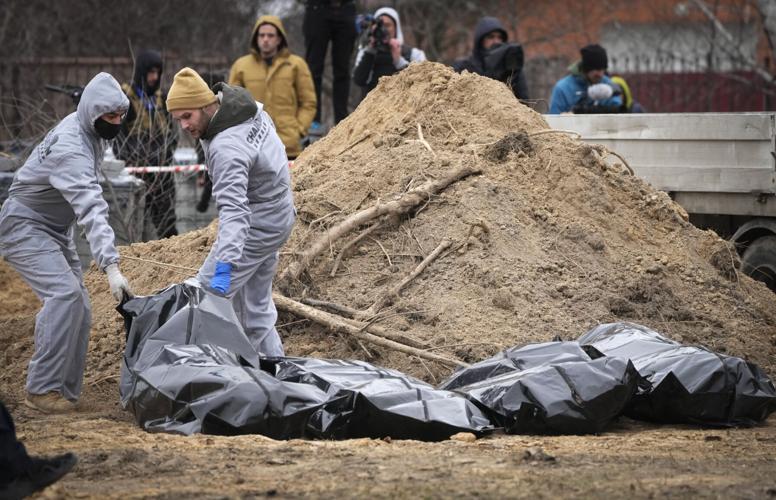
Men wearing protective gear exhume the bodies of civilians killed during the Russian occupation in Bucha, in the outskirts of Kyiv, Ukraine, Wednesday, April 13, 2022. Dozens of bodies of civilians executed by the Russian troops have been exhumed already from the mass grave. (AP Photo/Efrem Lukatsky)
WHY DOES IT MATTER IF WORLD LEADERS USE "GENOCIDE" TO DESCRIBE RUSSIA'S ACTIONS?
Embedded in the genocide convention is an obligation that the U.S. and other signers of the treaty have treated warily — if they acknowledge a genocide is occurring, they're committed to ensuring investigation and prosecution, at the least.
People and countries committing genocide "shall be punished," the treaty declares, seeking to crush any wiggle room.
U.S. leaders for decades dodged using the word "genocide" to avoid increasing the pressure on them to act as mass killings targeted classes of people or ethnic groups in Cambodia, Bosnia, Iraq, Rwanda and elsewhere.
Regretting his failure to do more to stop the killing of 800,000 ethnic Tutsis by Hutus in Rwanda in 1994, Bill Clinton in June 1999 became the first U.S. president to recognize an act of genocide as it was playing out, saying Serb forces carrying out a deadly campaign against ethnic Albanians in Kosovo were attempting genocide.
NATO intervened, lobbing 78 days of airstrikes that forced Serbian fighters' withdrawal from Kosovo. An international tribunal charged Serbian leader Slobodan Milosevic with war crimes, although Milosevic died before his trial concluded.
Starting in 2005, world also leaders embraced – in principle – responsibility for collective action to stop genocide, war crimes and crimes against humanity. Atrocities and targeted campaigns against groups continue around the world, however, and the so-called responsibility to protect is seldom invoked.

WHAT HAPPENS IF THE U.S. DOES DECLARE RUSSIAN ACTIONS TO BE GENOCIDE?
U.S. leaders long have feared that acknowledging genocide would require them to intervene, even to send in troops, with all the risks, costs and political backlash that would entail. It's been a main reason leaders limit themselves to angry statements and humanitarian aid.
Biden is adamant the U.S. will not use its own military to confront Russian forces on behalf of Ukraine. Doing so would risk World War III, he says.
He and allies in Europe and elsewhere already are intervening by sanctioning Russia and by sending weapons and other support to Ukraine for its defense.
Biden and other Western leaders also have called for war crimes trials. The International Criminal Court already has started an investigation. But longstanding U.S. opposition to the International Criminal Court, over worries that U.S. troops could face prosecution there one day, complicates such prosecutions. So can Russia's veto power on the U.N. Security Council. And practically speaking, bringing Putin before a court is a long shot.
In the past, Americans' opposition to entanglement in foreign wars also has helped discourage U.S. leaders from doing more to stop possible acts of genocide.
But Russia's invasion of a neighboring country and brutality against Ukraine's people have angered Americans in a way that genocidal campaigns in Cambodia, Kurdish areas of Iraq and elsewhere did not.
A recent poll by the Associated Press and NORC Center for Public Affairs Research found that 40% of people in America believe the U.S. should have a "major role" in ending Russia's invasion. Just 13% think the U.S. shouldn't be involved at all.
___
Photos: A devastating walk through Bucha's horror

FILE - Ira Gavriluk holds her cat as she walks next to the corpses of her husband and her brother, who were killed in Bucha, on the outskirts of Kyiv, Ukraine, Monday, April 4, 2022. (AP Photo/Rodrigo Abd, File)

FILE - A neighbor comforts Natalya, whose husband and nephew were killed by Russian forces, as she cries in her garden in Bucha, Ukraine, Monday, April 4, 2022. (AP Photo/Vadim Ghirda, File)

FILE - Vladyslav Minchenko, left, with policemen collect information next to corpses of civilians killed in Bucha, before the corpses are transported to the morgue, on the outskirts of Kyiv, Ukraine, Wednesday, April 6, 2022. (AP Photo/Rodrigo Abd, File)

FILE - The body of a man who was killed lies in the staircase of a building in Bucha, Ukraine, Sunday, April 3, 2022. (AP Photo/Vadim Ghirda, File)

FiLE - Municipal workers remove the body of a man who died from a house in Bucha, Ukraine, Thursday, April 7, 2022. (AP Photo/Vadim Ghirda, File)

FILE - A family walks amid destroyed Russian tanks in Bucha, on the outskirts of Kyiv, Ukraine, Wednesday, April 6, 2022. (AP Photo/Felipe Dana, File)

FILE - A dog passes near another dog that was killed in the courtyard of a house in Bucha, on the outskirts of Kyiv, Ukraine, Tuesday, April 5, 2022. (AP Photo/Rodrigo Abd, File)

A woman cooks on an open fire outside an apartment building which according to residents has no gas, water, electricity and heating for more than a month in the formerly Russian-occupied Kyiv suburb of Bucha, Ukraine, Saturday, April 2, 2022. (AP Photo/Vadim Ghirda)

FILE - A man and child ride on a bicycle as bodies of civilians lie in the street in the formerly Russian-occupied Kyiv suburb of Bucha, Ukraine, Saturday, April 2, 2022. (AP Photo/Vadim Ghirda, File)

FILE - Tanya Nedashkivs'ka, 57, mourns the death of her husband on the site where he was buried, in Bucha, on the outskirts of Kyiv, Ukraine, Monday, April 4, 2022. (AP Photo/Rodrigo Abd)

FILE - A Ukrainian serviceman uses a piece of wood to check if the body of a man dressed in civilian clothing is booby-trapped with explosive devices, in the formerly Russian-occupied Kyiv suburb of Bucha, Ukraine, Saturday, April 2, 2022. (AP Photo/Vadim Ghirda)

FILE - A dog stands next to the body of an elderly woman killed at the entrance of her house in Bucha, outskirts of Kyiv, Ukraine, Tuesday, April 5, 2022. (AP Photo/Felipe Dana, File)

FILE - Nina Kirinchenko, 90, greets journalists next to her husband in part of a building that was converted as housing for 400 people, since apartments were used by Russian soldiers during the occupation of Bucha, on the outskirts of Kyiv, Ukraine, April 4, 2022. (AP Photo/Rodrigo Abd, File)

The body of a man who was killed with his hands tied behind his back lies on the ground in Bucha, Ukraine, Sunday, April 3, 2022. (AP Photo/Vadim Ghirda)

FILE - Bodies lie in a mass grave in Bucha, on the outskirts of Kyiv, Ukraine, Sunday, April 3, 2022. (AP Photo/Rodrigo Abd, File)

FILE - A woman cries as residents listen to a Ukrainian serviceman speaking after a convoy of military and aid vehicles arrived in the formerly Russian-occupied Kyiv suburb of Bucha, Ukraine, April 2, 2022. (AP Photo/Vadim Ghirda)