

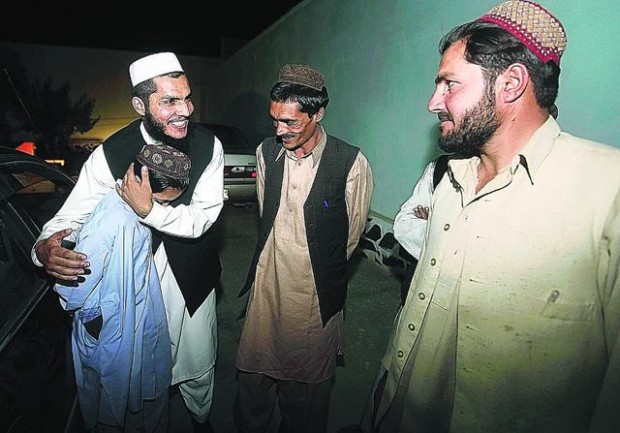
KABUL — A young Afghan held for six years at the U.S. military prison at Guantanamo Bay, Cuba, rejoined his family in southern Kabul late Monday, ending an odyssey that came to symbolize many of the problems of the Bush administration's war-on-terror detention policies.
Mohammed Jawad, who may have been as young as 12 when he was arrested in 2002 on suspicion of throwing a grenade that wounded two American soldiers, pronounced himself "very happy" but tired after a day in which he arrived in Afghanistan on a U.S. military flight, in shackles and blindfolded, according to his lawyer.
He then met with Afghan- istan's attorney general and President Hamid Karzai before he was driven by the attorney general to his family's rented brick home in a modest Kabul neighborhood.
"I am very happy that I am back home with my family," Jawad said before he begged off answering questions, citing a headache.
People are also reading…
Jawad's journey home began in October, when a U.S. military judge at Guantanamo ruled that Afghan police had threatened during his interrogation to kill both Jawad and his family if he didn't confess to throwing a grenade that injured two reservists from California and their Afghan interpreter. Those threats constituted torture, Army Col. Stephen Henley said, ruling that the confession therefore wasn't admissible as evidence.
On July 30, U.S. District Judge Ellen Segal Huvelle in Washington cited that ruling in ordering Jawad's release, saying that without the confession, there was no evidence to link Jawad to the grenade attack.
Justice Department lawyers said they would seek new evidence against him, but in the end, no additional charges were filed, the military withdrew its charges, and Jawad arrived in Afghanistan hours before the Justice Department was due to report back to Huvelle on his status.
Marine Maj. Eric Montalvo, one of Jawad's military lawyers who flew to Afghanistan to witness Jawad's release, said he had remained uncertain that Jawad would go free until he saw him actually rejoin his family.
"I don't trust anything until I see him in his house with his family," said Montalvo, who flew to Afghanistan as a private citizen after the Pentagon denied him permission to do so in his official capacity.
Another of Jawad's defense attorneys, Air Force Reserve Maj. David Frakt, credited Montalvo's presence with ensuring that Jawad went free and wasn't imprisoned again.
"When Major Montalvo arrived this morning, he went straight to the attorney general's office and learned that Jawad was being transported to an Afghan prison. Major Montalvo intervened and persuaded the AG to divert Jawad directly to the AG's office," Frakt said in a statement. "Jawad had a happy reunion with Eric, then Jawad's family was summoned and they all convened in the AG's office for a tearful and joyous reunion."
Montalvo's trip to Afghanistan was paid for by the American Civil Liberties Union, Human Rights Watch and an unidentified North Carolina donor.


