

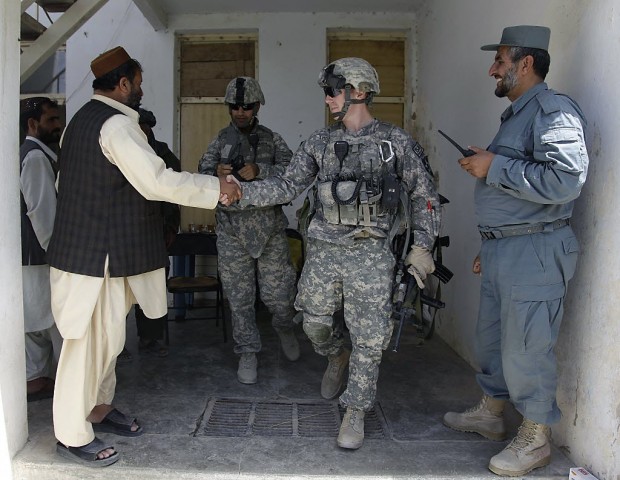
HUTAL, Afghanistan - In the U.S. Army, Casey Thoreen is just a 30-year-old captain. Around here, he's known as the "King of Maiwand" district - testimony to the fact that without the young captain and a fat international wallet, local government here as in much of the insurgency-ravaged south could not function at all.
Setting up effective governments at the district level is key to U.S. strategy. U.S. officials hope that providing basic services will draw support away from the Taliban, especially here in the Islamist group's heartland of Kandahar province.
But in this dusty farming community 40 miles west of Kandahar, Thoreen has discovered that bolstering the authority of a district governor, who relies on him almost completely for financial resources and credibility, is a delicate balancing act. He also knows the effort is unsustainable without greater support from the central Afghan government in Kabul.
People are also reading…
"We are putting a big gamble on this," Thoreen said. "Any of this stuff we're doing here, not just at our level but the $800 billion we have spent so far in the country, is contingent on the government being effective."
Few resources
For now, Thoreen and Maiwand's district governor, Obaidullah Bawari, are working with what they have - which isn't much.
The 49-year-old Bawari, who has occupied the post for a year, has no staff except his personal assistant and no government budget except for the roughly $400 monthly salary that he receives from Kabul. He is responsible for civilian government operations in the district, including water, power and schools, and he mediates disputes.
There are about 150 Afghan police deployed in Maiwand, but they report to both the chief of police in Kandahar City as well as the provincial governor.
"Everything you see here is from the coalition forces," said Bawari, sweeping his hand toward the center of the district capital, Hutal, where the Army has paid for a new government headquarters, an agricultural center and various other projects.
It's a picture repeated across the country, including the ethnic Pashtun heartland of southern Afghanistan where opposition to the government and support for the Taliban run deep.
Afghan government outreach
The Afghan government recently launched a new program backed by the U.S. to increase support to 80 key districts in the country, many of them in the south and east.
But Kandahar's provincial governor, Tooryalai Wesa, visited Maiwand for the first time recently and said he didn't have any additional resources to offer the district.
"That kind of blew my mind," said Thoreen, a West Point graduate from Seattle. "After nine years in Afghanistan we're still at this point."
When the troops from 2nd Battalion, 1st Infantry Regiment first arrived in Hutal in September, Bawari basically had no authority within the district because he doesn't come from a powerful family and isn't well-educated.
"He was very intimidated, very helpless and had no sense of his responsibilities," Thoreen said.
The troops, who live in a small base in the middle of Hutal, have tried to boost Bawari's standing by encouraging him to take credit for development projects the U.S. military funded. They have also set up a series of traditional meetings with tribal elders.
But the dynamic gets more complicated when Thoreen and the district governor disagree on an issue.
Such a situation arose at a recent shura when 25 farmers showed up to demand the return of more than 300 pounds of opium that Special Forces had seized from a car.
Thoreen refused to return the opium or compensate them for it, saying U.S. forces have been clear that while they will not seize drugs from individual farmers, they will target smugglers. He sidelined Bawari during the debate. Afterward, Bawari complained that the captain's decision damaged his credibility.
US toll in Afghanistan
• Deaths: 964
• Wounded: 5,676
Latest identifications
• 1st Lt. Salvatore S. Corma, 24, of Wenonah, N.J.; assigned to the 2nd Battalion, 508th Parachute Infantry Regiment, 4th Brigade Combat Team, 82nd Airborne Division, Fort Bragg, N.C.
SOURCE: Department of Defense.


