

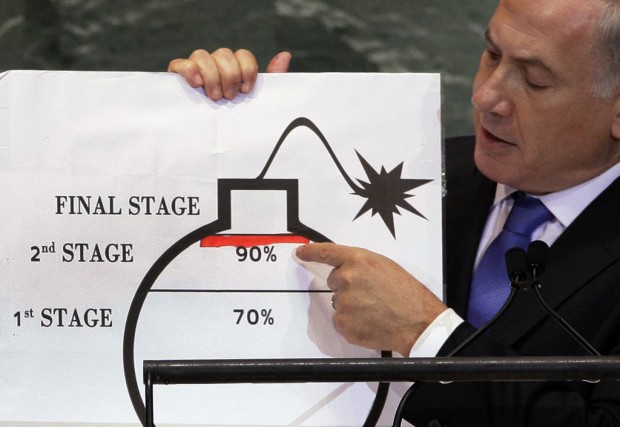
JERUSALEM - When Israeli Prime Minister Benjamin Netanyahu held up a cartoonlike drawing of a bomb during his speech at the U.N., he set off an explosion of jokes and mockery - but it also got plenty of attention.
The Bibi Bomb, as it's being called using Netanyahu's nickname, is the latest prop used by the Israeli leader as he tries to keep the global spotlight on Iran's disputed nuclear program.
The image of Netanyahu and the diagram of a bomb with a lighted fuse was top news around the world. Headlines in Europe referred to Netanyahu's "bomb cartoon" and "comic strip."
"How much enriched uranium do you need for a bomb? And how close is Iran to getting it?" Netanyahu asked in his speech Thursday to the U.N. General Assembly. "Well, let me show you. I brought a diagram."
He used a marker to draw a red line across what he said was a threshold that Iran was approaching and that Israel could not tolerate - 90 percent of the way to the uranium enrichment needed to make a nuclear weapon.
People are also reading…
Netanyahu is a fan of visual aids. At the U.N. in 2009, he waved the blueprints for the Nazi death camp at Auschwitz. For a speech to the pro-Israel lobby AIPAC in March, he brought letters between the World Jewish Congress and the U.S. government written during the Holocaust.
Within hours of Netanyahu's speech Thursday, the stunt was fodder for jokes.
On "The Daily Show," Jon Stewart mocked Netanyahu's simplistic drawing by saying: "Bibi, bubbe. What's with the Wile E. Coyote nuclear bomb?" Stewart then presented his solution to counter such a weapon by holding up a drawing of an equally cartoonish giant magnet.
Barcelona's El Periodico newspaper poked fun at the drawing in a headline that said Netanyahu used "a ridiculous chart" to warn about Tehran's nuclear program. Madrid's El Mundo said: "Netanyahu explains the nuclear threat with a comic strip."
But even the mockery was welcomed by Netanyahu supporters.
The jokes "are maybe part of the success because it was an unforgettable speech that delivered its message," Deputy Foreign Minister Danny Ayalon told Israel's Channel 2 TV. "Today everyone is talking about it."
While the simplistic drawing displayed by Netanyahu succeeded in grabbing attention, it's not clear what effect it will have on the international community.
Netanyahu has repeatedly been at odds with world powers over Iran's nuclear program. He has argued that time is running out to stop Iran from becoming a nuclear power and that the threat of force must be seriously considered.
Israel considers a nuclear-armed Iran to be an existential threat, citing Iranian denials of the Holocaust, its calls for Israel's destruction, its development of missiles capable of striking the Jewish state and its support for hostile Arab militant groups. Iran says its nuclear program is for civilian purposes, a claim rejected by much of the international community.


