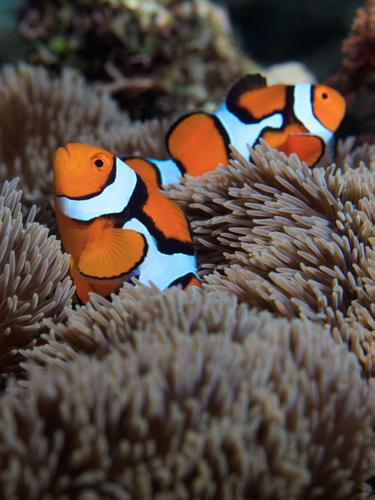
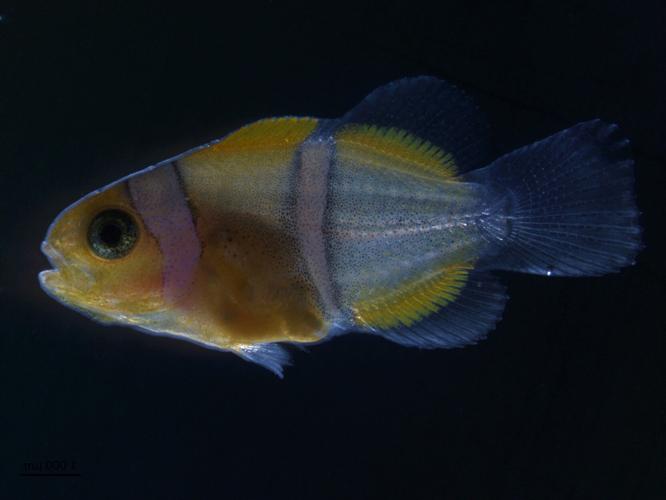
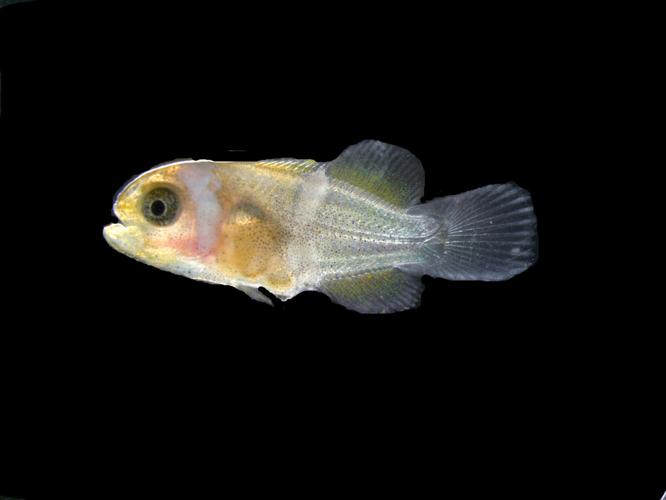
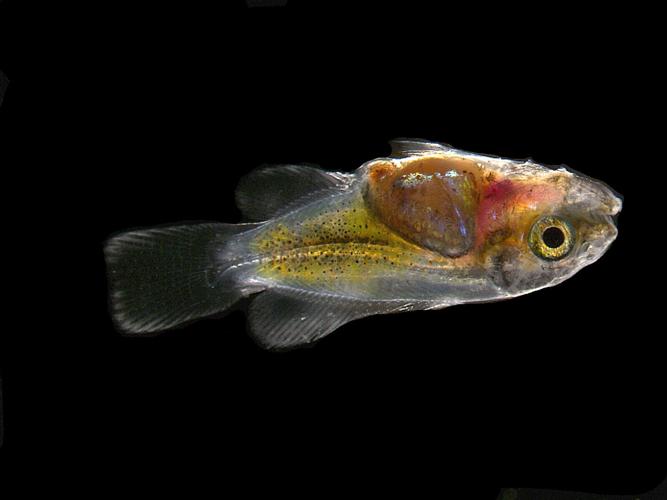
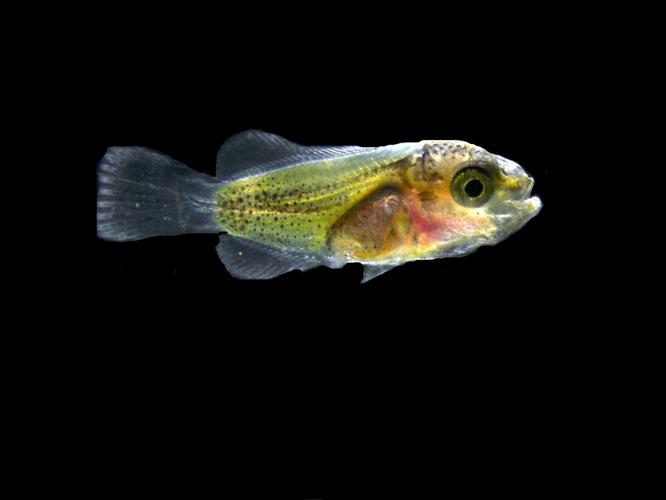
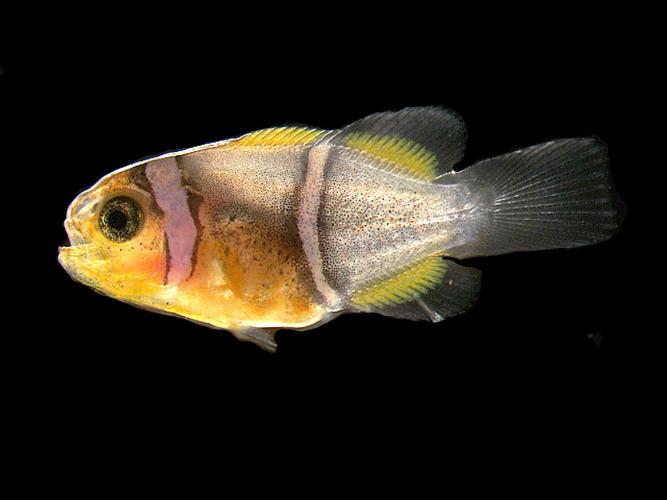
With its vibrant orange color and white stripes, also known as bars, the clownfish is among the most iconic sea creatures. But how does Nemo develop its distinctive look? Scientists are learning more about that process.
The speed at which a clownfish develops its white bars is connected to which sea anemone species it decides to live in, a new study published on Monday in PNAS has found.
Clownfish live symbiotically with either of two sea anemone species: Heteractis magnifica -- also known as the magnificent sea anemone, characterized by longer, flowing tentacles -- and Stichodactyla gigantea, or giant carpet anemone, a more toxic variety with shorter tentacles.
Observing clownfish of the Amphiprion percula species in Kimbe Bay, Papua New Guinea, scientists noticed that clownfish living in giant carpet anemones would develop their white bars more rapidly than clownfish living in magnificent sea anemones.
People are also reading…
In this video, an anemonefish, also known as clownfish, swims around a magnificent anemone underwater. Credit: 'Sellamoment' via 'My Dive Video'
Lab analyses on the wild clownfish found that the ones living in the giant carpet anemones exhibited a higher level of thyroid hormones and of a gene called duox, which has an important role in the formation of thyroid hormones.
It had already been known that a closely related clownfish species, Amphiprion ocellaris, develops its white bars during the metamorphosis process, when thyroid hormones are responsible for a variety of morphological changes as larvae transform into juvenile fish. With this in mind, researchers of this latest study analyzed whether the speed at which the bars developed was connected to the level of thydroid hormones.
By exposing A. ocellaris clownfish to different dosages of thyroid hormones, and to thyroid hormone-blocking chemicals, scientists found a connection between higher hormone levels and faster formation of the white bars. The research team also demonstrated that clownfish exposed to thyroid hormone-blocking chemicals developed more translucent bars and had a decreased orange coloration, the study said.
Finding proof that thyroid hormone levels control the rate of white bar formation both in the lab and in the wild was "a great moment," said study coauthor Vincent Laudet, a professor who leads the Marine Eco-Evo-Devo unit at the Okinawa Institute of Science and Technology Graduate University in Japan and the Academia Sinica in Taiwan.
"The significance of the result is to show how hormones can change the development of an organism according to environmental changes," Laudet explained.
"This is called phenotypic plasticity and there are not many cases for which we know how it works," he added.
Nemo, the anemone, and many open questions
Clownfish live in sea anemones for protection, according to Laudet. The anemones "have stinging tentacles that can kill other fishes but not clownfish," he explained.
It's still unclear how clownfish avoid triggering sea anemone tentacles, or how they choose between species of sea anemone.
We also don't yet know why clownfish living in giant carpet anemones presented higher levels of thyroid hormones than those that didn't. That, according to Laudet, might have something to do with adapting to the harsher environment presented by that species of anemone, which is more toxic than the magnificent sea anemone and with shorter tentacles, providing less shelter.

Orange clownfish, or Amphiprion percula, are shown in Kimbe Bay, Papua New Guinea. How quickly this fish develops its stripes depends on the sea anemone species it chooses to live in, a study has found.
Laudet thinks it's possible that different thyroid hormone levels could also impact other factors in the life of clownfish, such as immunity, metabolism and appetite.
"The problem is that we have a very poor understanding of the environment of the clownfish within their sea anemone. They probably are sensitive to things that for us are invisible," Laudet said.
"My dream would be to be able to sense like a clownfish to better appreciate the difference between the two sea anemone species. I am convinced that for them it is huge!" Laudet added.
Pauline Salis, the study's first author and a postdoctoral researcher at the Observatoire Océanologique de Banyuls-sur-Mer, Sorbonne Université Paris and the French National Centre for Scientific Research, spoke to CNN about how complementary approaches among the researchers benefited the study, which took four years to complete.
While Laudet is interested in the role of thyroid hormones in ecology and evolution, Salis studied how cells interact during development to shape tissue. "I'm mostly interested in understanding how color patterns are formed," Salis explained via email.
Salis told CNN observing clownfish in aquariums is fascinating.
"It is just crazy to see how each clownfish individual has its own behavior. Whereas some are very curious, others are very aggressive," she explained.
As scientists continue researching open questions about the clownfish and its environment, Salis is looking forward to observations in the field to better understand this charismatic sea creature.
***
Photos: Fishing, harvest of eggs blamed for drop in sea turtles

This July 5, 2017, photo shows a leatherback turtle swimming in the Pacific Ocean near Moss Landing, Calif. All seven distinct populations of leatherbacks in the world are troubled, but a new study shows an 80% population drop in just 30 years for one extraordinary sub-group that migrates 7,000 miles across the Pacific Ocean to feed on jellyfish in cold waters off California. Scientists say international fishing and the harvest of eggs from nesting beaches in the western Pacific are to blame. (Kate Cummings via AP)

In this photo taken Sept. 25, 2007, in the waters off central California, scientists including Scott Benson, at far left, can be seen posing with a giant western Pacific leatherback sea turtle as they take measurements and attach a GOP satellite tracking device to its shell. (Heather Harris/NOAA-ESA Permit #15634 via AP)

In this aerial photo provided by Joel Schumacher, scientists in a research boat pursue a Pacific leatherback turtle in the Pacific Ocean off California in September 2016. (Joel Schumacher via AP)

A leatherback turtle is seen in Monterey, Calif., during a scientific expedition to research the turtles' migration patterns. (Scott Benson via AP)

Scott Benson, an ecologist and leatherback turtle expert with the National Oceanic and Atmospheric Administration Fisheries Service, looks out over the water from his research boat in Monterey, Calif., on March 25, 2021. Benson has studied western Pacific leatherback turtles for decades and recently co-authored a study that shows an 80% population drop in just 30 years for one extraordinary sub-group that migrates 7,000 miles across the Pacific Ocean to feed on jellyfish in cold waters off California. (AP Photo/Haven Daley)