

Halloween is the second-largest commercial holiday in the U.S., with Americans spending about $13 billion dollars celebrating it this year.
It wasn’t always so. Halloween did not start to become a major holiday until the 1950s, when trick-or-treating became widespread. Prior to that, Oct. 31 was still largely known as All Hallow’s Eve, the day before All Saints’ Day.
Nov. 2 is All Souls’ Day. Few people outside the Catholic faith celebrate or even know about that, and I don’t think anybody tracks its economic impact. Nobody in my neighborhood decorates their yard for All Souls’ Day.
In fact, we don’t talk much about souls anymore, except when someone dies. And that is curious because 86% of Americans believe they have a soul. I don’t even know what people mean when they say they have a soul.
When it comes to thinking about souls, we have inherited two dominant traditions. The first is spiritual. Most of the major world religions subscribe to some version of the view that human beings are essentially spiritual creatures who have bodies for a time. The soul is permanent; the body is temporary.
People are also reading…
The second tradition is scientific. It begins with René Descartes in the 17th century and comes through Gregor Mendel and Charles Darwin. This way of thinking says that human beings are material, just like everything else in the universe. If there is any uniqueness to humanity, it is due to our neural complexity. The phenomenon of consciousness arises out of our ability to use language in sophisticated ways.
Sigmund Freud thought a third way of understanding ourselves was necessary. He distrusted both clergy and medical doctors. So, he looked back to Greek and Roman myths for a way to describe how we can come to understand ourselves.
He called this way of approaching self-understanding “psychoanalysis,” after the story of Psyche, who traveled to the underworld to be reunited with Eros, the god of Love. The chief aim of psychoanalysis — which Freud referred to as “the talking cure” — was to help us understand ourselves.
It might seem odd to say that Freud helps us understand the soul, but that’s only because every reference Freud makes to the soul (the German “seele”) was translated into English as “mind” or “intellect.”
Freud claimed that most of our thoughts and feelings are unconscious. And if we do not know how to reconcile our unconscious drives with our conscious thoughts and expressions, we are going to find ourselves in trouble.
He wasn’t the first to realize this. The idea that impulses deep within us can cause conflict go back a long way. In the Christian tradition, the explanation for this is our sinful nature. St. Paul says, “I do not understand what I do. For what I want to do I do not do, but what I hate I do.”
For Freud, the struggles that take place within the soul get expressed in the culture. If we are puzzled by what is taking place in our nation today — by our desire for individual freedom side-by-side with an embrace of strong leaders, or by our profession of love and kindness along with a fascination with horror and violence — it is because we do not know ourselves.
It is unfortunate that when people talk about souls today, they mostly focus on the question of life after death. It is much more important to start with the idea that each of us is a soul; that is, a being with a vast, rich and complex inner life that needs to be nurtured in order to flourish.
Freud helps us do that. He turns the question of the soul away from concern about the afterlife and back to the moral question: How should I live? And for Freud, like the ancient Greeks, the answer lies in knowing oneself.
The first thing that happens when we think of ourselves as souls is that we begin to prioritize love over material comforts and distractions. The body thrives on pleasure, and if we think of ourselves only as material beings all our attention is on maximizing pleasure and minimizing pain.
The second thing that happens is we begin to invest in conversation, both the internal conversation that allows us to recognize and come to terms with the darkness within and the external conversation that enables us to work out our relationships with others.
The third thing that happens is we begin to perceive others with reverence, as beings of inestimable value who deserve our care and attention. When other people are seen as material objects, it is easy to start regarding them as obstacles that can be manipulated to make one’s way in the world.
Now that Halloween is over, most of us will turn away from our fascination with monsters, ghosts and horror to celebrate Thanksgiving and Christmas, focusing on gratitude, friendship and love.
These holidays are not opposites; they are complementary. They are darkness and light, and the seeds of both reside within our souls.
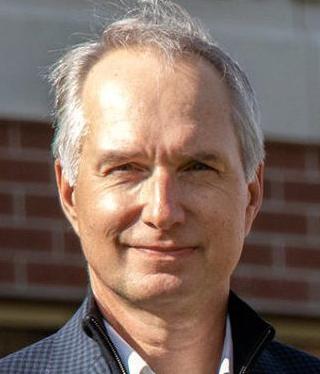
Richard Kyte is director of the D.B. Reinhart Institute for Ethics in Leadership at Viterbo University in La Crosse, Wis., and co-host of "The Ethical Life" podcast.
Richard Kyte is the director of the D.B. Reinhart Institute for Ethics in Leadership at Viterbo University in La Crosse, Wisconsin. His new book, “Finding Your Third Place: Building Happier Communities (and Making Great Friends Along the Way),” is available from Fulcrum Books. He also cohosts “The Ethical Life” podcast.
