
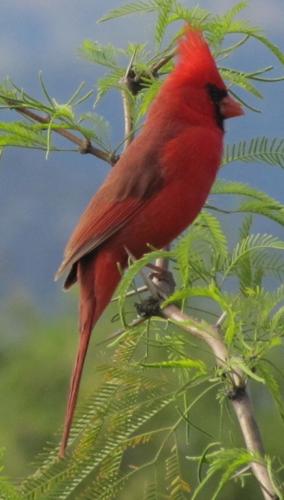
When the United States declared independence in 1776, choosing state birds was not high on the priority list. In fact, nearly 150 years passed before Kentucky stepped up and named the first state bird, Feb. 26, 1926. Not surprisingly, that first choice was the Northern Cardinal, one of the most recognizable, brightly colored and popular birds in the country. The cardinal was so popular that six other states (all clustered around and near Kentucky) selected the same bird. If you think competitive and independent states would make a point of choosing unique birds, you’d be wrong. All 50 states now have official birds, but 30 of those states share their selection with at least one other state. Following the seven-state cardinal, six states chose the Western Meadowlark and five the Northern Mockingbird. Other birds shared by at least two states include the American Robin, American Goldfinch, Mountain Bluebird, Eastern Bluebird and Black-capped Chickadee. Playing copycat was hardly necessary, since there are plenty of appropriately unique choices among America’s birds. In addition, some of the omissions are as surprising as some of the choices. For example, while two states chose chickens, there are no hummingbirds or raptors on the list.
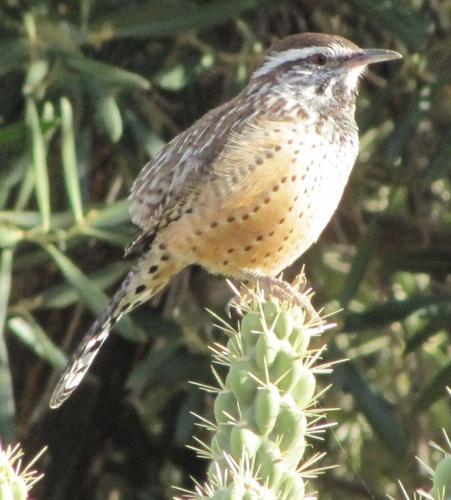
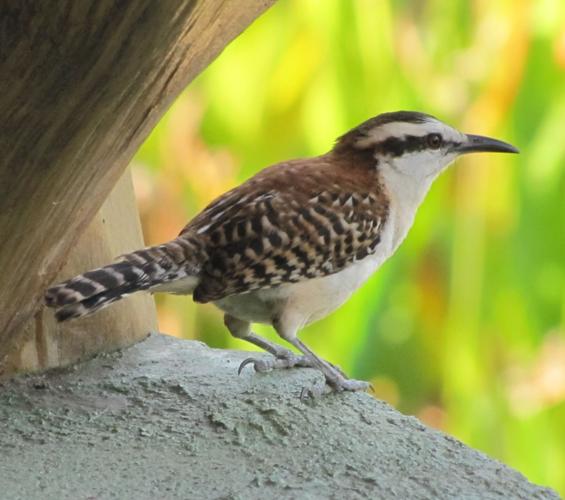
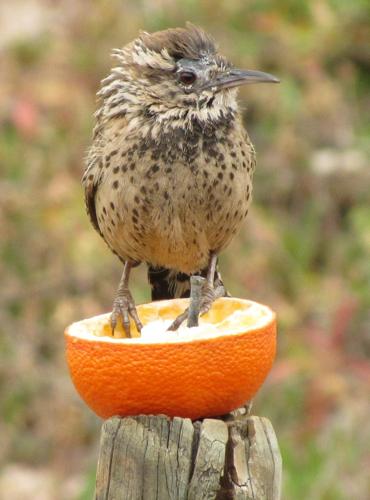
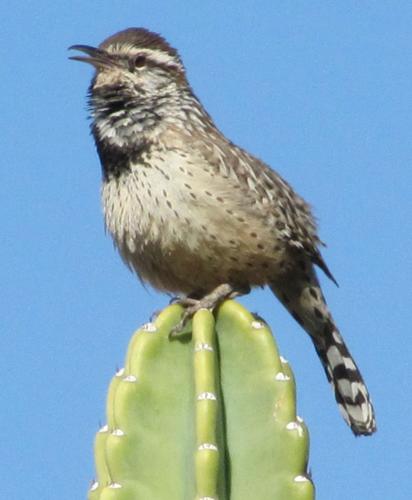
It should come as no surprise that Arizona is one of just 20 states that chose a unique state bird. After all, this is the state with an official tie (the bolo), an official rattlesnake (the Ridge-nosed) and an official gun, the Colt revolver. In 1931, 19 years after becoming the 48th state, Arizona’s legislature chose the Cactus Wren. It’s doubtful the choice was based on the bird’s song, a sputtering, staccato-chugging babble that might be compared with a state legislative session. That ‘song’, which David Sibley calls “unmusical…. like a quacking duck” is just one unique characteristic of the Cactus Wren. While the other eight North American wrens are small, drab, shy and furtive, the Cactus Wren stands alone. He is big, boldly patterned, boisterous, brash and inquisitive. At eight inches, he dwarfs our other wrens, and his bullying behavior is more like a thrasher than a wren. Appropriately, his scientific name is a 10-syllable mouthful, Campylorhynchus brunneicapillus, meaning “brown-capped curved bill.” The Cactus Wren builds multiple nests, most of which are never occupied, and, as you might guess, these nests are usually found in cactus. Here the bird perches, oblivious to the sharp spines, shattering the clear desert air with his staccato song. Limited in the U.S. to the southwest, the wren is widespread south to central Mexico, and a dozen generic cousins can be found from Mexico to Brazil. One of these, the similarly looking Rufous-naped Wren, made us think we were back in Arizona when he snatched scraps from our table in Costa Rica.
Far from shy, the Cactus Wren carries a chip on his shoulder and is not one to mess with. They will destroy bird nests and eggs, including those of other Cactus Wrens. I’ve had my hat knocked off after getting too close to a Cactus Wren nest, and another made a surprise high speed landing in the center of my back. I also saw one peck a downed House Finch to death. Like Arizona retirees, they are mostly monogamous, adapt well to suburban desert neighborhoods and often growl when they meet their mates. This is a bird that, if it could, would sport a bolo tie and carry a Colt. Without question, a good choice for the Wild West state of Arizona.
If you have questions or comments about SaddleBrooke’s birds, or to receive emailed information about bird walks led by Bob and Prudy, call 825-9895 or email bobandpru@aol.com. Earlier birding articles are at www.birdingthebrookeandbeyond.com.
 Historic bank vault now new Tucson speakeasy


